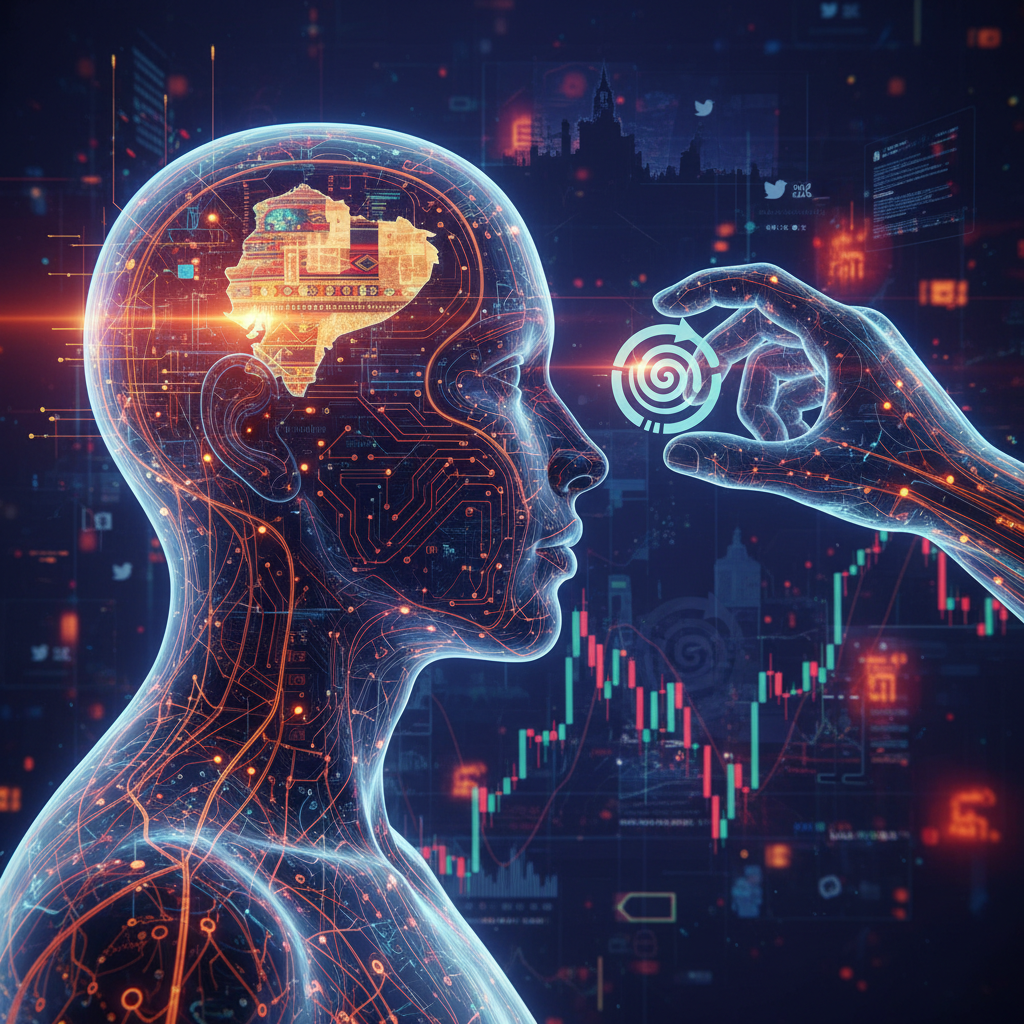

Imagine María, a talented artisan from Otavalo, whose vibrant textiles tell stories centuries old. She dreams of reaching customers beyond the Peguche waterfall, perhaps even across the Pacific. So, like many savvy entrepreneurs today, she turns to an online marketplace, an AI-powered platform promising global reach. She uploads her beautiful ponchos and intricate tapestries, hopeful for the future. But weeks turn into months, and her sales remain stubbornly low, far below what her quality and craftsmanship deserve. Meanwhile, a mass-produced, less authentic item from a distant factory, promoted by the same algorithm, flies off the digital shelves. María starts to wonder if her art, her culture, is somehow less 'visible' to the digital eye, less 'valuable' to the unseen code. This isn't just a business problem for María, it's a cognitive one, slowly eroding her confidence and reshaping her perception of her own worth in a globalized market. She begins to question if her unique Ecuadorian heritage is a digital advantage or a silent barrier. This is the subtle, yet profound, impact of algorithmic bias on human cognition and behavior, right here in the heart of Ecuador.
This scenario, far from being isolated, is becoming increasingly common. Algorithmic bias, often an unintended consequence of incomplete or skewed training data, is not merely a technical glitch; it's a psychological force. It influences our choices, our perceptions, and even our sense of identity. In Ecuador, a nation celebrated for its incredible biodiversity and rich cultural tapestry, these biases can have particularly poignant effects. We are seeing how AI, designed to connect and optimize, can inadvertently create digital divides and reinforce existing societal inequalities, subtly altering our cognitive maps of the world.
Recent research from the Universidad San Francisco de Quito's AI Ethics Lab, led by the brilliant Dr. Sofia Morales, indicates a worrying trend. "We analyzed several popular e-commerce platforms and loan application algorithms prevalent in Ecuador," Dr. Morales explained to me last week, her eyes sparkling with passion. "Our findings suggest that algorithms often prioritize products or applicants from historically dominant regions or demographic groups, even when objective quality or creditworthiness is comparable. This isn't malicious, but it's a reflection of the datasets they were trained on, which often lack sufficient representation from diverse Ecuadorian communities. For users like María, this translates into a cognitive dissonance, a feeling that the digital world doesn't 'see' them fairly, leading to reduced engagement and even self-doubt." Her team found that products from indigenous communities were 30 percent less likely to appear in top search results on certain platforms, despite high user ratings.
Psychologically, this constant, subtle reinforcement of bias can lead to what Dr. Ricardo Peña, a cognitive psychologist at the Pontificia Universidad Católica del Ecuador, calls 'algorithmic learned helplessness.' "When an individual repeatedly experiences negative outcomes or lack of visibility within AI-driven systems, despite their best efforts, they can internalize this as a personal failing," Dr. Peña elaborated during our discussion over a strong café pasado. "This can diminish motivation, foster distrust in digital tools, and even lead to a withdrawal from opportunities that could otherwise be beneficial. It's a quiet form of psychological erosion, where the algorithm isn't just failing to connect, it's actively shaping a person's self-efficacy and their perception of fairness in the digital realm." The psychological toll is not just on individuals, but on communities, as traditional knowledge and products struggle to find their digital voice, creating a cultural void in the online space.
The broader societal implications for Ecuador are significant. Our nation thrives on its diversity, from the Amazon rainforest to the Andes mountains, and down to the Pacific coast. When AI systems inadvertently favor one type of product, one demographic, or one cultural expression over others, it risks undermining the very foundations of our pluralistic society. It can exacerbate economic disparities, creating a two-tiered digital economy where some flourish under algorithmic light, while others toil in its shadows. Moreover, it impacts our collective cognitive landscape, subtly teaching us what is 'mainstream' or 'valuable' based on biased digital signals, potentially eroding appreciation for our unique cultural heritage. Wired has extensively covered how algorithmic biases can perpetuate stereotypes and inequalities globally, and Ecuador is certainly not immune.
But here's the exciting part, the part that fills me with such vibrant hope: we are not passive recipients of this digital destiny. Ecuador's biodiversity meets AI and it's magical, even in the face of these challenges. There are incredible efforts underway to combat these biases and ensure that our digital future is inclusive. For instance, This Ecuadorian startup just launched 'Kawsay AI,' a platform specifically designed to promote indigenous crafts and sustainable tourism initiatives, using ethically sourced and culturally sensitive datasets. Their approach involves active community participation in data labeling and algorithm training, ensuring that the AI 'learns' to value the nuances of Ecuadorian culture, not just globalized trends. This is a brilliant example of how we can build AI that truly reflects our world.
"We need to move beyond simply identifying bias to actively engineering for fairness," stated Dr. Elena Vásquez, CEO of Kawsay AI, a company that has been garnering significant attention from TechCrunch for its innovative approach. "Our goal is to create algorithms that are not just neutral, but actively equitable, providing a platform where every artisan, every community, has an equal chance to be seen and celebrated. It's about building trust, both in the technology and in the digital marketplace." Their platform uses a novel weighting system that prioritizes cultural authenticity and local impact, rather than just raw sales volume, to ensure visibility for smaller, traditional businesses.
So, what can we, as everyday users and citizens, do? First, cultivate a critical awareness. Question the recommendations you receive online. Ask yourself why certain products or information are being presented to you. Diversify your information sources and actively seek out content that challenges your algorithmic bubble. Second, support initiatives like Kawsay AI that are consciously building ethical and inclusive AI. Third, advocate for transparency and accountability from the tech companies whose algorithms shape our digital lives. Demand that they explain how their systems work and how they are addressing bias. Finally, remember that the human element remains paramount. Our critical thinking, our empathy, and our commitment to fairness are the ultimate safeguards against the unintended consequences of technology. We have the power to guide the algorithms, ensuring they serve all of us, not just a select few. The future of our cognition, our culture, and our connections depends on it. This is our chance to build the Galápagos of technology, a unique ecosystem where innovation thrives with ethical responsibility at its core.