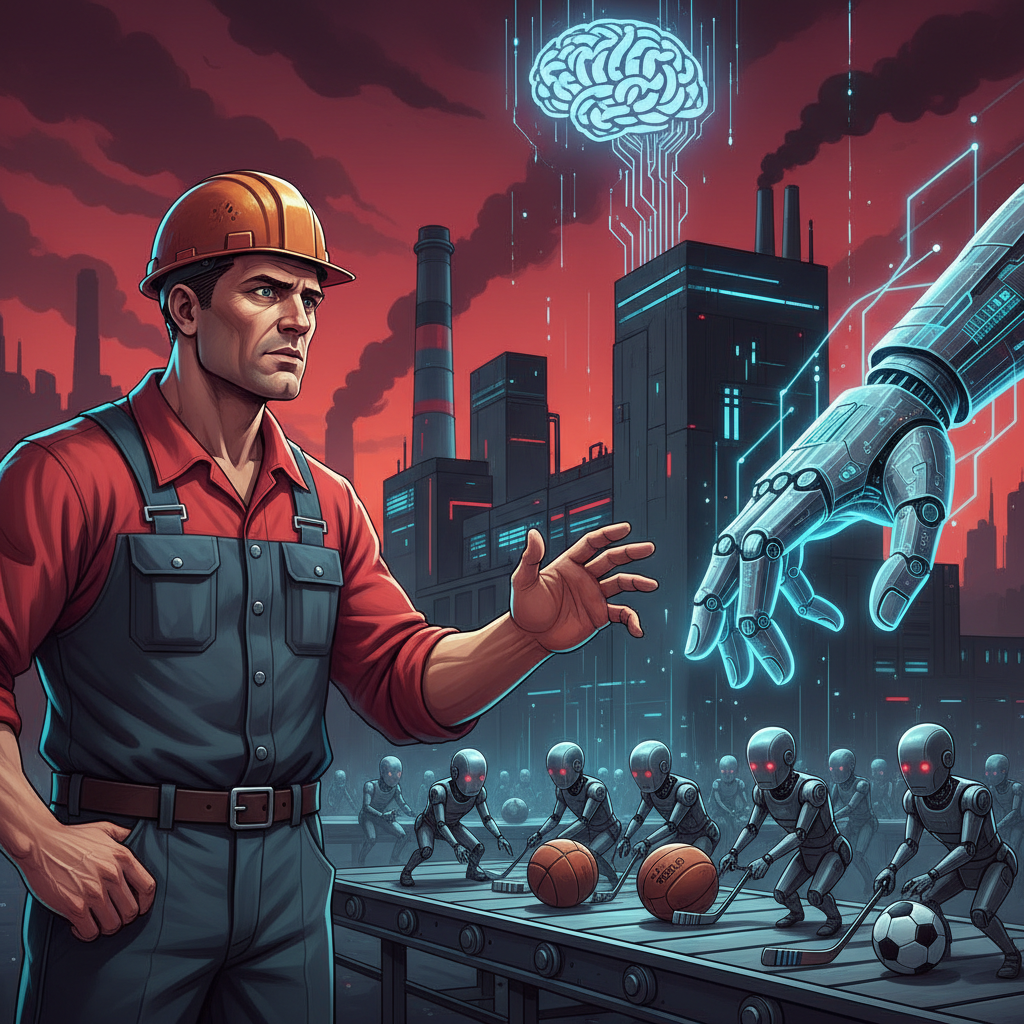

The relentless march of artificial intelligence into every corner of industry is no longer a distant prophecy, but a tangible reality reshaping global labor markets. From automated logistics in warehouses to predictive analytics in white-collar professions, AI driven automation promises efficiency and cost reduction. Yet, this promise often casts a long shadow of uncertainty over the human workforce. While much of the global discourse on AI and labor focuses on Western economies, the implications for Russia, with its distinct economic landscape and social fabric, are particularly acute and often overlooked.
The risk scenario is straightforward: widespread adoption of AI technologies, particularly in sectors ripe for automation, could lead to significant job losses, wage stagnation, and increased social inequality. This is not merely an abstract economic projection; it is a lived experience for many already grappling with economic shifts. Consider the manufacturing sector, a cornerstone of Russia's industrial might. Factories, from those producing heavy machinery to consumer goods, are increasingly integrating robotics and AI powered systems for quality control, assembly, and inventory management. The official story often emphasizes increased productivity and competitiveness. However, the question remains: what becomes of the human hands that once performed these tasks?
Technical explanations for this phenomenon are rooted in the very capabilities of modern AI. Large language models, such as those developed by OpenAI or Google DeepMind, are now capable of performing tasks that once required human cognitive abilities: drafting reports, analyzing data, customer service, and even basic legal research. Machine vision systems, often powered by NVIDIA's advanced GPUs, can inspect products with greater speed and accuracy than human eyes. Robotic process automation, or RPA, streamlines administrative tasks, eliminating the need for human intervention in repetitive data entry or processing. These technologies are not just tools; they are increasingly autonomous agents capable of learning and adapting, making them formidable substitutes for human labor in specific, well defined roles.
Expert debate on this issue is predictably polarized. On one side, proponents of AI driven automation, often from the technology sector, argue that historical precedents suggest new jobs will emerge to replace those lost. "Every technological revolution has created more jobs than it destroyed in the long run," stated Sundar Pichai, CEO of Google and Alphabet, in a recent interview, emphasizing the need for reskilling and adaptation. This perspective suggests that while some roles will vanish, the overall economic pie will grow, creating opportunities in AI development, maintenance, and new service industries. They point to the creation of roles like 'prompt engineer' or 'AI ethicist' as evidence of this generative power.
Conversely, labor advocates and some economists warn of a different future. "The pace and scale of this current wave of automation are unprecedented," argued Sharan Burrow, former General Secretary of the International Trade Union Confederation, before her retirement, highlighting that many displaced workers may not possess the skills or resources to transition into these new, highly specialized roles. In Russia, where the state plays a significant role in employment and social welfare, the potential for mass displacement poses a unique challenge to social stability. The notion that a factory worker in Magnitogorsk can simply retrain as an AI specialist in Moscow is, for many, a fantasy, not a practical pathway.
Real world implications are already manifesting. In Russia, the push for digital transformation, accelerated by geopolitical pressures and the need for self sufficiency, has seen significant investment in AI across various sectors. Russian companies like Sberbank, for instance, have heavily invested in AI for customer service, fraud detection, and even internal operations, reportedly achieving significant cost savings. While these advancements are hailed as strategic victories, the human cost is less frequently discussed. Anecdotal evidence from regional industrial centers suggests a quiet erosion of traditional manufacturing jobs, with workers often reassigned to less skilled, lower paying roles or facing early retirement. The official story doesn't add up when one speaks to individuals directly affected.
The impact extends beyond mere job numbers. The nature of work itself is changing. AI powered surveillance and performance monitoring systems, deployed in logistics and delivery companies, for example, can exert unprecedented control over workers, dictating pace and efficiency with algorithmic precision. This can lead to increased stress, reduced autonomy, and a de humanization of the workplace. For a nation that values collective effort and social solidarity, such shifts could have profound cultural ramifications.
What should be done? First, a candid and transparent assessment of AI's impact on employment is urgently needed. Current government statistics often focus on the growth of the IT sector, but a comprehensive analysis of job displacement across traditional industries is scarce. This lack of clear data makes it difficult to formulate effective policy responses. MIT Technology Review frequently publishes analyses on this global trend, and Russia would do well to adopt a similar rigorous approach.
Second, investment in robust, accessible, and future oriented reskilling and upskilling programs is paramount. These programs must be designed not just for urban centers, but for regional industrial towns where the impact of automation is likely to be most severe. Partnerships between educational institutions, industry, and labor unions could ensure that training aligns with actual labor market needs. This is not about converting every displaced worker into a programmer, but equipping them with transferable skills that are resilient to automation.
Third, labor unions in Russia, which historically have played a role in social welfare, must adapt and strengthen their capacity to negotiate with employers on the terms of AI adoption. This includes advocating for fair transition pathways, retraining opportunities, and even a share of the productivity gains generated by AI. The current framework often appears ill equipped to address the complexities of algorithmic management and job redesign. Bloomberg Technology often covers the evolving role of unions in other nations facing similar challenges.
Finally, a national dialogue on the ethical implications of AI in the workplace is essential. This conversation must involve not only technologists and policymakers, but also workers, sociologists, and philosophers. How do we define meaningful work in an age of automation? What are our collective responsibilities to those whose livelihoods are disrupted? These are not mere academic questions; they are fundamental to maintaining social cohesion and ensuring a just transition. Russian AI talent deserves better than to be mere cogs in a global machine that disregards the human element.
Behind the sanctions curtain, Russia has been forced to innovate and develop its own technological solutions, including in AI. This self reliance, while strategically important, must not come at the cost of its own workforce. The true measure of technological progress is not just economic efficiency, but also its ability to serve the well being of all citizens. Failing to address the human impact of AI automation head on would be a profound miscalculation, one that could destabilize the very foundations of society.