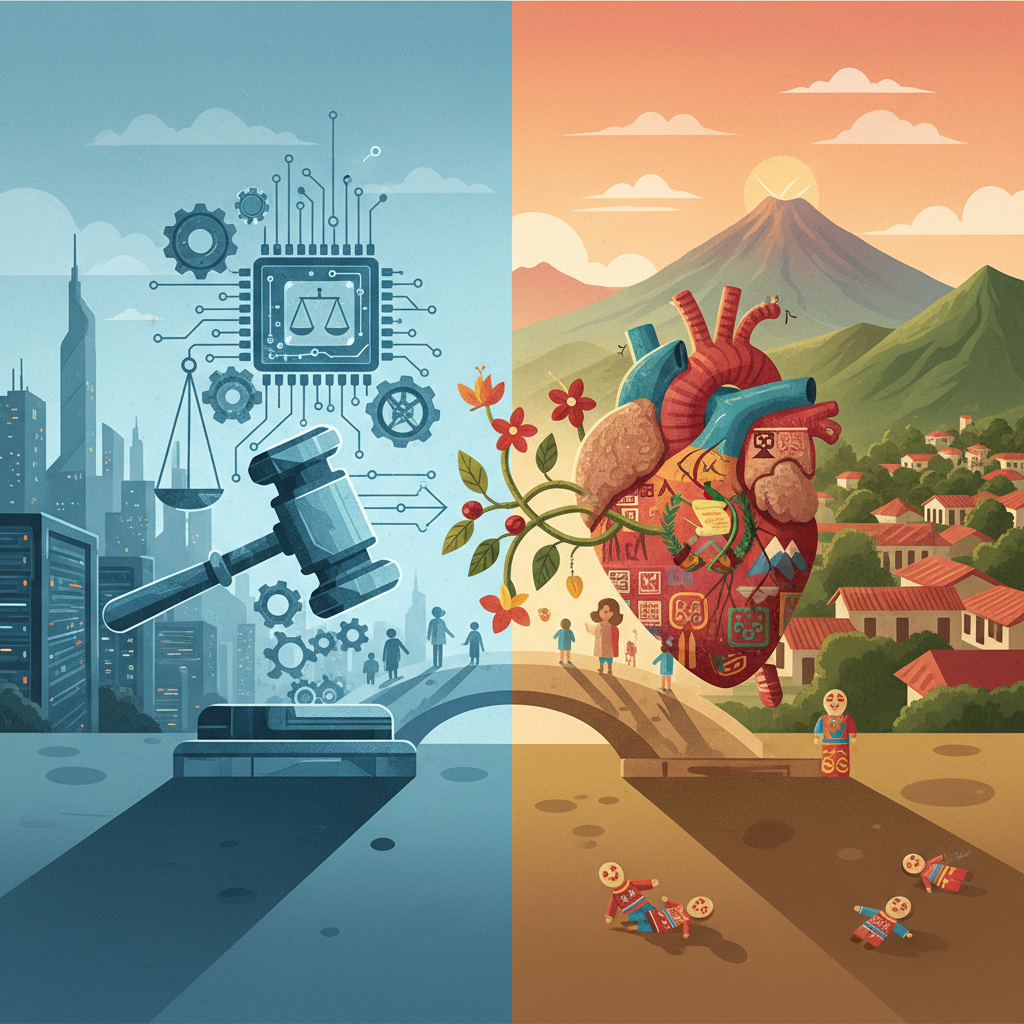

The morning mist still clings to the mountains around my village, San Juan Sacatepéquez, as I sip my coffee and read the latest headlines about artificial intelligence. The world, it seems, is racing towards a future where algorithms decide everything, even who is a criminal and what their punishment should be. But from my vantage point here in Guatemala, a country intimately familiar with the deep scars of injustice, I cannot help but feel a profound unease about the march of AI into our justice systems.
They call it 'predictive policing' or 'sentencing algorithms,' sophisticated systems designed by companies like Palantir and often championed by tech giants like Google and Microsoft, promising efficiency and objectivity. The idea is simple, or so they say: feed historical crime data into a machine, and it will identify patterns, predict future hotspots, and even recommend sentences. On paper, it sounds almost utopian, a way to remove human bias from the equation. But what happens when the data itself is biased, a reflection of generations of systemic inequality and prejudice?
Consider the context. In a small village in Guatemala, where access to justice is often a luxury, where historical records are incomplete or tainted by corruption, and where indigenous communities have long faced discrimination, the idea of an algorithm trained on such data is not just flawed, it is terrifying. It is not objectivity, it is automation of existing prejudice. It is like trying to build a new house on rotten foundations. The structure will inevitably collapse.
This is a story about resilience, yes, but also about the urgent need for critical thought. We cannot simply import these technologies from Silicon Valley, designed in contexts vastly different from our own, and expect them to work fairly. The very notion that an algorithm can be 'neutral' when it learns from human-generated data is a dangerous fantasy. As Dr. Joy Buolamwini, a prominent AI ethics researcher and founder of the Algorithmic Justice League, has repeatedly highlighted, "When we think about artificial intelligence, we have to ask: who is being included and who is being excluded?" Her grandmother's wisdom meets machine learning in a way that demands we question the very source code of justice.
Proponents argue that AI can reduce human error and improve consistency in sentencing. They point to studies suggesting that algorithms can identify patterns that humans miss, leading to more effective resource allocation for police departments. They might say that human judges are inherently biased, swayed by emotion or personal prejudices, and that a cold, hard algorithm offers a fairer alternative. They might even cite instances in countries like the United States where AI tools are already in use, reportedly helping to streamline court processes and identify individuals at higher risk of recidivism.
But this argument conveniently ignores the fundamental problem: the data. If historical policing has disproportionately targeted certain communities, if arrests and convictions have been higher for people of color or those from lower socioeconomic backgrounds, then an AI trained on this data will simply learn to perpetuate those same disparities. It will see patterns of criminality where there are only patterns of surveillance and systemic disadvantage. It will recommend harsher sentences for those who have historically received them, not because they are inherently more dangerous, but because the system has always treated them that way. This is not justice; it is algorithmic oppression.
In Guatemala, where indigenous populations have historically been marginalized and criminalized, the thought of an AI system deciding their fate based on biased historical records sends shivers down my spine. We have seen how easily power can be abused, how quickly systems meant to protect can be turned into instruments of control. An algorithm, devoid of empathy, incapable of understanding the nuances of poverty, cultural differences, or the deep-seated trauma that can lead someone to crime, would be a disaster. It would amplify the voices of the powerful and silence the already marginalized.
We need to demand transparency and accountability from the companies developing these tools. We need to ask: who built this algorithm? What data was it trained on? Can we audit its decisions? Organizations like the Electronic Frontier Foundation have been vocal about the need for robust oversight and public scrutiny of these systems. Without it, these black box algorithms become untouchable arbiters of destiny, their decisions unquestionable.
Instead of blindly adopting these technologies, we must approach AI in criminal justice with extreme caution and a deep understanding of human rights. We need to prioritize the voices of those most affected, the communities that stand to lose the most if these systems go awry. This means involving community leaders, legal experts, and human rights advocates in the design and implementation of any such tools, not just tech engineers.
Perhaps the solution lies not in replacing human judgment with artificial intelligence, but in using AI as a supportive tool for human decision-makers, always with a human in the loop. An AI could help process vast amounts of data, identify trends, and flag potential biases, but the ultimate decision must always rest with a human judge or police officer who can exercise empathy, discretion, and a profound understanding of justice. The goal should be to augment human wisdom, not to supplant it with cold, unfeeling code. For more insights into the ethical considerations of AI, particularly in sensitive domains, the MIT Technology Review often publishes compelling analyses.
The promise of AI is immense, but its application in criminal justice, particularly in countries with complex social histories like Guatemala, demands a level of ethical rigor and cultural sensitivity that I fear is currently lacking. We must ensure that the pursuit of efficiency does not come at the cost of fundamental human dignity and fairness. The future of justice, for all of us, depends on it. We must build systems that reflect our highest ideals, not our deepest prejudices. The conversation about AI in criminal justice should not just be happening in boardrooms in California, but in every village, every community, and every courthouse, including those here in Guatemala. The BBC News Technology section frequently covers global perspectives on AI ethics, which can offer broader context to these discussions.