
Is the American dream of independent work slowly being re-engineered by lines of code? That's the question I keep asking myself as I watch the gig economy mature, morphing from a flexible side hustle into a primary source of income for a significant slice of the US workforce. What started as a promise of freedom and flexibility has, for many, become a labyrinth of algorithmic directives, where every minute, every route, and every customer interaction is scrutinized by an unseen digital overlord. This isn't just a trend; it's a fundamental shift in the employer-employee dynamic, and it's happening right here in our backyard, from the delivery drivers navigating Boston's historic streets to the Instacart shoppers hustling through a supermarket in Houston.
To truly grasp what's unfolding, we need a quick trip down memory lane. The concept of piece-rate work, where payment is tied directly to output, is as old as the industrial revolution itself. Think of textile workers paid by the garment or fruit pickers paid by the bushel. The 20th century saw the rise of the traditional employment model, with fixed wages, benefits, and a clear hierarchy. Then came the internet, and with it, the gig economy. Companies like Uber, Lyft, DoorDash, and Amazon Flex burst onto the scene in the early 2010s, promising a new era of entrepreneurial freedom. Drivers and delivery personnel were branded as 'independent contractors,' free to set their own hours and be their own bosses. It sounded great, a real American ideal, a return to self-reliance with a tech twist.
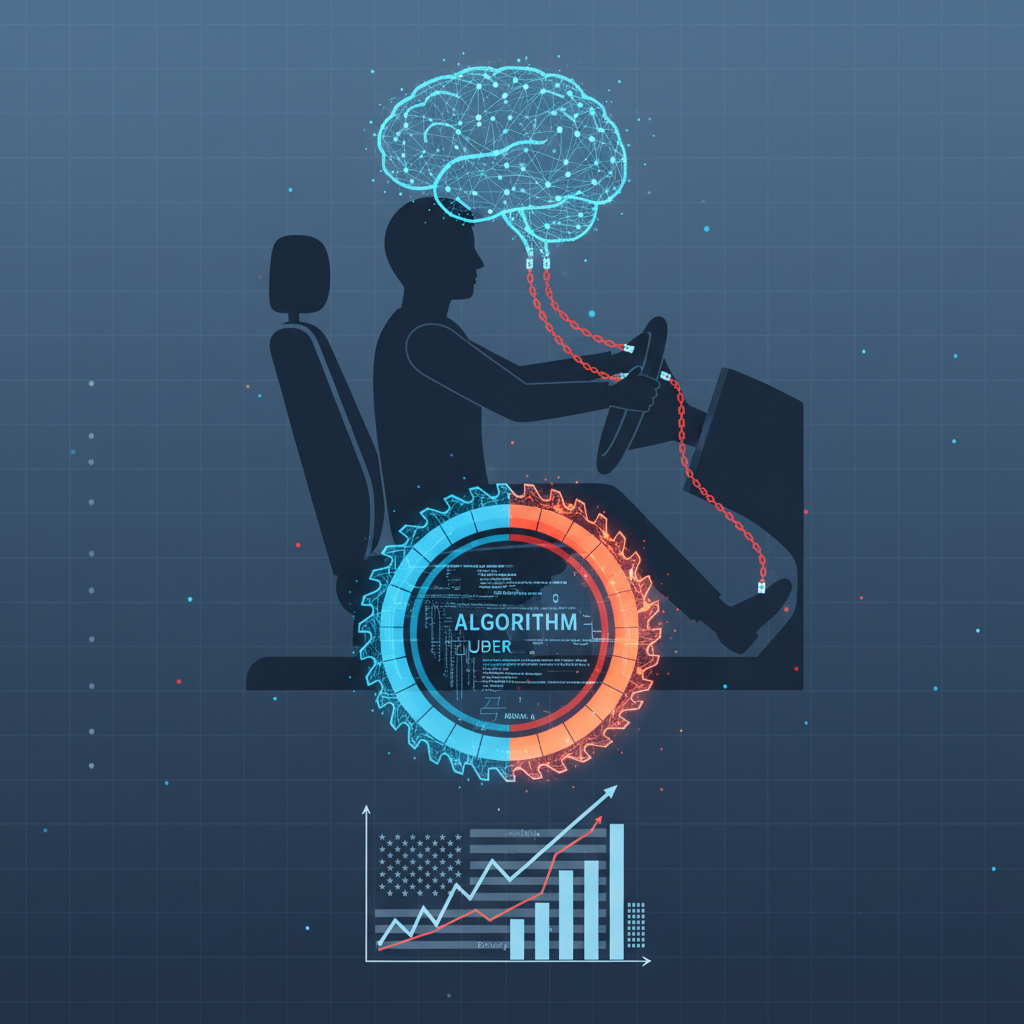
But here's what's actually happening inside companies like Uber and DoorDash: the algorithms are not just matching customers with drivers; they are actively managing, incentivizing, and, yes, controlling the workforce. These sophisticated AI systems are the digital equivalent of a factory foreman, but with far more data and far less human empathy. They determine pricing, allocate tasks, optimize routes, and even influence worker behavior through dynamic incentives and ratings systems. For instance, a driver might accept a low-paying ride because the algorithm has subtly nudged them by showing an 'opportunity zone' that promises higher earnings later, a promise that often feels like a mirage in the desert.
Data backs this up. A 2023 study by the UC Berkeley Labor Center found that gig workers in California spend an average of 33% of their time waiting for assignments, a period for which they are typically not paid. The algorithms are designed to minimize this 'idle time' from the platform's perspective, not necessarily the worker's. Furthermore, a report from the National Bureau of Economic Research indicated that driver earnings on ride-sharing platforms have seen a decline in real terms over the past few years, even as demand for services has grown. This suggests that the algorithmic control is optimizing for platform profit, sometimes at the expense of worker income. It's like a digital puppet master pulling strings, and the workers are dancing to its tune, often without fully understanding the choreography.
Let me decode this for you. Imagine you're a chess player. The algorithm isn't just telling you whose turn it is; it's suggesting moves, analyzing your past performance, and even subtly influencing your strategy by showing you potential rewards for certain plays. If you don't follow its suggestions, your 'rating' might drop, or you might get fewer desirable assignments. This isn't traditional employment, but it's certainly not traditional independent contracting either. It's a new hybrid, an 'algorithmic management' model, where the boss is a black box of code.
Experts are weighing in on this evolving landscape. Dr. Mary L. Gray, a senior principal researcher at Microsoft Research and author of Ghost Work, has long highlighted the invisible labor and algorithmic control inherent in these systems. She stated in a recent interview,