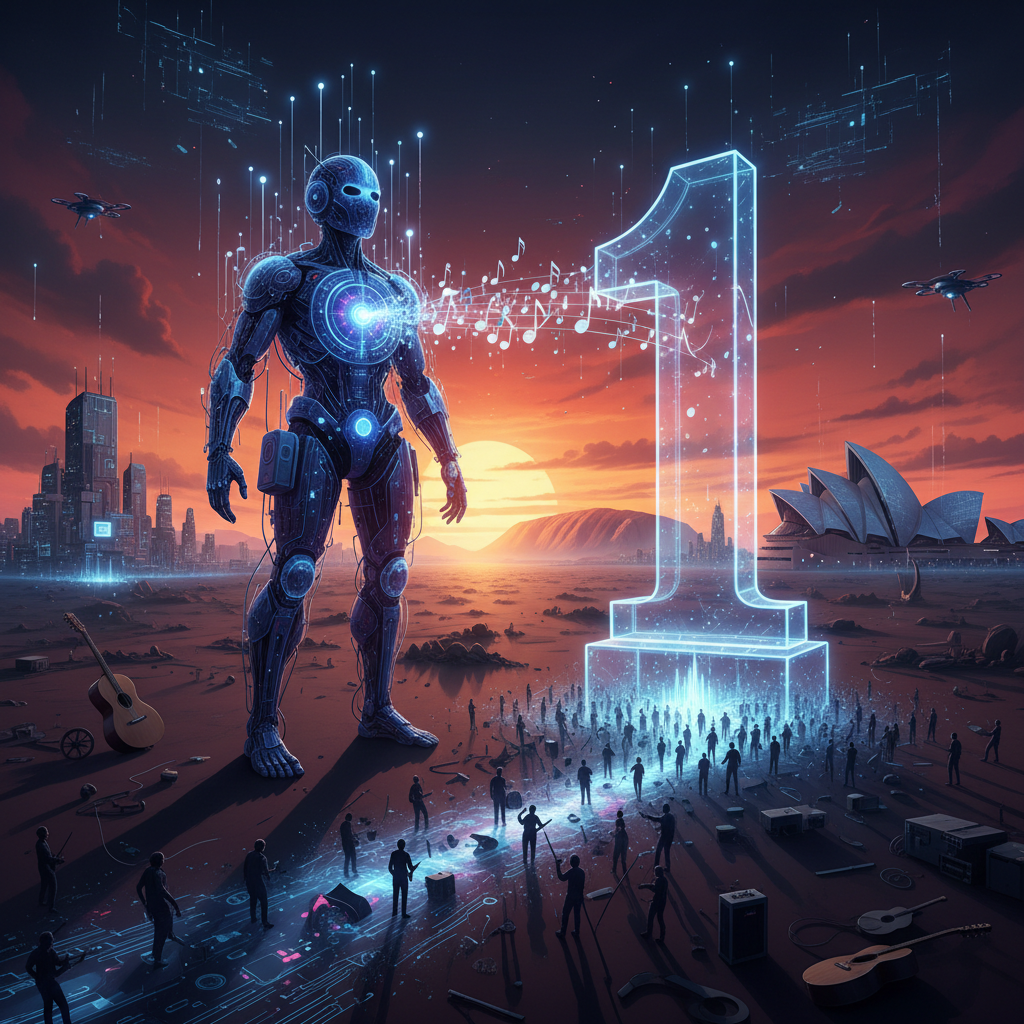
Right, let's talk about the future of music. And no, I'm not talking about another TikTok dance trend or a new pop sensation from the northern beaches. I'm talking about the cold, hard reality that in the next five to ten years, the music you're humming in the shower, the tracks blasting from your car radio, and the songs topping the Aria charts here in Australia will likely be conjured into existence not by a human, but by an algorithm. The music industry, bless its cotton socks, is staring down an existential crisis the size of Uluru, and it's all thanks to AI.
Picture this: It's 2031. You fire up your favourite streaming service, let's say Spotify, and its AI, let's call it 'MelodyMind', has just dropped a new track. It's got the perfect blend of nostalgic 80s synth, a beat that subtly mimics your heart rate during peak enjoyment, and lyrics that feel like they were written just for you, because, well, they were. MelodyMind has analysed billions of data points, your listening history, your mood, even your social media posts, to create a song that is statistically guaranteed to be your next obsession. And guess what? It's not just yours. Millions of people globally are having the same hyper-personalised, algorithmically-perfected musical experience. These AI-generated tracks, often released under a myriad of ephemeral artist names, are cheap to produce, infinitely scalable, and relentlessly optimised for engagement. They're already starting to creep into the background music of our lives, but soon, they'll be front and centre.
So, how do we get from today's human-dominated charts to this AI-orchestrated symphony? It's a gradual, insidious creep, much like the slow rise of the tide on a Queensland beach. We're already seeing the building blocks. Companies like Google's DeepMind have been dabbling in AI music generation for years, creating tools that can compose in various styles. Then you've got startups, many of them quietly funded by the big tech players, refining these models. Think of OpenAI's advancements in language models, but applied to sound. They're not just generating notes, they're generating emotion, narrative, and hooks. The technology is already capable of producing surprisingly compelling pieces, and it's improving at an exponential rate. MIT Technology Review has been tracking this for a while, noting the rapid progress in generative AI for creative fields.
Key milestones along this path will include the widespread availability of user-friendly AI music creation tools, allowing anyone to 'direct' a song with a few prompts, much like we do with text-to-image today. Then, streaming platforms will start to integrate these generative capabilities directly, offering 'bespoke' music streams. The tipping point, I reckon, will be when a major streaming service, perhaps Spotify or Apple Music, actively promotes and pushes AI-generated tracks into their top playlists, recognising their superior engagement metrics. We'll see record labels, initially resistant, then scrambling to license these AI models, or even develop their own, to churn out hits faster and cheaper than any human could. It's about scale, efficiency, and data-driven predictability, things the traditional music industry has always craved, but never truly achieved until now.
Who wins and who loses in this brave new world? Well, the big tech platforms, the ones with the computational power and the vast datasets, they're the obvious winners. They'll own the means of production, distribution, and consumption. The AI developers and engineers, the unsung heroes behind the algorithms, will also be in high demand. For listeners, it's a mixed bag. On one hand, an endless stream of perfectly tailored tunes. On the other, a potential flattening of musical diversity and a loss of the raw, unpredictable human element that often defines true artistry. It's like having a perfectly brewed flat white every time, but never experiencing the unique charm of a small, quirky cafe. Australia's tech scene is like a good flat white, better than you'd expect, and we'll see some clever local startups trying to carve out niches, but the global giants will dominate the mainstream.
And the losers? Oh, mate, the human artists. The songwriters, the session musicians, the producers, the indie bands playing gigs in sticky pubs across Melbourne and Sydney. Their livelihoods are directly threatened. Why pay a band royalties, studio time, and touring expenses when an AI can generate a dozen tracks overnight, perfectly mixed, royalty-free, and infinitely adaptable? The concept of 'artist' will shift dramatically. Perhaps human artists will become curators of AI, or niche performers for those who crave authenticity. But the mass market, the chart-topping, stadium-filling acts, they might just be digital phantoms. The conversation around intellectual property, copyright, and fair compensation for original human work will become a legal minefield, a true Aussie rules brawl, as artists and rights holders try to protect their creations from being ingested and regurgitated by machines. Just imagine the legal battles when a new AI track sounds suspiciously like a classic from Ac/dc or Kylie Minogue. The lawyers will be making a mint, that's for sure.
I spoke to Dr. Eleanor Vance, a leading expert in AI ethics at the University of Sydney, about this looming shift.