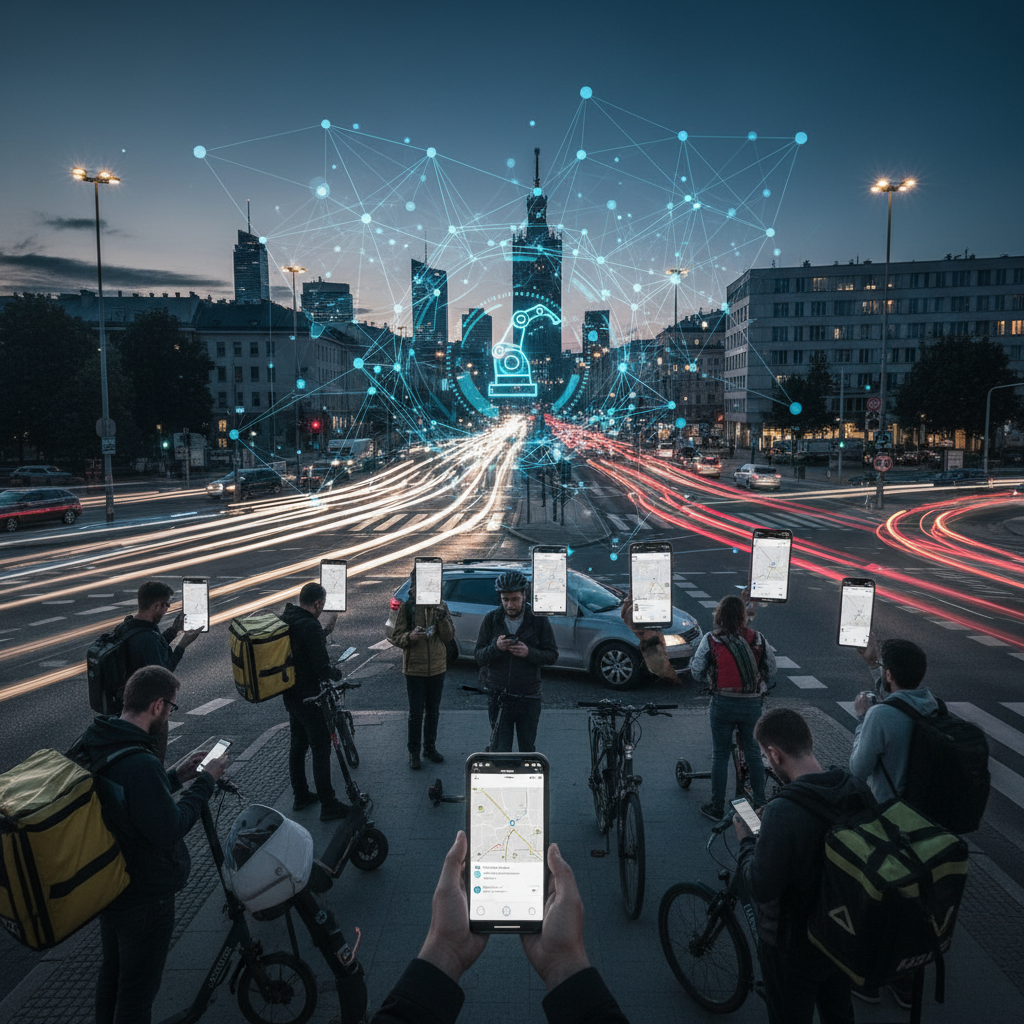

The cobblestone streets of Kraków and the bustling avenues of Warsaw, once the domain of traditional taxis and local delivery services, now hum with the electric charge of the gig economy. Drivers and couriers, navigating the urban labyrinth, operate under an unseen hand, a digital foreman that dictates their routes, their earnings, and even their very presence on the platform. This unseen hand, of course, is artificial intelligence, and its pervasive influence on Poland's gig workers is a subject demanding rigorous examination.
From a systems perspective, these platforms are marvels of computational efficiency. Companies like Uber, Bolt, and Glovo, which dominate the Polish market, rely on complex algorithms to match supply with demand, optimize routes, dynamically price services, and manage a distributed workforce numbering in the tens of thousands across the country. The algorithm works like this: it ingests real-time data on rider requests, driver availability, traffic conditions, and historical patterns. It then dispatches tasks, adjusts pay rates based on perceived demand surges, and even nudges workers towards specific areas. This intricate dance of data and decision making is designed to maximize profit and user experience, but it often comes at the cost of worker autonomy.
Consider the dynamic pricing models, a prime example of algorithmic control. During peak hours, or in areas with high demand, a driver might see a 'surge' multiplier, promising higher earnings. This acts as a powerful incentive, drawing more drivers into specific zones, effectively balancing the market. However, the algorithm can also 'throttle' earnings during periods of low demand, making it difficult for workers to predict their income. "It is like chasing a ghost sometimes," remarked Jan Kowalski, a Bolt driver in Poznań, during a recent interview with a local newspaper. "One hour I am earning well, the next I am driving for pennies, and I do not know why. The app just tells me to go here or there." This opacity is a common complaint, echoing sentiments found in studies across Europe, where workers often feel they are negotiating with a black box rather than a human manager.
Poland's engineering talent explains why many of these platforms have found fertile ground for technological development and adoption. Our universities, like the Warsaw University of Technology and AGH University of Science and Technology in Kraków, produce highly skilled software engineers who contribute to the global tech landscape, including the development of these very algorithmic systems. Yet, even with this technical prowess, the ethical implications of algorithmic management are a growing concern. The European Union, recognizing these challenges, has been at the forefront of legislative efforts to regulate AI, including its application in employment. The proposed AI Act, expected to be fully implemented in the coming years, aims to classify AI systems based on their risk level, with those impacting employment decisions falling into a higher risk category, necessitating greater transparency and human oversight.
Indeed, the debate is not merely academic. In 2023, a significant ruling by the Dutch Supreme Court affirmed that Uber drivers are employees, not independent contractors, a decision that sent ripples across the continent. While the legal landscape in Poland still largely favors the independent contractor model for gig workers, such precedents highlight a growing global pushback against the current algorithmic status quo. "The idea that an algorithm can unilaterally change working conditions without human intervention or explanation is fundamentally at odds with basic labor rights," stated Dr. Anna Nowak, a labor law expert at the University of Warsaw. "We are seeing a slow but steady shift towards recognizing the employment relationship inherent in these platforms, regardless of how they are legally structured on paper." This sentiment resonates strongly with the ongoing discussions in Brussels, where policymakers are grappling with how to balance innovation with worker protection. For more on these regulatory challenges, see reports from Reuters Technology.
Beyond pay, algorithms also dictate performance metrics, often without clear explanations. Drivers can be deactivated for low ratings, cancellations, or perceived inefficiencies, all determined by algorithmic assessment. This creates a constant pressure to conform to the system's demands, fostering a sense of precariousness. A driver who declines too many low-paying rides, for instance, might find themselves receiving fewer requests, a subtle form of algorithmic punishment. This gamification of work, where performance is reduced to numerical scores and arbitrary targets, can erode the dignity of labor.
Moreover, the data collected by these platforms is immense and constantly growing. Every journey, every delivery, every interaction is logged. This data is then fed back into the algorithms, creating a self-reinforcing loop that continually refines the control mechanisms. While proponents argue this leads to greater efficiency and better service for consumers, critics point to the potential for surveillance and manipulation. The power asymmetry between the platform and the individual worker becomes starkly evident when one considers the sheer volume of data the algorithm possesses about each worker's habits, preferences, and performance, compared to the worker's almost complete lack of insight into the algorithm's decision-making process.
However, it is not a monolithic picture of exploitation. Some workers appreciate the flexibility and the ability to earn income on their own terms, a stark contrast to the rigid schedules of traditional employment. For many, especially students or those seeking supplementary income, the gig economy offers a vital lifeline. The challenge lies in finding a balance where this flexibility is preserved, but workers are not subjected to arbitrary algorithmic control without recourse. Initiatives like the 'Fairwork' project, which assesses the working conditions in the gig economy against five principles of fair work, are attempting to provide benchmarks and advocate for better practices globally. Their findings often highlight significant disparities in how platforms treat their workers, even within the same country.
The path forward involves a multi-pronged approach. Regulatory frameworks, like those being developed by the EU, are crucial for establishing minimum standards of transparency and fairness. Worker collectives and unions are also beginning to emerge, using collective bargaining to push for better terms and conditions, much like the traditional labor movements of the past. Technology itself can also play a role, with open-source initiatives exploring ways to create more transparent and worker-centric platform models. The conversation is evolving, and it is imperative that we, as a society, ensure that the benefits of AI-driven efficiency do not come at the expense of human dignity and fair labor practices. The future of work in Poland, and indeed across Europe, depends on our ability to tame the algorithmic foreman and ensure that technology serves humanity, not the other way around. For a deeper dive into the societal implications of AI, Wired's AI section offers extensive coverage. The discussion around algorithmic accountability is also gaining traction in academic circles, as documented by MIT Technology Review.
Ultimately, the question is not whether AI will manage labor, but how. Will it be a tool for empowering workers with more flexible and fairly compensated opportunities, or will it be an opaque instrument of control, further eroding the rights and autonomy of the individual? The answer, I believe, lies in our collective will to demand transparency, accountability, and a human-centered approach to technological progress.