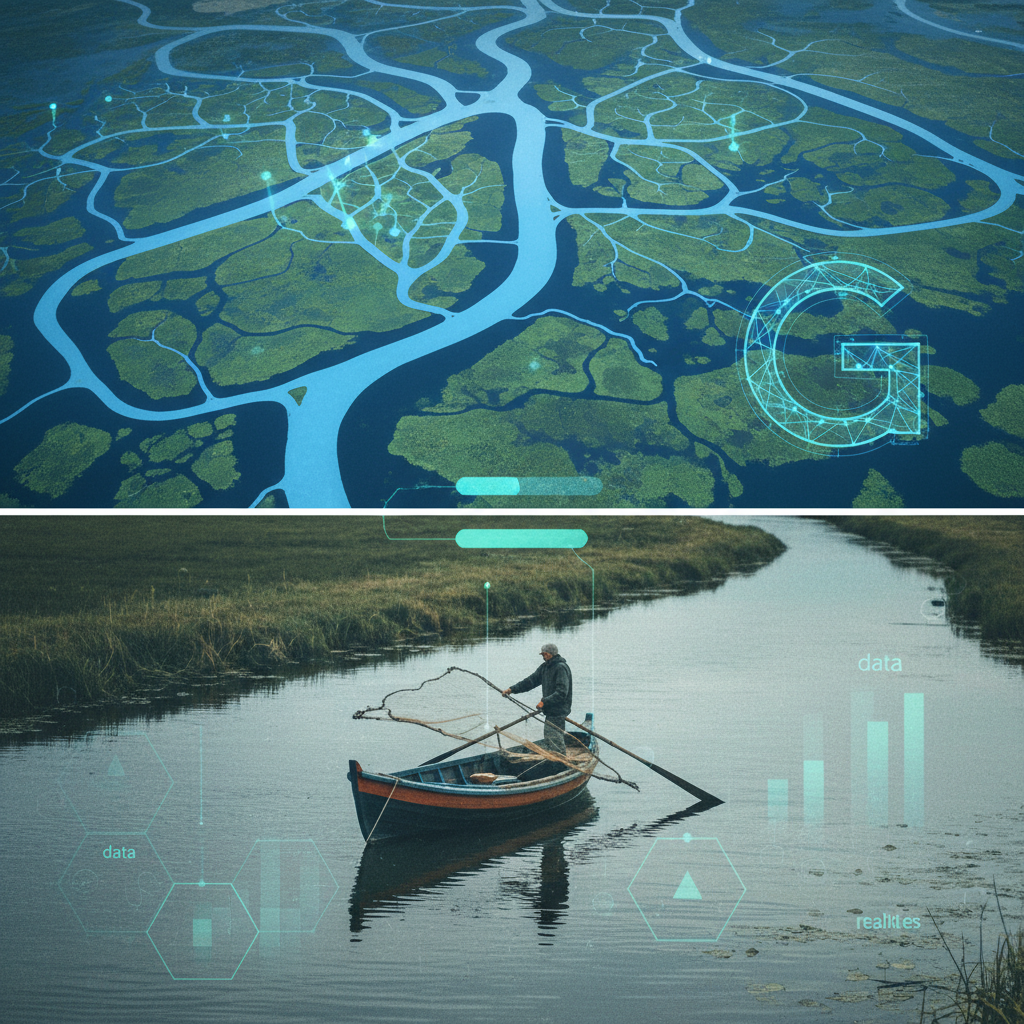

The question echoes through the hallowed halls of Davos and across the digital pages of every tech publication: can artificial intelligence truly save our planet? It is a seductive narrative, one where algorithms, not activists, become the vanguard against ecological collapse. Yet, from my vantage point in Bucharest, where the echoes of grand promises often collide with the grit of reality, I find myself asking a more pointed question: at what cost, and for whose benefit, are these AI-driven climate solutions being deployed, especially when the EU funding trail is so often obscured?
Historically, technology has been a double-edged sword for the environment. The industrial revolution brought unprecedented progress but also the carbon footprint that now threatens our very existence. In the early 2000s, the rise of big data promised efficiency gains, yet also fueled an insatiable demand for energy-hungry data centers. Now, we are told, AI is different. It is positioned not as another contributor to the problem, but as the ultimate solution, a digital deus ex machina capable of optimizing energy grids, predicting extreme weather, and managing natural resources with unparalleled precision. This optimistic outlook is championed by tech titans like Sundar Pichai of Google, who frequently highlights initiatives such as using AI to improve traffic flow and reduce emissions, or Microsoft's AI for Earth program, which pledges millions to environmental projects.
However, the path from Silicon Valley's idealistic pronouncements to tangible, equitable environmental impact is fraught with challenges. Consider the case of the Danube Delta, a Unesco World Heritage site and Europe's second-largest river delta, a place of immense biodiversity that is also incredibly vulnerable to climate change. Here, the promise of AI for ecological monitoring and flood prediction holds immense appeal. Romanian authorities, often eager to align with EU directives and secure funding, have embraced the concept of 'smart' environmental management. But what does this truly entail on the ground?
My investigation uncovered a labyrinth of pilot projects, often funded by European Union grants, that claim to deploy AI for climate resilience. One such initiative, backed by a consortium involving a major Western European tech firm and a local Romanian university, proposed using satellite imagery analyzed by machine learning models to track illegal logging and water pollution in the Delta. On paper, it sounded revolutionary. The project secured an initial 5 million euro grant, with promises of reducing deforestation by 30% within five years. Yet, two years into its implementation, local environmental NGOs report minimal tangible impact. The AI models, trained on datasets often lacking granular local context, frequently misidentified natural forest thinning as illegal logging or struggled to differentiate between agricultural runoff and industrial pollutants.
"The algorithms are only as good as the data they are fed, and often, that data is either incomplete, biased, or simply not representative of our unique ecosystems," stated Dr. Elena Popescu, a leading hydrologist at the Romanian Academy, when I spoke with her last month. "We see impressive dashboards and slick presentations, but the on-the-ground reality for our park rangers and local communities remains largely unchanged. The human element, the local knowledge, is often sidelined in favor of an AI solution that is perceived as more modern or 'European.'"
This sentiment is echoed by Marius Stan, a former government official involved in EU project management, now an independent consultant. "The Romanian tech boom hides a darker story sometimes, particularly in how these 'innovative' solutions are procured and implemented. There's a tendency to prioritize projects that look good on paper for grant applications, rather than those that genuinely address the core issues. The allure of AI often overshadows the fundamental need for robust infrastructure, transparent governance, and sustained local engagement. It becomes a checkbox, not a true transformation." Stan's observations align with a broader pattern I have observed across the region, where the promise of digital transformation often becomes a vehicle for inflated contracts and questionable outcomes.
Indeed, the energy footprint of AI itself cannot be ignored. Training large language models like OpenAI's GPT-4 or Google's Gemini requires immense computational power, translating into substantial electricity consumption and carbon emissions. While companies like NVIDIA are developing more energy-efficient hardware, and cloud providers are investing in renewable energy, the exponential growth of AI applications means that the net environmental impact remains a critical concern. A recent report by the International Energy Agency estimated that data centers could account for 3-4% of global electricity demand by 2030, with AI being a significant driver. This raises a crucial paradox: can AI save the planet if its very operation contributes to its degradation?
Expert opinions vary widely. Dr. Anya Sharma, a senior researcher at the MIT Technology Review focusing on sustainable AI, believes that the potential still outweighs the risks, provided there is stringent oversight. "We are at a critical juncture. AI offers unprecedented capabilities for climate modeling, resource optimization, and early warning systems for natural disasters. However, it requires a conscious effort to develop 'green AI' practices, focusing on model efficiency, data center sustainability, and ensuring that these technologies are deployed ethically and equitably. The carbon cost of training a model must be weighed against its potential climate benefits, and that calculation is rarely straightforward."
Conversely, Dr. Bogdan Ionescu, a computational ethicist at the University of Bucharest, offers a more cautious perspective. "The narrative of AI as a climate savior risks fostering a dangerous complacency. It distracts from the systemic changes required in our economic models and consumption patterns. We cannot simply outsource our climate responsibilities to algorithms. Furthermore, the concentration of AI development in a few powerful corporations, primarily in the West, raises questions of technological colonialism, where solutions are imposed rather than co-created with the communities most affected by climate change, such as those in the Global South or even here in Eastern Europe." This echoes concerns about data sovereignty and the ethical implications of deploying powerful technologies without local input.
My investigation into the intersection of EU funding, technology, and governance in Eastern Europe consistently reveals a pattern: grand visions, often imported from Western tech hubs, struggle to adapt to local realities. The enthusiasm for AI in climate action is no different. While the potential for AI to aid in climate mitigation and adaptation is undeniable, it is not a silver bullet. Its effectiveness is intrinsically linked to the quality of data, the transparency of its deployment, and the commitment of institutions to genuinely integrate these tools into broader, human-led strategies.
To truly harness AI for climate good, we must move beyond the hype and the superficial allure of innovation. We must scrutinize the funding, demand transparency in implementation, and ensure that local communities and experts are at the forefront of solution design, not merely passive recipients of externally imposed technologies. The EU funding trail must lead not just to impressive press releases, but to measurable, sustainable environmental impact on the ground. Without this critical oversight, the promise of AI saving the planet risks becoming another well-intentioned, yet ultimately ineffective, chapter in our ongoing struggle against climate change. It is not enough for algorithms to be smart; they must also be just and accountable. For more insights into the broader implications of AI in environmental monitoring, one might consult resources such as Reuters Technology.
Ultimately, the question of whether AI can save the planet is not a technical one, but a socio-political one. It depends not on the algorithms themselves, but on how we, as a society, choose to wield them. Will we allow them to be instruments of genuine change, or merely sophisticated tools for maintaining the status quo, dressed in green rhetoric? The answer, I suspect, lies not in the code, but in our collective will to demand accountability and integrity from those who promise salvation through technology. The future of places like the Danube Delta depends on it.