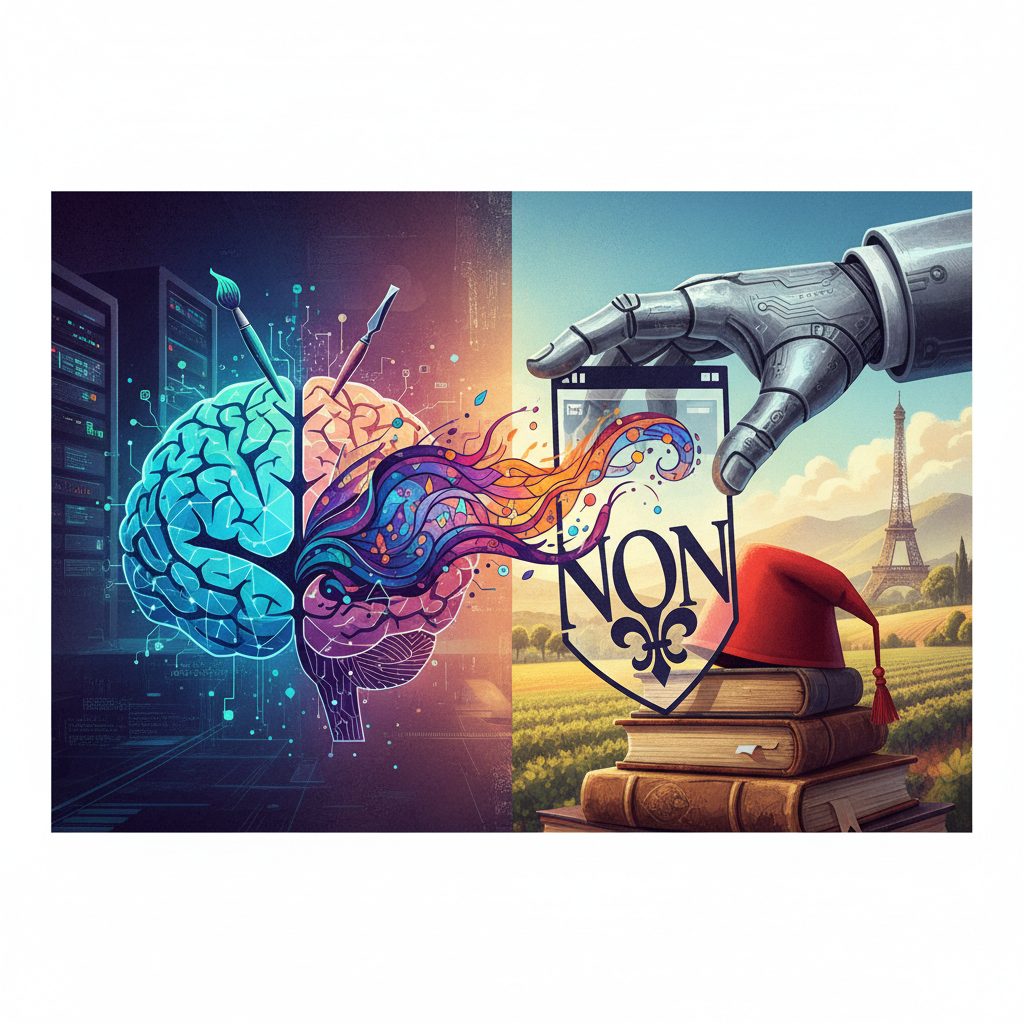

The scent of freshly baked pain au chocolat still lingers in the air as I write this, a small comfort against the digital storm brewing across the Atlantic. For months, perhaps even years, we have been told that artificial intelligence is the future, a boundless wellspring of innovation. And indeed, in many ways, it is. But when this boundless wellspring starts to churn out works that mimic, adapt, and sometimes even surpass human creations, a fundamental question arises: who owns the intellectual property, the very soul, of what an AI creates? For Silicon Valley, the answer often seems to be whoever built the machine, or perhaps, whoever paid for its electricity bill. Mon Dieu, the arrogance of Big Tech, to assume that creativity can be so easily commodified and claimed.
From my vantage point in Paris, this American perspective feels profoundly, almost comically, misguided. It is a view rooted in a capitalist ethos that prioritizes corporate ownership and technological advancement above all else, often at the expense of the individual creator. Companies like OpenAI, Google, and Meta, with their vast datasets and even vaster computing power, are developing generative AI models that can produce everything from intricate musical compositions to photorealistic images, compelling prose, and even architectural designs. The outputs are undeniably impressive, yet the legal and ethical frameworks for their ownership remain stubbornly, deliberately, vague.
Consider the plight of artists, writers, and musicians whose life's work has been ingested, often without consent or compensation, into these gargantuan models. Their unique styles, their years of practice, their very creative identities, are now part of a digital soup from which new 'creations' emerge. When an AI produces a painting in the style of Van Gogh, or a novel reminiscent of Proust, is it a new work, or simply a sophisticated pastiche, a digital echo of human genius? And if it is a new work, who is the author? The programmer? The company? The AI itself? The current legal landscape, particularly in the United States, leans heavily towards granting ownership to the human or entity that 'prompted' the AI, or the company that developed it. This approach effectively reduces the AI to a mere tool, an advanced paint brush, ignoring the complex, emergent nature of its output.
But the European way is not the American way, and that is the point. Here in France, and across much of the European Union, the concept of intellectual property, particularly copyright, is deeply intertwined with the notion of human authorship. Our legal traditions, stemming from the Berne Convention for the Protection of Literary and Artistic Works, emphasize the moral rights of the author: the right to be recognized as the creator, and the right to preserve the integrity of their work. This is not just about economic rights, it is about dignity. As Professor Alain Strowel, an intellectual property law expert at the Université Saint-Louis Bruxelles, once articulated,