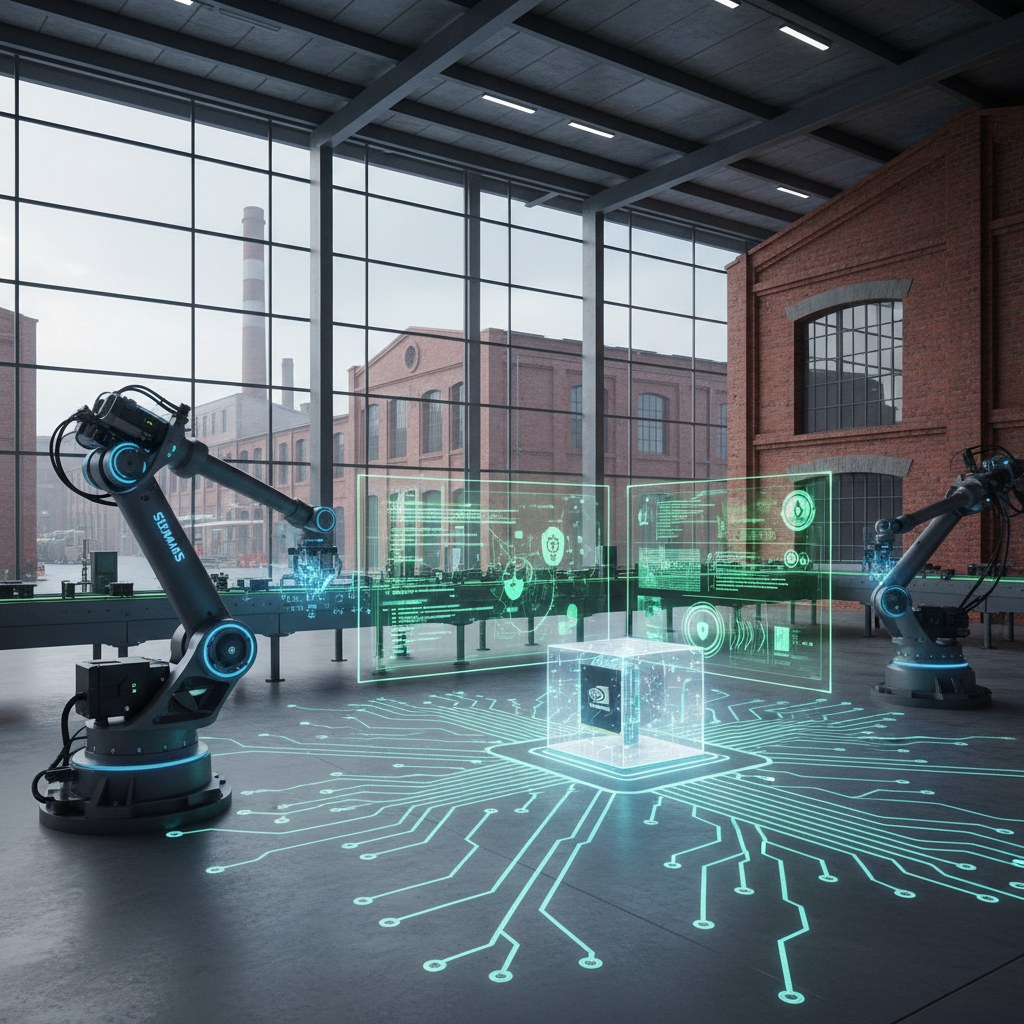

The rhythmic hum of machinery, the precise dance of robotic arms, the intricate flow of materials across an assembly line; this is the symphony of modern manufacturing. Yet, beneath this orchestrated precision, inefficiencies lurk. Unforeseen equipment failures, subtle quality deviations, and suboptimal resource allocation have long been the silent saboteurs of productivity. Today, however, a new conductor has entered the orchestra: Artificial Intelligence. For an engineer from Poland, a country with a proud heritage of industrial innovation and a burgeoning tech sector, observing this transformation is not merely academic, it is a testament to applied ingenuity.
The technical challenge we are addressing is multifaceted. Firstly, the sheer volume and velocity of operational data generated by contemporary industrial assets are overwhelming for human analysis. Sensors on a single CNC machine can produce terabytes of data daily, encompassing vibration, temperature, pressure, current, and acoustic signatures. Secondly, the complexity of identifying subtle patterns indicative of impending failure or quality degradation requires sophisticated analytical techniques that traditional statistical process control often cannot provide. Lastly, the need for real-time decision making and autonomous adaptation in dynamic factory environments demands an architecture that is both robust and agile.
From a systems perspective, an AI-driven smart factory architecture is a layered construct, akin to the meticulously planned infrastructure of a modern city. At the base, we have the Edge Layer, comprising IoT sensors, Programmable Logic Controllers (PLCs), and industrial PCs. These devices are the eyes and ears of the factory, collecting raw operational data. Above this, the Fog Layer or Edge Compute Layer processes data locally, performing initial filtering, aggregation, and even real-time inference using lightweight AI models. This minimizes latency and reduces bandwidth requirements for data transmission. Think of it as a local police station handling minor incidents before escalating to a central command. Finally, the Cloud Layer provides the heavy lifting: large-scale data storage, advanced analytics, model training, and global orchestration. Companies like Siemens, with their MindSphere platform, and NVIDIA, through their Metropolis and Omniverse platforms, are providing the foundational tooling for these layers.
Key Algorithms and Approaches
Predictive Maintenance: The algorithm works like this: we are moving beyond reactive or even preventive maintenance to truly predictive models. The core here is anomaly detection and time series forecasting. For instance, Long Short-Term Memory (lstm) networks or Transformer models are exceptionally well-suited for analyzing sensor data streams. Consider a vibration sensor on a critical bearing. An Lstm can learn the normal operational vibration patterns. When a new data point deviates significantly from the predicted pattern, it signals an anomaly. This deviation, often subtle, can indicate early wear long before a catastrophic failure. For example, a model might predict the remaining useful life (RUL) of a component using a regression approach trained on historical failure data. If a component's RUL falls below a predefined threshold, maintenance is scheduled proactively.
Conceptual Example for Anomaly Detection:
FUNCTION detect_anomaly(time_series_data, trained_lstm_model, threshold):
 predictions = trained_lstm_model.predict(time_series_data)
 anomalies = []
 FOR i From 0 TO LENGTH(time_series_data) - 1:
 error = ABS(time_series_data[i] - predictions[i])
 IF error > threshold:
 anomalies.append((i, time_series_data[i], error))
 Return anomalies
FUNCTION detect_anomaly(time_series_data, trained_lstm_model, threshold):
 predictions = trained_lstm_model.predict(time_series_data)
 anomalies = []
 FOR i From 0 TO LENGTH(time_series_data) - 1:
 error = ABS(time_series_data[i] - predictions[i])
 IF error > threshold:
 anomalies.append((i, time_series_data[i], error))
 Return anomalies
Quality Control: This often involves computer vision. High-resolution cameras capture images of products at various stages of production. Convolutional Neural Networks (CNNs), particularly architectures like ResNet or EfficientNet, are deployed to identify defects such as cracks, scratches, misalignments, or incorrect component placement. These models are trained on vast datasets of both pristine and defective products. For example, in the automotive industry, paint shop inspections historically relied on human eyes. Now, an NVIDIA Jetson-powered edge device can run a CNN model, inspecting every square centimeter of a car body for imperfections with superhuman consistency and speed. This ensures a defect rate reduction by orders of magnitude, often exceeding 99.5% accuracy in controlled environments.
Smart Factory Orchestration: This is where reinforcement learning and optimization algorithms shine. Imagine a factory floor where machines communicate, and production schedules dynamically adjust based on real-time demand, machine health, and material availability. Multi-agent reinforcement learning (marl) can be used where each machine or robotic arm is an 'agent' learning to optimize its actions to achieve global factory goals, such as maximizing throughput or minimizing energy consumption. This requires a sophisticated digital twin of the factory, often built using platforms like Siemens' Xcelerator or NVIDIA Omniverse, allowing for simulation and training in a virtual environment before deployment to the physical world.
Implementation Considerations
The journey to an AI-driven factory is not without its challenges. Data acquisition is paramount; ensuring consistent, clean, and labeled data streams from diverse industrial equipment is a monumental task. Data governance, cybersecurity, and interoperability standards are critical. The integration of legacy systems with modern AI infrastructure requires careful planning. Furthermore, the computational demands for training complex models, especially for computer vision and reinforcement learning, necessitate powerful hardware. This is where NVIDIA's GPUs and their Cuda platform become indispensable, enabling parallel processing that dramatically accelerates training times. Poland's engineering talent explains why many European manufacturers are looking here for robust integration solutions, leveraging our strong background in industrial automation and software development.
Benchmarks and Comparisons
Traditional rule-based systems or statistical process control (SPC) methods, while foundational, are often rigid and struggle with the non-linear, high-dimensional data characteristic of modern manufacturing. AI models, particularly deep learning, offer superior pattern recognition capabilities and adaptability. For instance, a major Polish automotive component manufacturer reported a 15% reduction in unplanned downtime and a 7% improvement in yield after deploying an LSTM-based predictive maintenance system, compared to their previous SPC approach which only managed a 3% downtime reduction. The initial investment in AI infrastructure, including NVIDIA's A100 GPUs for training and Jetson modules for edge inference, was recouped within 18 months.
Code-Level Insights
For predictive maintenance, Python libraries like TensorFlow or PyTorch are standard. Data preprocessing often involves Pandas and NumPy. Feature engineering might include Fourier transforms for frequency domain analysis of vibration data. For computer vision, OpenCV is essential for image processing, and pre-trained models from TensorFlow Hub or PyTorch Hub can provide a strong starting point for transfer learning. Deployment to edge devices often involves model quantization and optimization using tools like NVIDIA TensorRT to ensure efficient inference. Message queues like Apache Kafka or Mqtt are crucial for real-time data ingestion and distribution across the factory network. For example, a common pattern involves a Python script running on a Jetson Nano, subscribing to an Mqtt topic for sensor data, performing inference with a TensorFlow Lite model, and publishing anomaly alerts back to another Mqtt topic for action by the PLC or Scada system.
Real-World Use Cases
- Volkswagen's Paint Shop in Września, Poland: Leveraging NVIDIA's Metropolis, Volkswagen has deployed AI-powered optical inspection systems to detect minute paint defects on vehicles, achieving near-perfect quality control and significantly reducing manual re-inspection time. This has led to a reported 20% increase in throughput on the paint line. Read more on industrial AI applications.
- Bosch's Smart Factory in Germany: Bosch utilizes AI for predictive maintenance on their CNC machines, reducing unexpected breakdowns by 25% and extending machine lifespan. Their system integrates sensor data with a central AI platform, providing maintenance teams with actionable insights and optimal scheduling.
- LG Electronics in South Korea: LG has implemented AI-driven quality inspection for display panels, using deep learning models to identify microscopic defects that are invisible to the human eye, ensuring higher product quality and customer satisfaction.
- A Polish Steel Mill in Silesia: A lesser-known but equally impactful deployment involves AI models predicting the optimal moment for furnace relining, based on thermal imaging and material stress data. This has extended furnace operational cycles by an average of 10%, translating to millions of zlotys in annual savings.
Gotchas and Pitfalls
One common pitfall is the 'data graveyard' syndrome, where vast amounts of sensor data are collected but never properly utilized or labeled, making model training impossible. Another is over-reliance on synthetic data; while useful, it rarely captures the full complexity and noise of real-world industrial environments. Model drift, where a deployed model's performance degrades over time due to changes in operating conditions or equipment wear, is also a significant challenge requiring continuous monitoring and retraining. Furthermore, the 'black box' nature of deep learning models can be a barrier to adoption in highly regulated industries, necessitating explainable AI (XAI) techniques to build trust and provide audit trails. The human element cannot be overlooked; proper training and change management are crucial for factory workers to embrace, not resist, these new technologies. As Dr. Anna Kowalska, Head of AI Research at AGH University of Science and Technology in Kraków, recently stated, "The most sophisticated algorithm is useless if the people on the factory floor do not understand its purpose or trust its recommendations. We must build bridges, not just models."
Resources for Going Deeper
For those looking to dive deeper, I recommend exploring the NVIDIA Developer Program for their industrial AI SDKs and resources. The MIT Technology Review frequently publishes excellent analyses on industrial AI. Academic papers on anomaly detection in time series, particularly those leveraging LSTMs and Transformers, can be found on arXiv. For practical implementation, consider courses on industrial IoT and edge AI from platforms like Coursera or edX, often featuring real-world case studies. The "From Warsaw to the World: How 'MateriałAI' is Forging Superconductors and Battery Breakthroughs, Challenging Silicon Valley's Grip" article also provides context on Poland's role in advanced materials, which often intertwines with smart manufacturing initiatives. The future of manufacturing is being written in algorithms and data streams, and it is a narrative that Poland is actively shaping.