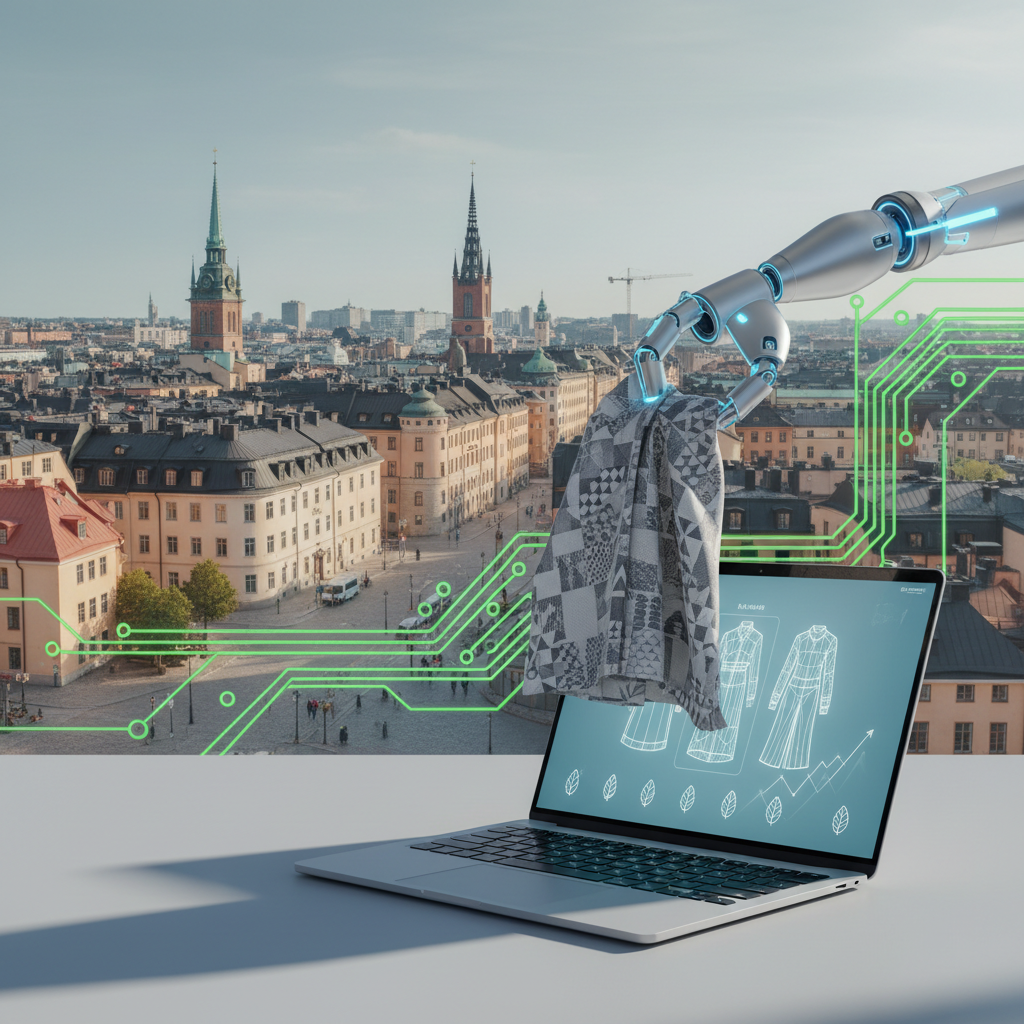

The digital landscape, much like the rugged fjords of my homeland, is a place of breathtaking beauty and formidable challenges. For years, we have navigated its currents with a certain degree of confidence, anchored by verifiable information and trusted sources. However, the recent proliferation of generative image artificial intelligence, spearheaded by entities such as Stability AI and Midjourney, has introduced a new, turbulent element. These tools, capable of conjuring photorealistic images from mere text prompts, are not simply artistic curiosities; they are potent instruments with far-reaching implications, particularly for a society like Norway that places immense value on transparency and trust.
The risk scenario is both subtle and profound. Imagine a financial report, meticulously crafted, yet featuring a single, highly convincing AI-generated image of a non-existent asset or a fabricated executive meeting. Or consider a public statement, purportedly from a government official, accompanied by an image of them in a compromising, entirely artificial situation. The ease with which these deceptive visuals can be produced and disseminated threatens to erode the very bedrock of public discourse and financial markets. In Norway, where the public's confidence in institutions and information is a cornerstone of our social contract, this erosion is not merely an inconvenience; it is a fundamental threat.
Let me explain the engineering behind this revolution. At their core, generative image models like Stable Diffusion, the technology underpinning Stability AI's offerings, and Midjourney, operate on principles of deep learning, specifically leveraging diffusion models. These models begin with a training dataset of billions of images, often scraped from the internet without explicit consent, paired with descriptive text. During training, the model learns to progressively denoise an image from pure static, guided by the text prompt. It is akin to an artist starting with a canvas of random splatters and, through iterative refinement, bringing a coherent, requested scene to life. The process involves a forward diffusion step, where noise is gradually added to an image, and a reverse diffusion step, where the model learns to reverse this process, effectively generating an image from noise conditioned on a text input. The sheer scale of the training data, combined with sophisticated neural network architectures, allows these models to capture an astonishing breadth of visual concepts and styles, from hyperrealistic photographs to intricate illustrations.
The technical sophistication, while impressive, also underpins the risk. The models' ability to generate images that are indistinguishable from reality, even to trained eyes, makes detection challenging. Watermarking and digital provenance solutions are being explored, but they face an uphill battle against the rapid evolution of the generative capabilities. As Dr. Håkon Wium Lie, a prominent Norwegian computer scientist and co-creator of CSS, once remarked,