From my lanai, looking out at the vast, ever-changing Pacific, I often ponder the currents of technology that sweep across our islands. We sit at a unique crossroads, between the digital heart of Silicon Valley and the ancient wisdom of Oceania. Right now, a powerful new tide is rolling in, one that promises to reshape the very act of creation: generative artificial intelligence. Tools like OpenAI's Sora, Google's Lumiere, and even Meta's Llama-powered image generators are not just incremental improvements, they are paradigm shifts, and they are forcing us to confront profound questions about the future of the creator economy.
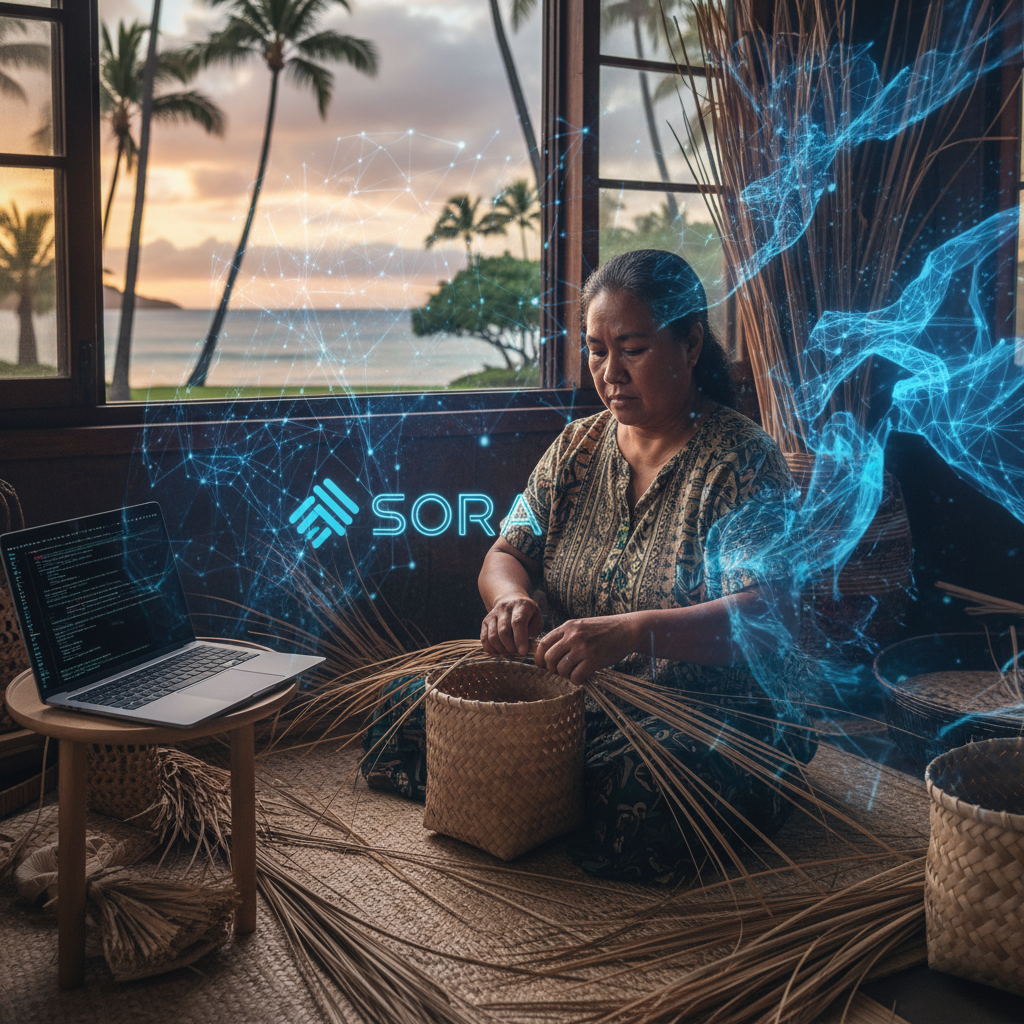
For generations, the art of storytelling, weaving, carving, and chant has been the lifeblood of our communities across the Pacific. These are not just hobbies, they are cultural anchors, passed down through families, each stroke and syllable imbued with mana, with spiritual power and ancestral knowledge. Now, we see AI models capable of generating photorealistic video from text prompts, producing intricate designs, and even composing music. The potential for empowerment is undeniable. Imagine a small lauhala weaver in Puna, using AI to visualize complex new patterns, or a storyteller in Samoa leveraging AI to animate ancient myths for a global audience, without needing a multi-million dollar studio. This is the promise, the exciting horizon.
Yet, a shadow looms large over this promise. The core question for independent creators, particularly those rooted in indigenous traditions, is whether these tools will truly empower them or simply become another mechanism for extraction and commodification. The data used to train these massive AI models, often scraped from the internet without consent or compensation, includes countless works by artists, writers, musicians, and designers. When an AI generates a piece of art that echoes a specific cultural style, whose intellectual property is it? Whose spirit is being channeled, and who benefits financially?
This isn't a hypothetical concern. We've already seen instances where AI models, trained on vast datasets, reproduce stylistic elements that are deeply tied to specific artists or cultural groups. The controversy around AI art generators mimicking the styles of living artists, often without their permission or remuneration, has been a central point of contention for over a year. "The current legal frameworks are simply not equipped to handle the complexities of AI-generated content and copyright," noted Maria Pallante, the President and CEO of the Association of American Publishers, in a recent address. "We need new dialogues, new legislation, and new ethical guidelines that protect creators, not just the platforms." Her words resonate deeply here, where cultural appropriation has been a historical struggle.
Consider the case of a local artist, perhaps a tattooist specializing in traditional Hawaiian patterns, or a kapa maker whose designs tell specific genealogical stories. If an AI can generate similar patterns or designs, who owns that output? More importantly, does the AI truly understand the cultural significance, the sacredness, of what it is replicating? I believe aloha means more than hello because it's a framework for ethical AI. It demands respect, reciprocity, and a deep understanding of interconnectedness. Without these principles guiding AI development and deployment, we risk creating tools that are culturally tone-deaf at best, and actively extractive at worst.
Major players are certainly feeling the heat. Adobe, for example, has been trying to position its Firefly generative AI as an ethical alternative, promising to compensate creators whose work contributes to its training data. They've launched a 'Contributor Program' aimed at building a more transparent and equitable system. This is a step in the right direction, but the devil, as always, is in the details of implementation and the scale of compensation. Will it truly be fair, or just a token gesture? Meanwhile, companies like Midjourney and Stability AI continue to operate in a more ambiguous legal and ethical space, facing ongoing lawsuits from artists and copyright holders.
Here in Hawaii, we are particularly sensitive to these issues. Our intellectual property, our cultural heritage, is not just about economic value; it's about identity, sovereignty, and the perpetuation of our way of life. The Office of Hawaiian Affairs has been actively advocating for greater protections for traditional knowledge and cultural expressions. "Our stories, our designs, our chants, these are not just data points for an algorithm to consume," explained Dr. Kamana Beamer, a prominent Hawaiian scholar and community leader. "They are living entities, imbued with history and meaning. Any technology that interacts with them must do so with the utmost reverence and responsibility." His perspective underscores the profound difference between simply generating an image and understanding its cultural context and sacredness.
The economic implications are staggering. A report by Goldman Sachs last year estimated that generative AI could boost global GDP by 7% over a decade, but also warned of significant job displacement, particularly in creative fields. For independent creators, this means a rapidly changing landscape. Some will undoubtedly embrace AI as a powerful co-pilot, enhancing their productivity and expanding their creative horizons. Others will find themselves competing with algorithms that can produce content at lightning speed and virtually no cost. The market for human-made, authentic, and culturally resonant work could become even more valuable, but also more niche.
This is where the concept of provenance becomes critical. Consumers, I believe, will increasingly seek out and pay for content that is verifiably human-made, ethically sourced, and culturally authentic. Blockchain technology and digital watermarking could play a role here, providing transparent ledgers of creation and ownership. Imagine a digital certificate of authenticity for a piece of music, verifying it was composed by a human artist, not an AI, and that any cultural elements were used with permission and proper attribution.
The future is being built on volcanic rock, a foundation that is both ancient and constantly shifting. We need to actively shape this future, not just passively observe it. This means demanding greater transparency from AI developers about their training data, advocating for robust intellectual property rights for creators, and exploring new economic models that ensure fair compensation. It also means fostering digital literacy and critical thinking among creators, so they can harness AI's power while safeguarding their unique voices and cultural integrity.
The conversation around AI and the creator economy is not just about technology; it's about humanity. It's about how we value creativity, how we protect cultural heritage, and how we ensure a just and equitable future for all. As we navigate these complex waters, the principles of aloha, of care, harmony, and mutual respect, must be our guiding stars. The choices we make today, in April 2026, will echo for decades to come, shaping whether AI becomes a tool for genuine creative flourishing or merely another engine for cultural erosion. The time for thoughtful action, for building bridges between innovation and tradition, is now. For more insights into the evolving landscape of AI and its impact on various industries, you can explore the extensive coverage on TechCrunch or Wired. The dialogue is global, and the stakes are high.