
The scent of freshly printed textbooks, once a hallmark of the new school year, is rapidly being replaced by the glow of screens and the hum of artificial intelligence. In Romania, as across Europe, the advent of sophisticated AI chatbots such as those developed by OpenAI and Google DeepMind has ignited a fervent debate within educational circles: are these tools harbingers of a new era of learning, or merely sophisticated instruments for academic dishonesty? My investigation suggests the truth is far more nuanced, entangled with issues of funding, infrastructure, and a deep-seated resistance to change.
For decades, Romanian education has grappled with underfunding and an often-outdated curriculum. The promise of digital transformation, frequently touted by Brussels and local politicians alike, has often materialized as a patchwork of initiatives, some genuinely innovative, others merely cosmetic. Now, with AI chatbots capable of generating coherent essays, solving complex mathematical problems, and even writing code, the stakes have been dramatically raised. Teachers, already burdened by large class sizes and administrative tasks, find themselves on the front lines of a technological shift they are often ill-equipped to navigate.
"We are caught between a rock and a hard place," stated Professor Elena Popescu, a veteran literature teacher at a prestigious Bucharest high school. "On one hand, these tools can personalize learning and provide instant feedback, which is invaluable. On the other, the temptation for students to simply outsource their thinking to a machine is immense. Our current assessment methods are simply not designed for this reality." Her sentiment echoes across the country, from the bustling capital to the quiet villages where internet access itself remains a luxury for many.
The European Union, through various funding mechanisms, has been a significant proponent of digital education initiatives. Follow the EU funding trail, and you will find millions of euros allocated for digital infrastructure, teacher training, and e-learning platforms. Yet, the rapid pace of AI development, particularly in large language models, has outstripped the bureaucratic cycles of funding and implementation. By the time a project is approved and deployed, the technology it aims to address has often evolved significantly. This creates a perpetual state of catch-up, where schools are always one step behind the cutting edge.
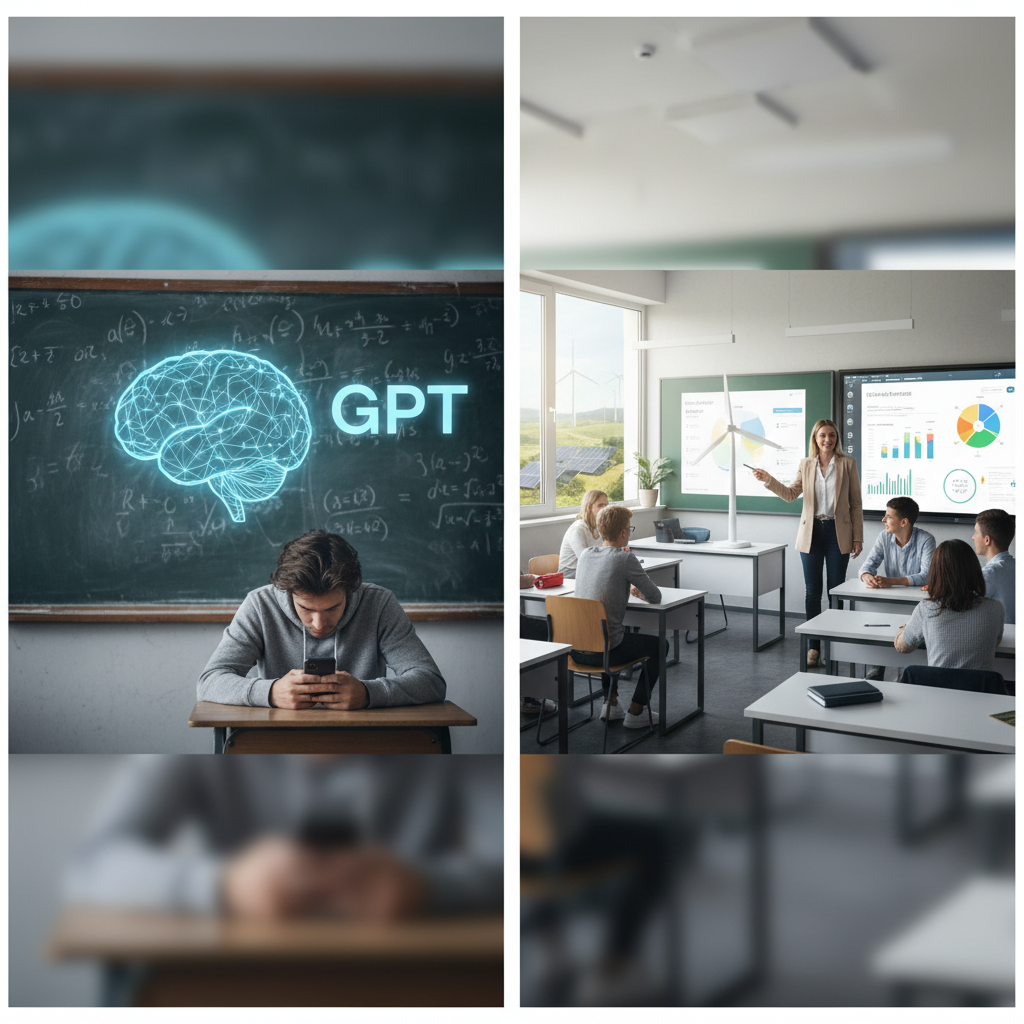
Consider the case of OpenAI's GPT models. Their capabilities have expanded exponentially in the last two years, making them accessible and powerful tools for students. While some educators advocate for teaching students how to use these tools responsibly, others call for outright bans, fearing a complete erosion of critical thinking and original work. A recent survey conducted by the Romanian Ministry of Education, still unpublished but leaked to DataGlobal Hub, indicated that over 60 percent of high school teachers believe AI chatbots have already led to an increase in plagiarism, with only 15 percent feeling adequately prepared to address this challenge. This is a stark indicator of the chasm between technological advancement and pedagogical readiness.
Dr. Andrei Dumitrescu, a leading expert in educational technology at the University of Bucharest, offers a more optimistic perspective, albeit with caution. "Banning these tools is like banning calculators in a math class; it is ultimately futile and counterproductive," he told me. "The focus must shift from detection to integration. We need to educate both teachers and students on AI literacy, ethical use, and how to leverage these tools to enhance learning, not replace it. This requires significant investment in training and curriculum redesign." His words carry weight, reflecting a growing consensus among forward-thinking academics.
The Romanian tech boom hides a darker story: a persistent digital divide. While cities like Cluj-Napoca and Bucharest boast thriving tech hubs and high-speed internet, many rural areas still struggle with basic connectivity. This disparity means that the benefits, and indeed the challenges, of AI in education are not evenly distributed. Students in well-resourced urban schools might have access to the latest AI tools and teachers trained in their use, while their rural counterparts remain isolated, further exacerbating educational inequalities. This is not merely a technological problem, but a societal one, reflecting deeper structural issues within our nation.
My investigation uncovered instances where schools, lacking official guidance, have implemented their own ad-hoc policies. Some have embraced AI, integrating tools like Microsoft's Copilot into coding classes, while others have resorted to draconian measures, banning all personal devices and imposing strict surveillance during exams. This fragmented approach creates confusion and inconsistency, undermining any coherent national strategy. The lack of a unified framework from the Ministry of Education leaves individual institutions to fend for themselves, often without the necessary resources or expertise.
Across the continent, similar debates are unfolding. In France, the Ministry of National Education has issued guidelines emphasizing the responsible use of AI, while in Germany, some states have experimented with AI-powered tutoring systems. The European Commission itself has acknowledged the transformative potential of AI in education, but also its risks, particularly concerning data privacy and bias. The EU AI Act, set to fully apply in the coming years, will undoubtedly impact how AI is developed and deployed in educational settings, but its direct implications for classroom practices are still being interpreted. You can read more about the broader implications of AI regulation on education via Reuters.
The private sector is also keenly observing this landscape. Companies like Google, with its Gemini models, and Anthropic, with Claude, are developing educational applications and partnerships. The potential market for AI in education is vast, estimated to be worth billions globally, and Romania, with its burgeoning tech sector, is an attractive prospect. However, the ethical considerations of integrating commercial AI into public education, particularly regarding student data and algorithmic influence, cannot be overlooked. The question of who truly benefits from these partnerships, the students or the corporations, remains a critical area for scrutiny.
As a journalist who has witnessed Romania's journey through post-communism and into the digital age, I understand that technological adoption is rarely a straightforward path. The promise of AI in education is immense: personalized learning paths, automated administrative tasks, and access to vast knowledge bases. However, without careful planning, substantial investment in teacher training, and a robust ethical framework, this revolution risks becoming a chaotic free-for-all, further widening the gap between the privileged and the underserved. The future of our children's education, and indeed the intellectual capital of our nation, hangs in the balance. The time for reactive measures is over; proactive, thoughtful engagement with AI is not just an option, it is an imperative. For more detailed analysis on AI's impact on society, one might consult Wired.
This is not merely a technical challenge; it is a profound societal and philosophical one. How do we define learning when machines can generate answers? What skills become paramount when rote memorization is rendered obsolete? These are the questions that Romanian educators, policymakers, and parents must confront, not with fear, but with a clear-eyed understanding of both the opportunities and the perils that lie ahead. The choice is not whether to embrace AI, but how to do so responsibly and equitably, ensuring that the next generation is prepared for a world irrevocably shaped by artificial intelligence.