
The wind howls outside my window here in Reykjavík, a familiar companion to thought. It is April 2026, and the world, it seems, is still reeling from the arrival of AI chatbots in our classrooms. From California to Copenhagen, educators are wringing their hands, fearing a tidal wave of plagiarism, a generation of students who outsource their thinking to algorithms. But here, in the land of fire and ice, AI takes a different form. We see things a little differently, perhaps because our small size often forces us to innovate, to adapt, to look beyond the immediate panic.
Let me be clear: the idea that AI chatbots like OpenAI's GPT-4 or Google's Gemini are solely instruments of cheating is a failure of imagination. It is akin to banning calculators because students might use them to solve math problems, or forbidding libraries because one could copy text from a book. The technology is here, it is powerful, and it is not going away. Our task, as educators, parents, and a society invested in the future, is not to build higher walls, but to teach our children how to navigate this new landscape, how to wield these tools responsibly and intelligently.
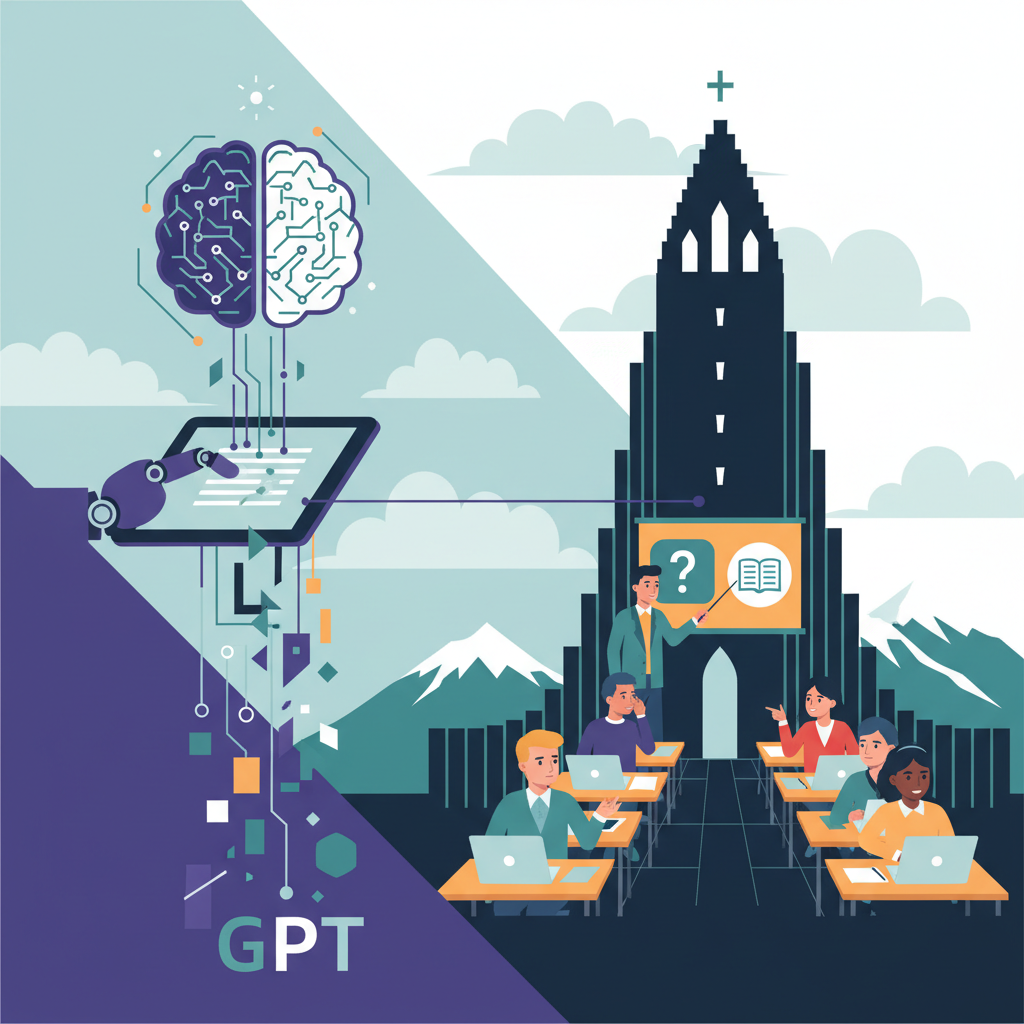
I recently visited a small school in Akureyri, a charming town nestled by a fjord in northern Iceland. The principal, a woman named Elín Jónsdóttir, with eyes that sparkled like the northern lights, showed me her research in a lab overlooking a glacier. She is pioneering a program where students are not just allowed, but encouraged, to use AI tools for their assignments. “The world outside these walls uses AI,” she told me, gesturing towards the majestic mountains. “Our students need to learn to master it, not fear it. They need to understand its strengths and its limitations. That is the real lesson.”
Elín's approach is not about letting AI write essays wholesale. It is about teaching students to use AI as a research assistant, a brainstorming partner, a critical thinking sparring partner. Imagine a student struggling to understand a complex historical event. Instead of simply copying from Wikipedia, they can prompt GPT to explain it in simpler terms, to offer different perspectives, or even to role-play a historical figure. They can then take that generated information, critically evaluate it, synthesize it with other sources, and form their own original argument. This is not cheating; this is a sophisticated form of inquiry and learning.
Indeed, some of the most forward-thinking institutions are already embracing this. Dr. Ethan Mollick, a professor at the Wharton School of the University of Pennsylvania, has been a vocal proponent of integrating AI into education. He famously stated, “If you ban AI, you are banning the future. If you embrace AI, you are teaching the future.” His research suggests that when students are taught to use AI effectively, their learning outcomes can actually improve, not decline. They learn to ask better questions, to refine their ideas, and to become more efficient researchers. It is about shifting the focus from rote memorization to critical engagement and creative problem-solving.
Of course, I hear the counterarguments, loud and clear. Many educators fear that AI will erode fundamental skills, that students will lose the ability to write coherent sentences or construct logical arguments if they rely too heavily on machines. There is a valid concern that the temptation to simply copy and paste will be too great for some, leading to a decline in academic integrity. And yes, the tools for detecting AI-generated text are imperfect, creating a cat-and-mouse game between students and teachers. These are not trivial concerns, and we must address them head-on.
But my rebuttal is this: the answer is not prohibition, but pedagogy. We need to redesign assignments, shift our assessment methods, and fundamentally rethink what we mean by