The reverberations of artificial intelligence are shaking the very foundations of creative industries, from the bustling studios of Hollywood to the quiet libraries of Warsaw. What began as a murmur has escalated into a cacophony of legal challenges, with artists, authors, and musicians worldwide asserting their rights against tech behemoths like OpenAI, Google, and Meta. This is not merely a legal skirmish; it is a profound philosophical debate about ownership, originality, and the future of human creativity in an age of algorithmic generation. From a systems perspective, the current legal framework, designed for a pre-AI era, is struggling to parse the intricate dependencies between data ingestion and creative output.
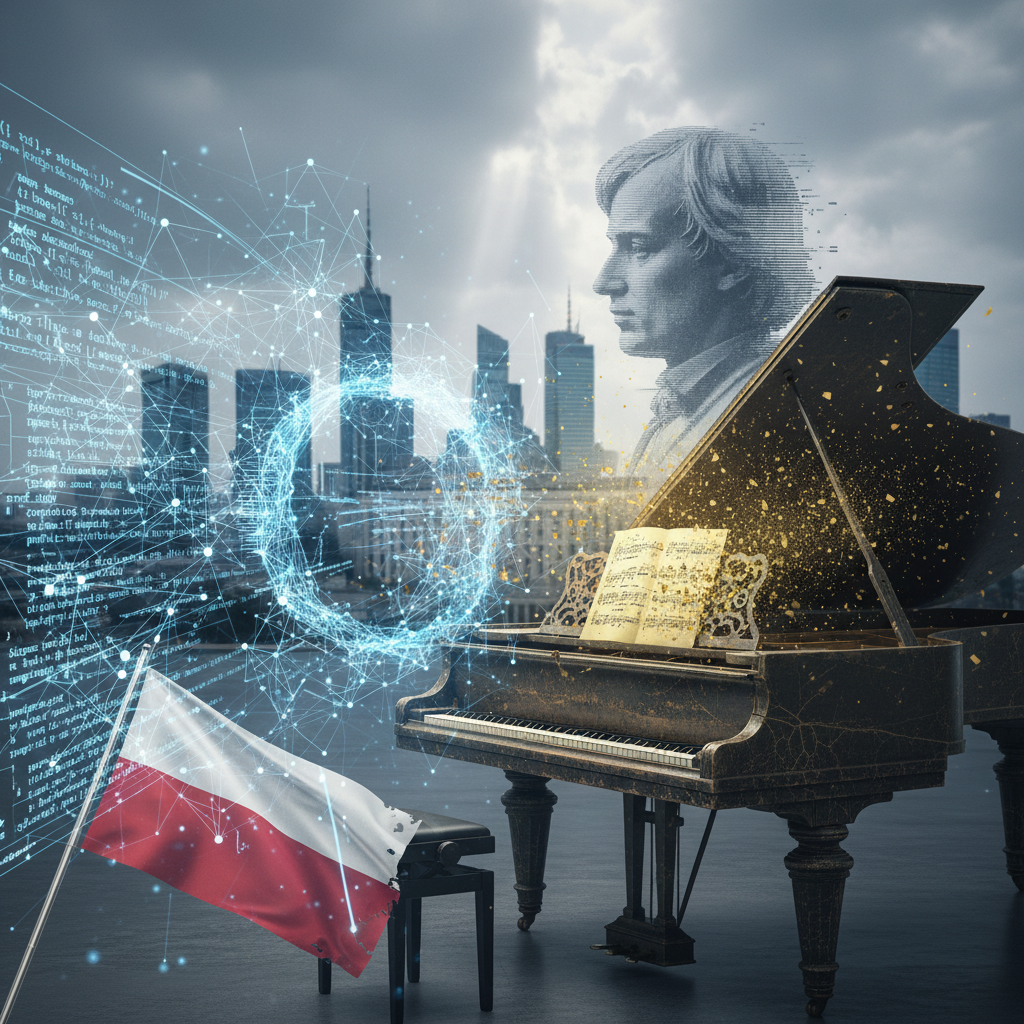
In Poland, a nation deeply proud of its artistic heritage, this conflict resonates with particular intensity. Our cultural landscape, rich with the works of Nobel laureates like Wisława Szymborska and the immortal compositions of Fryderyk Chopin, represents a vast, invaluable dataset. The question looming large is whether these treasures, often digitized and publicly accessible, can be indiscriminately consumed by large language models (LLMs) and generative AI systems without fair compensation or explicit consent. The algorithm works like this: vast swathes of text, images, and audio are ingested, patterns are identified, and new content is then generated based on these learned patterns. But where does the 'learning' end and 'copying' begin?
Recent data from the European Union indicates a 300% increase in copyright infringement claims related to AI-generated content across member states in the past year alone. This surge underscores the urgency of the situation. Major tech companies, while acknowledging the concerns, often argue that their use of public data falls under fair use or similar doctrines, framing it as a transformative process akin to a human learning from existing works. However, many creators view this as a digital land grab, an unauthorized appropriation of their life's work.
“The notion of 'fair use' was never intended to justify the wholesale ingestion of entire literary canons to train commercial products,” stated Professor Janusz Kowalski, a leading expert in intellectual property law at Jagiellonian University in Kraków. “We are talking about models that can, with startling accuracy, mimic the style and voice of specific authors. This moves beyond inspiration; it verges on digital cloning, and our existing laws are simply not equipped for this scale of exploitation.” Professor Kowalski's sentiment is widely echoed across Europe, where cultural protection is often enshrined with greater rigor than in some other parts of the world.
The legal battles are unfolding on multiple fronts. In the United States, high-profile lawsuits against OpenAI and Microsoft, filed by authors like George R.R. Martin and the New York Times, allege direct infringement and unfair competition. Similar actions are emerging in Europe. For instance, a collective of European visual artists recently initiated proceedings against Stability AI, claiming their works were used without permission to train the Stable Diffusion model. These cases are complex, often hinging on the technical intricacies of how AI models are trained and how their outputs relate to the input data. The legal teams are grappling with questions such as whether a model's 'internal representation' of a copyrighted work constitutes a copy, or if the generated output, even if stylistically similar, is truly derivative.
Poland's engineering talent explains why our nation is particularly attuned to these nuances. With a strong tradition in computer science and a burgeoning AI sector, many Polish developers and researchers understand the technical underpinnings of these models. They also appreciate the ethical dilemmas. Dr. Anna Nowak, a senior AI ethics researcher at the Warsaw University of Technology, highlighted this duality. “We are building these powerful tools, and we understand their potential. But we also have a responsibility to ensure they are built ethically. The current approach of ingesting everything available online without clear consent or compensation is unsustainable and unjust. It undermines the very creative ecosystem we claim to want to augment.” Her team's recent paper, published in MIT Technology Review, explored the economic implications of untraceable creative lineage in generative models.
The music industry, too, is feeling the heat. Universal Music Group, representing artists from Taylor Swift to The Beatles, has been vocal about the unauthorized use of copyrighted songs to train AI. They have actively pursued takedowns of AI-generated tracks that mimic their artists' voices or styles. The concern is not just about direct replication, but about the erosion of artistic identity and revenue streams. Imagine an AI trained on the entire discography of a beloved Polish folk band, then generating new songs in their exact style, potentially diluting their market and brand. This is a very real threat.
Regulators are beginning to respond. The European Union's AI Act, set to fully come into force in the coming months, includes provisions requiring transparency regarding copyrighted material used for training AI models. This is a significant step, albeit one that many argue does not go far enough. It mandates disclosure, but does not necessarily dictate compensation or consent for past training data. “Transparency is a good start, but it is merely the first step on a very long journey,” commented Marek Szymański, a cultural policy advisor to the Polish Ministry of Culture and National Heritage. “We need robust mechanisms for licensing and remuneration, otherwise we risk devaluing human creativity to mere training fodder.” He emphasized that Poland is actively engaging in EU-level discussions to strengthen these protections, advocating for a model that respects both innovation and artistic rights.
The stakes are incredibly high. If tech companies prevail in asserting broad 'fair use' rights, it could fundamentally alter the economic model for creators globally. It could lead to a future where the value of human-generated content is systematically diminished, as AI can produce similar outputs at near-zero marginal cost. Conversely, overly restrictive regulations could stifle innovation and slow the development of beneficial AI applications. The challenge lies in finding a delicate balance, a złoty środek as we say in Polish, a golden mean.
One potential path forward involves the development of robust licensing frameworks and micro-payment systems. Companies like Google and Adobe are exploring partnerships with content creators, offering compensation for the use of their data. Adobe, for example, has established a content fund to pay artists whose work is used to train its Firefly generative AI models. This proactive approach, while still nascent, offers a glimpse into a more equitable future. Such models could be integrated into platforms, allowing creators to opt-in or opt-out of having their work used for AI training, and to be compensated fairly if they choose to participate. This would be a welcome development, as it would transform the current adversarial relationship into a collaborative one.
The global nature of this challenge means that isolated national or regional regulations may not be sufficient. International cooperation, perhaps through bodies like the World Intellectual Property Organization (wipo), will be crucial. The outcome of these legal battles and policy debates will not only shape the future of AI development but also redefine the very concept of artistic ownership in the digital age. As we stand at this precipice, it is imperative that we remember that technology, while powerful, must ultimately serve humanity and uphold the value of human endeavor. The alternative, a world where algorithms consume creativity without consequence, is a future no artist, author, or musician would wish to compose. For further insights into the broader impact of AI on creative industries, one might consult TechCrunch for the latest industry developments. The debate is far from settled, and the next few years will be instrumental in charting this uncharted territory. The echoes of Chopin's nocturnes and Szymborska's verses must not be lost in the silicon hum of generative models; their legacy demands careful stewardship.