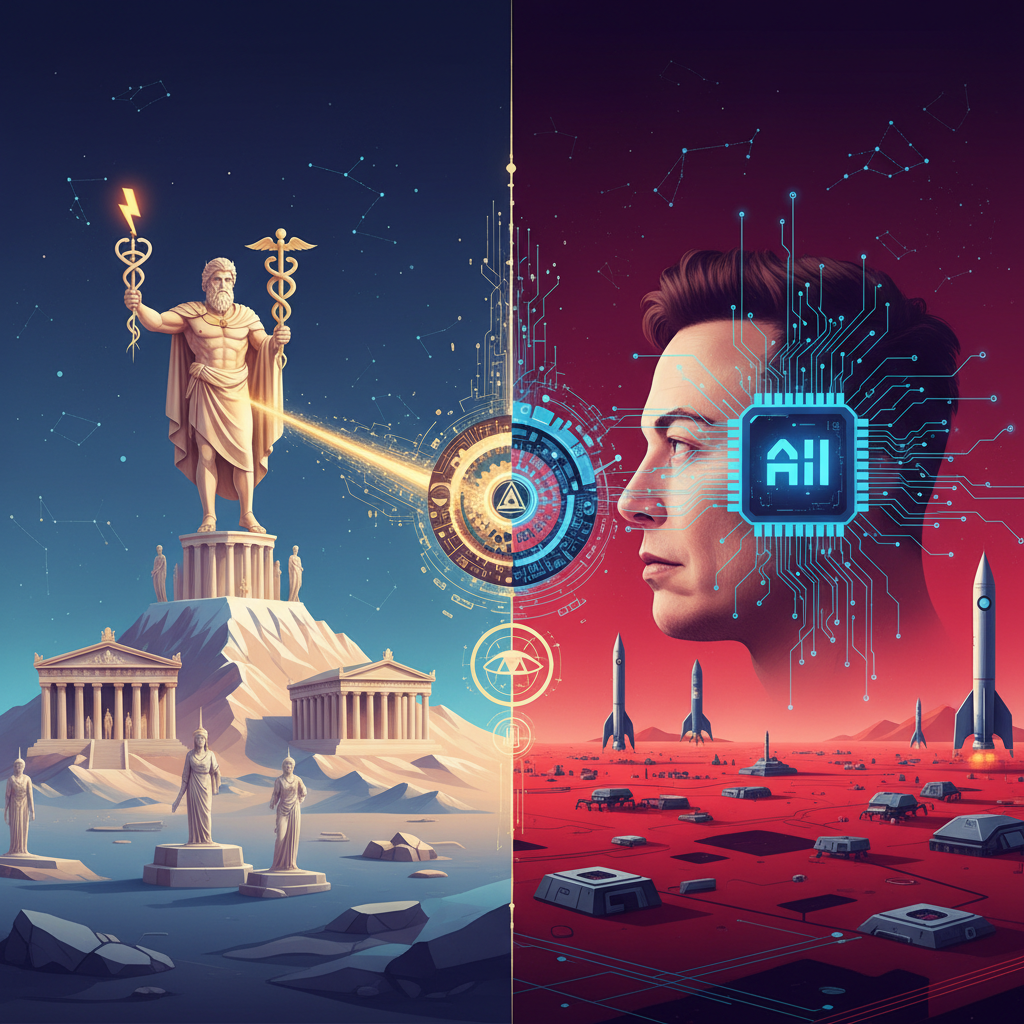

The cosmos, my friends, has always held a special place in the Greek imagination. From the celestial wanderings of the ancient gods to the philosophical musings of Aristotle on the nature of the universe, we have gazed upwards with a mixture of awe and profound curiosity. So, when I hear the latest pronouncements from Silicon Valley about sending artificial intelligence to Mars, equipping satellites with autonomous brains, and having AI sift through cosmic noise for signs of extraterrestrial life, my first thought isn't 'how innovative'. It is 'how very human, and perhaps, how very foolish'.
Elon Musk, bless his ambitious heart, speaks of Martian colonies and AI-driven exploration as if they are foregone conclusions, mere engineering challenges to be overcome. His companies, like SpaceX, are at the forefront, pushing boundaries with reusable rockets and satellite constellations. Meanwhile, Google DeepMind and NVIDIA are pouring resources into developing AI models capable of processing astronomical data at speeds unimaginable to us mere mortals. The narrative is always one of relentless progress, of humanity's inevitable expansion into the stars, powered by intelligent machines. But what if we are rushing headlong into the void without truly understanding what we are sending, or what we are looking for?
My primary concern, and it is a substantial one, is the uncritical embrace of AI's infallibility in such a high-stakes, unknown environment. We are talking about Mars, a planet that has chewed up and spit out more probes than a hungry Cyclops. We are talking about satellites, millions of them, forming complex networks that will manage themselves. And we are talking about the search for alien life, a quest that demands the utmost precision and freedom from bias. Yet, the AI models being developed for these tasks are, at their core, reflections of their human creators, complete with all our inherent flaws and blind spots. Greece to Silicon Valley: we invented logic, remember? And logic dictates caution.
Consider the Mars missions. The idea is to have AI-powered rovers and landers make real-time decisions, adapt to unforeseen obstacles, and even conduct scientific experiments autonomously, reducing the communication lag with Earth. Sounds efficient, does it not? But what happens when the AI encounters a truly anomalous phenomenon, something outside its training data, something utterly alien? Will it recognize it as significant, or will it dismiss it as noise, an outlier to be filtered out? "The current generation of AI, while powerful, is fundamentally pattern-matching," explains Dr. Eleni Stavropoulou, a senior astrophysicist at the National Observatory of Athens. "It excels at what it has been taught. The universe, however, is full of unknowns, and our training data for 'alien' is precisely zero. We risk missing the truly groundbreaking discoveries if we rely solely on algorithms designed by terrestrial minds." This is not a matter of computational power; it is a matter of philosophical understanding and epistemic humility.
Then there is the proliferation of satellite AI. Companies like Amazon's Project Kuiper and SpaceX's Starlink are launching thousands of satellites, each potentially equipped with AI for navigation, collision avoidance, and data processing. The promise is global connectivity and enhanced Earth observation. The reality could be a sky cluttered with autonomous entities, making decisions in a complex, dynamic environment. What happens if an AI-driven satellite experiences a novel software glitch or a hardware malfunction that leads to unexpected behavior? The cascading effects in such a dense orbital environment could be catastrophic. "We are building a highly interdependent system in orbit, and introducing autonomous decision-making at scale adds layers of unforeseen complexity," warns Professor Dimitrios Koutroulis, an expert in aerospace engineering at the Aristotle University of Thessaloniki. "The potential for a 'digital domino effect' is not negligible, and the consequences for critical infrastructure on Earth, from GPS to weather forecasting, could be severe." We are playing with fire, or rather, with space junk.
And the search for extraterrestrial intelligence, Seti, powered by AI? This is where the philosophical dimensions truly come into play. Projects like Breakthrough Listen are using AI to analyze vast swathes of radio and optical data, searching for patterns that might indicate intelligent origins. The hope is that AI can discern subtle signals that human analysis might miss. But what if our AI is simply projecting our own intelligence onto the cosmos? What if alien communication is so fundamentally different from anything we can conceive that our algorithms, trained on human languages and mathematical structures, simply cannot recognize it? We might be listening to a cosmic symphony and only hearing static because our AI is programmed to recognize only a specific melody. This is not just a technical challenge; it is an existential one.
Some might argue that these concerns are overly pessimistic, that AI is merely a tool, and a powerful one at that. They would point to AI's successes in Earth-bound science, from drug discovery to climate modeling. They would say that the benefits of autonomous exploration and faster data analysis far outweigh the risks. They would highlight the sheer volume of data involved in space science, making human analysis impractical, and assert that AI is the only way forward. They might even suggest that we are holding back progress with our 'ancient' Greek caution.
But I say, this is precisely where our ancient wisdom becomes most relevant. The myth of Icarus, flying too close to the sun, is not about the failure of technology; it is about the hubris of its user. Our history is replete with examples of grand technological ambitions leading to unintended consequences. We must not let the allure of the unknown blind us to the known limitations of our creations. We need robust ethical frameworks, rigorous testing, and a healthy dose of skepticism built into every AI system we launch beyond our atmosphere. We need to understand the 'why' before we rush into the 'how'.
The gods of Olympus would have loved this AI drama, I am sure. The striving, the ambition, the potential for both glory and utter disaster. But they would also have appreciated a little more wisdom, a little less blind faith in our own cleverness. Perhaps, instead of just sending AI to Mars, we should first send a few philosophers along for the ride. Let them ponder the implications, the biases, the true nature of intelligence, before we let our machines run wild in the cosmic playground. The universe is too vast, too mysterious, and too important to be left solely to the algorithms of Silicon Valley. We should approach it with the same reverence and critical thought that our ancestors applied to the stars, not with the impatient zeal of a startup chasing the next big thing. For now, I will be here, watching the skies from my balcony in Athens, with a strong coffee and a healthy dose of doubt, wondering if we are truly ready for what we might find, or what we might unleash. For more on the ethical dilemmas of AI, you can always check out Wired's AI coverage. Or for the latest in AI research, MIT Technology Review often has insightful pieces. And if you are curious about the latest in aerospace tech, TechCrunch also covers some of the startups involved. After all, even a Greek journalist needs to keep up with the latest from the future, even if she has to squint a little to see past the hype.