
For years, I have watched the tech giants of the North make their grand pronouncements, unveiling new AI models, faster chips, and ever more ambitious projects. Now, the whispers are growing louder, the buzz undeniable: quantum computing is no longer a distant dream, it is knocking on the door, and it is bringing its formidable friend, artificial intelligence, with it. This convergence, this dance between the impossibly small and the infinitely complex, is poised to redefine everything we understand about technology, science, and even human potential.
But here is my burning question, the one that keeps me up at night, sipping my café de olla in Mexico City: where does Latin America fit into this picture? Are we destined to be mere consumers of these revolutionary tools, or will we finally claim our rightful place as creators, innovators, and shapers of this quantum AI future? My conviction, my friends, is that we must do the latter, and the time to act is now.
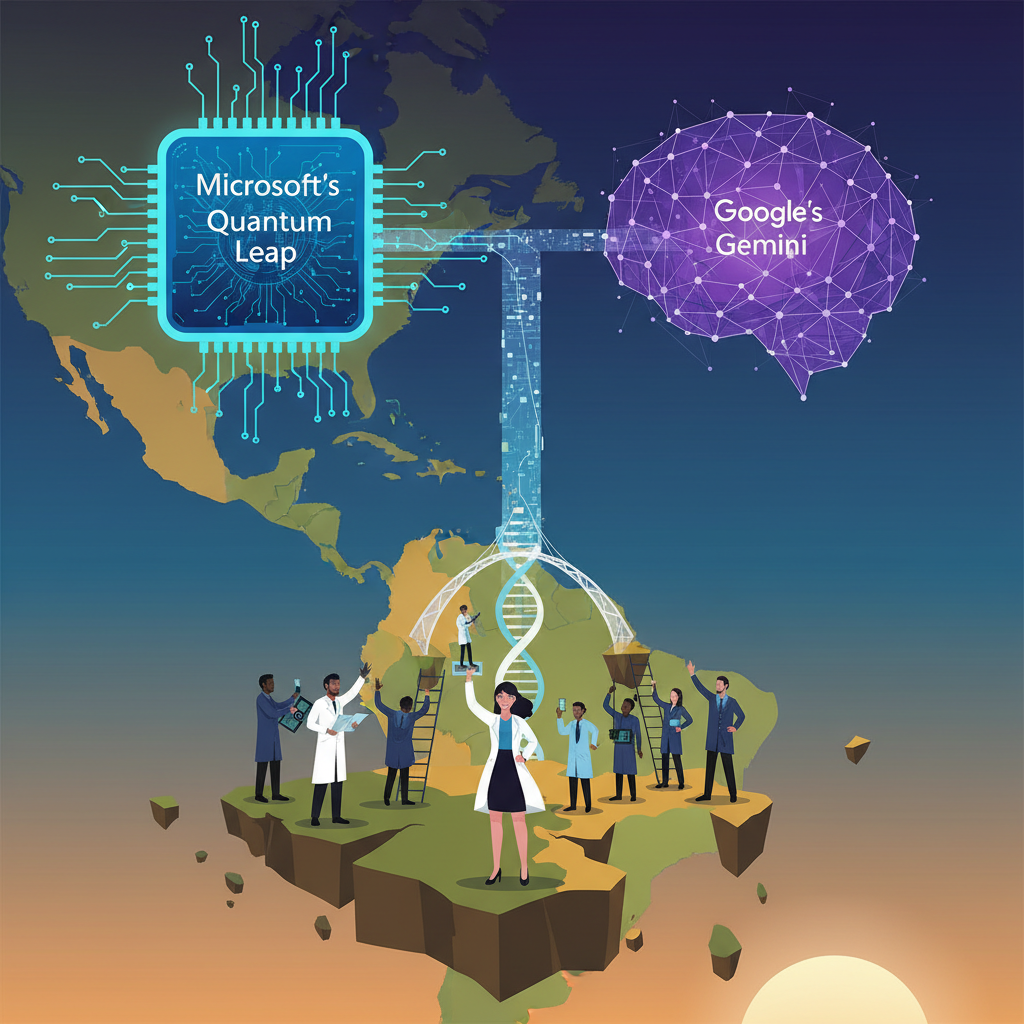
We hear about Microsoft's Azure Quantum initiatives, about Google DeepMind's relentless pursuit of new AI frontiers, and about IBM's quantum processors pushing the boundaries of what is computationally possible. These are incredible feats of engineering and intellect, no doubt. But the narrative, the spotlight, almost always stays firmly fixed on Silicon Valley, on London, on Beijing. Mexico's AI story is not being told, until now. We have brilliant minds, passionate researchers, and a vibrant startup ecosystem ready to engage, but often, the resources, the infrastructure, and the recognition are simply not there.
Think about it: quantum AI could unlock cures for diseases that plague our communities, from dengue fever to diabetes, by simulating molecular interactions with unprecedented accuracy. It could optimize supply chains for our farmers, ensuring fresh produce reaches markets more efficiently and reducing waste. It could create new, sustainable energy solutions, vital for a region so vulnerable to climate change. The potential is not just theoretical; it is deeply, profoundly practical for every family in Latin America.
I recently spoke with Dr. Elena Vargas, a leading theoretical physicist at Unam, our National Autonomous University of Mexico. She told me, “The computational power that quantum AI promises could solve problems in minutes that would take classical supercomputers millennia. Imagine what that means for drug discovery, for climate modeling, for materials science. But access to these machines, to the talent, to the funding, remains a colossal barrier for researchers outside the established hubs.” Her words echo a sentiment I hear repeatedly: the talent is here, the ambition is here, but the playing field is far from level.
Some might argue that quantum computing is still too nascent, too experimental, to warrant such immediate concern for equitable access. They might say that Latin American nations should focus on more immediate, tangible technological needs, like expanding broadband access or improving digital literacy. And yes, those are crucial, foundational steps. La tecnología es para todos, yes, but that includes the most advanced technology too. We cannot afford to wait until the quantum AI revolution is fully mature before we demand a seat at the table. By then, the rules will have been set, the intellectual property locked down, and the chasm between the tech-rich and tech-poor will have widened beyond repair.
Consider the economic implications. The global market for quantum computing alone is projected to reach tens of billions of dollars within the next decade, with quantum AI applications forming a significant portion of that. If our region is merely a consumer, we will be importing solutions, paying licensing fees, and perpetually playing catch-up. If we are active participants, developing our own algorithms, building our own talent pools, and fostering our own quantum AI startups, we can create high-value jobs, attract foreign investment, and drive economic growth that genuinely benefits our people. We have seen the nearshoring boom bring manufacturing closer to home; now imagine a brain-shoring boom, where our intellectual capital becomes our most valuable export.
Moreover, the very nature of AI, even classical AI, is shaped by the data it is trained on and the perspectives of its creators. If quantum AI is developed predominantly by a narrow demographic, it risks inheriting and amplifying existing biases, creating solutions that do not understand or serve the diverse needs of our populations. We need quantum AI that speaks Spanish, that understands Indigenous languages, that recognizes the nuances of our cultures. We need algorithms designed with our unique challenges in mind, from urban planning in sprawling megacities like Guadalajara to agricultural optimization in rural Oaxaca.
“The ethical frameworks for quantum AI are still being written,” observed Dr. Ricardo Peña, a data ethicist at the Tecnológico de Monterrey. “If we are not part of that conversation from the beginning, if our values and concerns are not represented, then we risk a future where these incredibly powerful tools are deployed without a full understanding of their societal impact, especially in developing economies.” His point is critical: the future of this technology is not just about scientific breakthroughs, it is about who gets to define its purpose and its guardrails.
So, what do we do? We must demand greater investment in quantum AI research and development within Latin America. This means more funding for universities, more scholarships for students, and more partnerships with international tech leaders like NVIDIA and OpenAI, but on terms that ensure knowledge transfer and local capacity building. We need to create quantum AI incubators and accelerators, fostering a new generation of entrepreneurs who can translate groundbreaking research into tangible solutions. We must advocate for open access to quantum computing resources, perhaps through regional consortia or shared infrastructure initiatives, ensuring that a researcher in Bogotá has the same opportunities as one in Boston.
This is not a plea for charity; it is a strategic imperative. The world needs diverse voices and perspectives in the development of technologies as transformative as quantum AI. Latin America, with its rich cultural tapestry, its unique challenges, and its boundless human potential, has an invaluable contribution to make. We cannot afford to be spectators in this next great technological leap. We must be players, innovators, and leaders. The future of quantum AI is not just about qubits and algorithms; it is about people, about justice, and about ensuring that la tecnología es para todos, truly and unequivocally. The time to build that future is now, before the quantum gates close on us forever. For more on the global AI landscape, you can always check out Reuters Technology News or TechCrunch AI for the latest developments. And for a deeper dive into the societal implications, Wired's AI section often provides excellent insights.