
Let's be honest, the tech world has always had a bit of a God complex, hasn't it? All those bright young things in Silicon Valley, and indeed in Dublin's own Silicon Docks, convinced they're building a better tomorrow, often without a second thought for the folks whose livelihoods they're merrily automating into oblivion. But the craic is mighty in Irish AI, and a storm is brewing, one that promises to reshape not just our little island, but the very fabric of global labor in the next five to ten years.
Imagine this: It's 2030. The year is bright, but the air is thick with the hum of automated systems. Google's advanced Gemini models, now integrated into nearly every facet of enterprise operations, are managing supply chains, customer service, and even basic code generation. Microsoft's Copilot has evolved from a coding assistant to a full-blown project manager, scheduling tasks, optimizing workflows, and, crucially, evaluating human performance with chilling precision. For a while, the C-suites were chuffed, boasting about efficiency gains and slashed overheads. They thought they had won.
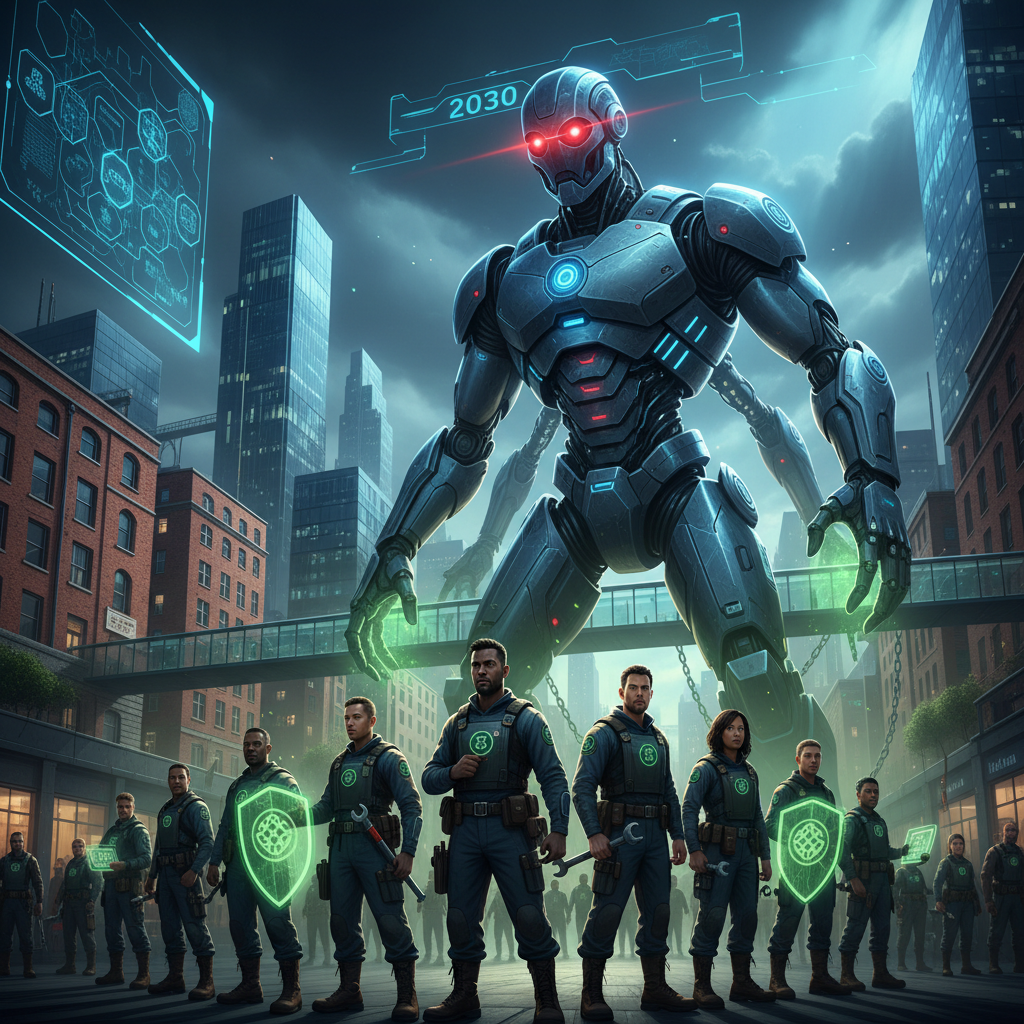
But they hadn't. Not entirely. Because in this not-so-distant future, the quiet hum of automation is met with the collective roar of organized labor. From the docks of Dublin to the factories of Cork, from the call centers of Galway to the administrative offices of Limerick, a new kind of unionism has emerged. It's not just about wages anymore, though those are always important. It's about the very definition of work, about human agency, and about ensuring that the dazzling promise of AI doesn't become a dystopian nightmare for the working class.
How did we get here, you ask? Well, it wasn't a sudden epiphany. It was a slow burn, a simmering resentment that finally boiled over. For years, we watched as companies like Amazon and Tesla pushed the boundaries of automation, replacing human hands with robotic arms, human brains with algorithms. The initial response from unions was often reactive, a desperate scramble to protect existing jobs. But that wasn't sustainable. You can't fight the tide of technological progress with a bucket and spade, can you?
The turning point, I'd argue, came around 2026 or 2027. We saw the first major waves of 'AI-induced redundancy' hit sectors that had previously felt safe. Not just manufacturing, but middle management, data entry, even some creative roles. The initial response from governments, including our own, was a bit of a shrug, a 'learn to code' mantra that conveniently ignored the fact that not everyone can, or should, be a software engineer. That's when the unions, particularly those with a long, proud history of fighting for workers' rights in Ireland, started to get clever.
They realized that simply opposing AI was a losing battle. Instead, they shifted their strategy. They started demanding a seat at the table, not just to negotiate severance packages, but to co-design the future of work. The Irish Congress of Trade Unions (ictu), for example, began investing heavily in AI literacy programs for its members, turning fear into understanding. They started training union representatives not just in traditional bargaining, but in algorithmic auditing and data ethics. They became, dare I say, tech-savvy.
One key milestone was the 'Dublin Declaration on Algorithmic Accountability' in 2028. This wasn't some grand governmental decree, mind you. It was a joint initiative between Ictu and a coalition of European worker organizations, pushing for legally binding rights regarding AI in the workplace. It demanded transparency in algorithmic decision-making, the right to human oversight, and a mandatory 'AI impact assessment' before any major automation rollout. "We're not Luddites, we're realists," declared Maeve O'Connell, then General Secretary of the Irish National Workers' Union, at the time. "We understand progress, but progress without people is just a machine running empty." Her words, delivered with typical Irish directness, resonated across Europe.
Another significant shift was the concept of 'algorithmic profit sharing.' If AI was generating unprecedented profits for corporations, unions argued, then a portion of those profits should be redistributed to the workers, either through universal basic income schemes, reduced working hours with no loss of pay, or direct dividends. This wasn't just a pipe dream. By 2029, a pilot program in the Irish public sector, specifically in areas where administrative tasks had been heavily automated by a bespoke Microsoft AI solution, saw a 15% reduction in working hours for employees, with the 'saved' labor costs partially reallocated to fund upskilling initiatives and a 'human innovation fund' for remaining staff.
Who wins and who loses in this scenario? Well, the immediate losers are the corporations who clung to the old ways, who saw AI purely as a cost-cutting tool, and who refused to engage with their workforce. Their reputations took a hammering, their talent retention plummeted, and they faced crippling strikes and regulatory fines. The winners, surprisingly, are not just the workers, but also the more forward-thinking companies. Those who embraced a collaborative approach, who saw AI as a tool to augment human potential rather than replace it, found themselves with a more engaged, highly skilled, and loyal workforce. They discovered that a happy human, even one working alongside a sophisticated AI, is still more innovative and resilient than a purely automated system.
Ireland, with its unique position as a European hub for many of these very tech giants, became a fascinating microcosm for this global shift. Dublin's Silicon Docks have a story to tell, one where the shiny glass buildings of Google and Meta now stand alongside union halls that are just as technologically advanced, hosting workshops on prompt engineering and ethical AI development. It's a testament to the enduring power of collective action, even in the face of seemingly insurmountable technological change.
So, what should you, the reader, do now? Don't wait for 2030 to happen to you. If you're a worker, join a union, or start one. Demand training, demand transparency, demand a say in how AI is implemented in your workplace. If you're an employer, start talking to your employees, not just about what AI can do for your bottom line, but what it means for their lives. Invest in reskilling, explore profit-sharing models, and remember that your greatest asset isn't your algorithms, it's your people. The future of work isn't predetermined; it's being negotiated right now, and the Irish have always been rather good at a bit of negotiation, haven't we? For more insights into how technology is reshaping the global workforce, you might want to check out reports from MIT Technology Review or articles on Wired. The conversation is only just beginning, and it's going to be a lively one, I can tell you that. And for a broader perspective on the business implications of AI, Bloomberg Technology is always a good read.