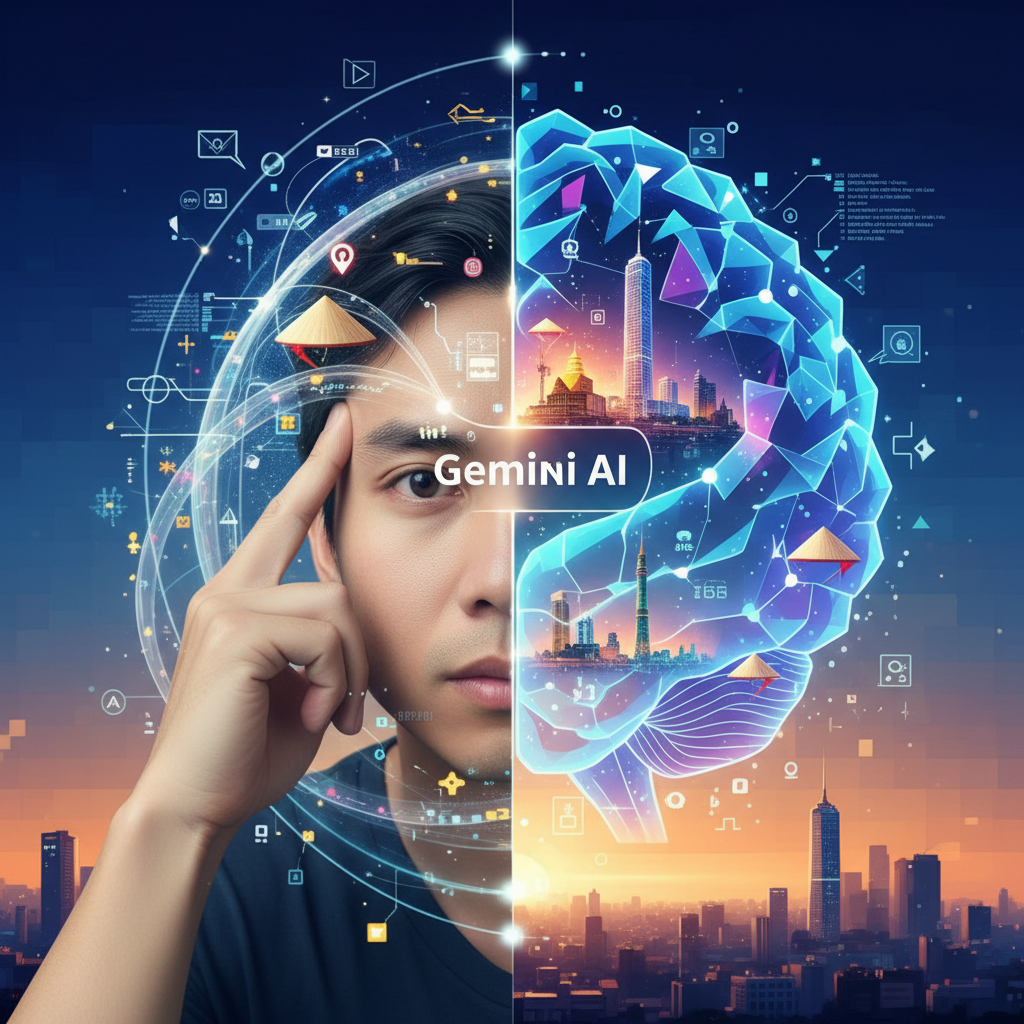

Chào bạn, my dear readers at DataGlobal Hub! It is Ngo Thi Huừngé here, and oh, do I have a story for you today, one that buzzes with the vibrant energy of Ho Chi Minh City itself. We are living in a time of incredible technological acceleration, aren't we? Every day, it feels like a new frontier is being crossed, and right now, the spotlight is firmly on multimodal AI. Specifically, I am talking about Google Gemini and its incredible capabilities, and how this race against OpenAI's GPT models is not just about computing power, but about something far more profound: how we, as humans, think, learn, and even remember.
Imagine this: My Aunt Mai, a woman who has seen more changes in Vietnam than most history books can capture, recently got a new smartphone. She is not a tech enthusiast, not by any stretch of the imagination. But one afternoon, her grandson, little Khoa, showed her how to point her phone at a wilting cây mai (apricot blossom tree, so important for Tết) in her garden. He asked Gemini, through a simple voice command in Vietnamese, 'Why is my tree sick?' Instantly, Gemini analyzed the image, cross-referenced it with common plant diseases in our region, and suggested a specific type of organic fertilizer available at the local chợ. Aunt Mai, with her lifelong wisdom of gardening, was utterly captivated. It was not just text, it was sight and sound, all working together. This is not just a fancy trick; it is a fundamental shift in how we access information and solve problems.
This scenario, repeated in countless variations across Vietnam and indeed, the world, is at the heart of a fascinating psychological phenomenon. For decades, our digital interactions were largely text-based. We typed, we read. Then came images, then video. But multimodal AI, like Google Gemini, integrates these senses seamlessly. It can understand context from an image, answer questions about it verbally, and even generate new content that blends these modalities. This is a cognitive leap, and researchers are just beginning to understand its implications.
Dr. Lê Thị Thu Thủy, a cognitive psychologist at Vietnam National University, Ho Chi Minh City, shared her insights with me. 'Our brains are naturally multimodal,' she explained. 'We perceive the world through a symphony of senses. Traditional computing often forced us to compartmentalize, to translate visual information into text, or vice versa. Multimodal AI removes these artificial barriers, potentially making interaction more intuitive and less cognitively demanding. However, it also raises questions about how we process and retain information when the AI does so much of the heavy lifting.'
Indeed, the ease of access is a double-edged sword. When Gemini can instantly identify a plant disease from a photo, or translate a street sign in real time, are we still engaging the same cognitive processes that build long-term memory and critical thinking skills? Some studies suggest that over-reliance on external cognitive tools, even advanced ones, could lead to a decline in certain internal cognitive functions. It is like using a GPS for every journey; eventually, your internal map of the city might not be as sharp. A recent paper published in Nature Machine Intelligence explored the impact of AI assistance on human problem-solving, highlighting both efficiency gains and potential risks to cognitive autonomy.
But let us not be pessimistic. I am Ngo Thi Huừngé, and I see the future, and it is bright! This is not about replacing human cognition, but augmenting it. Think of the potential for education. Children in remote villages, who might struggle with reading complex texts, can now interact with educational content that combines spoken explanations, vivid images, and even interactive simulations, all powered by multimodal AI. This could democratize learning in ways we have only dreamed of. Imagine a student learning about the history of the Lý Dynasty, not just by reading, but by seeing ancient artifacts, hearing expert commentary, and even virtually walking through a reconstructed Thăng Long citadel, all facilitated by Gemini's ability to understand and generate across modalities.
This is where Vietnam is the dark horse of AI. Our young, tech-savvy population is embracing these tools with an enthusiasm that is truly infectious. Startups here are already exploring how multimodal AI can enhance everything from agricultural diagnostics to personalized language learning. For instance, a local company, Fpt.ai, is integrating multimodal capabilities into their customer service solutions, allowing them to understand not just what a customer says, but also their emotional state from voice patterns and even visual cues from video calls. This kind of nuanced understanding was once the exclusive domain of human interaction, but now, AI is stepping in to enhance it.
However, the psychological implications extend beyond individual cognition. Multimodal AI also shapes our relationships and sense of reality. When an AI can generate hyper-realistic images and videos based on simple text prompts, or even mimic human voices with uncanny accuracy, how do we discern truth from fabrication? The race between Google Gemini and OpenAI's GPT models, and Anthropic's Claude, is not just about who has the most parameters; it is about who can build these systems responsibly, with safeguards against misuse. As Sundar Pichai, CEO of Google, has often emphasized, the development of AI must be guided by principles of safety and helpfulness. He stated in a recent interview, 'We have a profound responsibility to get this right, to ensure AI benefits everyone and is developed safely and ethically.' This sentiment resonates deeply, especially in a region like Southeast Asia, where digital literacy levels vary widely.
What can we do, then, as individuals navigating this brave new multimodal world? First, cultivate critical thinking. Always question the source, even if it feels incredibly real. Second, practice digital hygiene. Take breaks from constant AI interaction. Engage your own senses, your own memory, your own problem-solving skills. Third, embrace the augmentation, but do not surrender your autonomy. Use AI as a tool, not as a crutch. Ho Chi Minh City never sleeps, especially its coders, and they are building incredible things. But our human minds, with their unique capacity for creativity, empathy, and critical thought, remain our most precious asset. Let us ensure that this exciting AI revolution enhances, rather than diminishes, these essential human qualities. The future is multimodal, and it is calling us to be more thoughtful, more discerning, and more human than ever before. This startup just changed the game, and we are all part of it, my friends. We are all part of this grand experiment in human-AI co-evolution. For more on the ethical considerations of AI, you might find this article on AI ethics insightful.