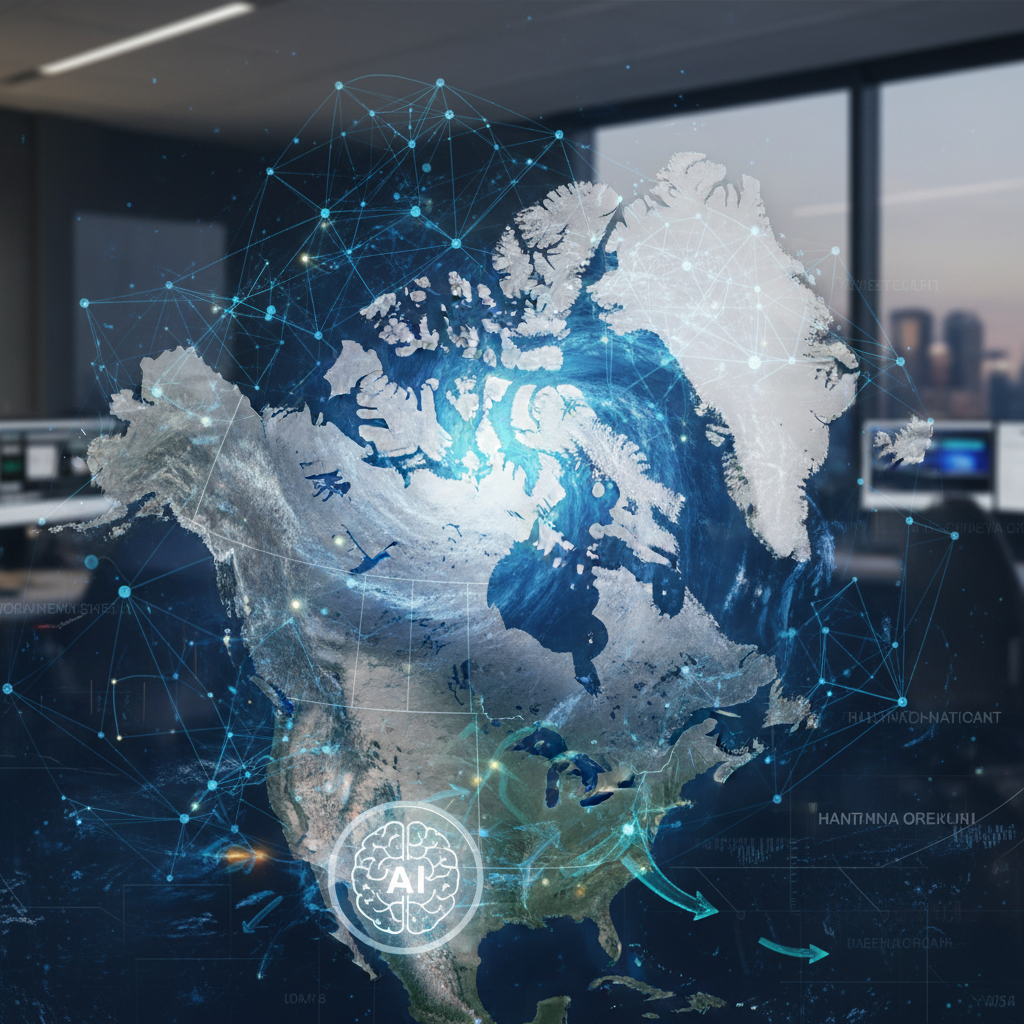

For generations, predicting the weather has been a blend of art, science, and a healthy dose of crossed fingers, especially here in Canada. Our winters are legendary, our summers can be scorching, and our coastlines face everything from hurricanes to atmospheric rivers. Traditional numerical weather prediction, or NWP, has served us well, built on complex physics equations and supercomputers the size of small houses. But let me tell you, a new player has entered the arena, and it is changing the game entirely: AI weather forecasting.
Imagine a weather forecast that is not just more accurate, but also faster to produce, allowing for critical extra hours or even days of preparation for blizzards, floods, or heatwaves. This is no longer a futuristic dream. Companies like Google DeepMind, with their groundbreaking GraphCast model, and Huawei's Pangu-Weather, have demonstrated an astonishing capability to predict global weather patterns with unprecedented accuracy, often outperforming the gold standard of European Centre for Medium-Range Weather Forecasts (ecmwf) models. We are talking about orders of magnitude improvement in some metrics, a truly seismic shift.
The Technical Challenge: Taming Atmospheric Chaos
Predicting the weather is, at its core, a massive multi-physics simulation problem. The Earth's atmosphere is a chaotic system, governed by fluid dynamics, thermodynamics, and radiative transfer. Traditional NWP models discretize the Earth into a grid, solving billions of differential equations at each grid point. This requires immense computational power, often running on national supercomputing centers like those used by Environment and Climate Change Canada. The computational cost means trade-offs: either higher resolution for smaller areas or longer forecast horizons with coarser resolution.
AI models, however, approach this differently. Instead of explicitly solving physics equations, they learn the underlying dynamics directly from vast historical weather datasets. Think of it like this: instead of writing down every single rule for how a hockey puck moves on ice, an AI watches millions of hockey games and learns to predict its trajectory based on past observations. This data-driven approach allows for incredible speed and, crucially, the ability to capture complex, non-linear interactions that might be computationally prohibitive for traditional models.
Architecture Overview: Graph Neural Networks to the Rescue
The secret sauce for many of these advanced AI weather models lies in their architecture, particularly the use of Graph Neural Networks (GNNs). Unlike traditional convolutional neural networks (CNNs) that operate on regular grids, GNNs are designed to process data structured as graphs, where nodes represent entities and edges represent relationships between them. This is a perfect fit for global weather data.
Imagine the Earth's surface and atmosphere as a gigantic, interconnected graph. Each node in this graph could represent a point on a weather grid, carrying information about temperature, pressure, humidity, wind speed, and direction at various atmospheric levels. The edges connect neighboring points, allowing the model to learn how changes at one location influence others. This allows the model to capture both local dynamics and long-range teleconnections, like how a change in ocean temperature off the coast of British Columbia might eventually influence winter patterns across the prairies.
Let me break down what Mila just published in a recent pre-print, building on similar concepts. Their proposed architecture, often called a 'graph-based mesh-to-mesh' transformer or encoder-decoder, typically involves several key components:
- Encoder: Takes the current state of the atmosphere, represented as a high-dimensional tensor (grid data), and projects it onto a lower-dimensional graph representation. This might involve downsampling and creating nodes with aggregated features.
- Processor (Graph Neural Network): The core of the model. This GNN iteratively passes messages along the graph's edges, updating the node features. Each message pass allows information to propagate across the simulated atmosphere, mimicking physical interactions. This is where the model learns the complex atmospheric dynamics.
- Decoder: Takes the processed graph representation and projects it back onto a high-resolution grid, outputting the predicted future state of the atmosphere.
This entire process is designed to be highly parallelizable, making it incredibly efficient on modern GPU architectures. NVIDIA's latest H100 GPUs, for example, are perfectly suited for the massive matrix multiplications and graph operations involved.
Key Algorithms and Approaches
The training of these models is a monumental undertaking. They are trained on decades of reanalysis data, which combines historical observations with NWP model outputs to create a consistent, comprehensive record of past weather. For instance, GraphCast was trained on 40 years of ECMWF's ERA5 reanalysis data, a dataset so vast it would make your hard drive weep.
Here's a conceptual look at the training objective:
# Conceptual training loop for an AI weather model

for epoch in range(num_epochs):
 for batch in training_data:
 # Input: Current atmospheric state (e.g., t=0)
 input_state = batch['input_features']

# Target: Future atmospheric state (e.g., t+6 hours)
 target_state = batch['target_features']

# Predict future state using the GNN model
 predicted_state = model(input_state)

# Calculate loss (e.g., Mean Squared Error) between prediction and target
 loss = calculate_loss(predicted_state, target_state)

# Backpropagate and update model weights
 loss.backward()
 optimizer.step()
 optimizer.zero_grad()
# Conceptual training loop for an AI weather model

for epoch in range(num_epochs):
 for batch in training_data:
 # Input: Current atmospheric state (e.g., t=0)
 input_state = batch['input_features']

# Target: Future atmospheric state (e.g., t+6 hours)
 target_state = batch['target_features']

# Predict future state using the GNN model
 predicted_state = model(input_state)

# Calculate loss (e.g., Mean Squared Error) between prediction and target
 loss = calculate_loss(predicted_state, target_state)

# Backpropagate and update model weights
 loss.backward()
 optimizer.step()
 optimizer.zero_grad()
The loss function often includes not just mean squared error on atmospheric variables, but also terms that encourage physical consistency, though this is an active area of research. The models learn to predict not just a single future state, but often multiple steps into the future, effectively learning to 'roll out' the weather evolution.
Implementation Considerations and Practicalities
Building and deploying such a system is no small feat. Data preprocessing is critical, as historical weather data comes in various formats and resolutions. Standardization and interpolation are necessary to feed it into a consistent graph structure. Furthermore, the sheer volume of data necessitates distributed training frameworks like PyTorch Distributed or TensorFlow Distributed.
One practical consideration is the trade-off between model complexity and inference speed. While larger models tend to be more accurate, they also require more computational resources for prediction. For operational forecasting, speed is paramount. A 10-day forecast that takes 2 hours to compute is less useful than one that takes 2 minutes. Google DeepMind's GraphCast, for example, can generate a 10-day forecast in less than a minute on a single TPUv4 machine, a feat unimaginable with traditional NWP at comparable resolution.
Another challenge is handling extreme events. While AI models excel at average conditions, their performance during rare, high-impact events like a 'polar vortex' plunging into the Canadian prairies needs careful validation. The models learn from past data, and if certain extreme events are underrepresented, their predictive power might diminish.
Benchmarks and Comparisons: The Proof is in the Prediction
When we talk about 'orders of magnitude' improvement, what does that actually mean? For a 6-hour forecast lead time, AI models can achieve accuracy comparable to traditional NWP models, but the real magic happens at longer lead times. For example, GraphCast has shown to be more accurate than the ECMWF's Integrated Forecasting System (IFS) for medium-range forecasts (3-10 days) on over 90% of 1380 verification targets, including variables like temperature, pressure, and wind speed. This is a monumental achievement.
Consider the Canadian context: a 24-hour lead time on a severe winter storm warning can mean the difference between life and death, or millions of dollars saved in infrastructure and transportation. If AI can consistently extend that lead time to 48 or 72 hours, the societal benefits are immense. "The research is fascinating, and the early results are compelling," says Dr. Anya Sharma, a senior research scientist at Environment and Climate Change Canada. "We're seeing improvements in skill scores that were previously thought to be years away. It's not just incremental gains, it's a paradigm shift."
Code-Level Insights: Frameworks and Patterns
For those looking to dive deeper, the ecosystem of tools is maturing rapidly. PyTorch Geometric (PyG) and Deep Graph Library (DGL) are excellent libraries for building GNNs. For large-scale data handling, Apache Parquet and Zarr are often used for storing multi-dimensional weather data efficiently. The models themselves are typically implemented in PyTorch or TensorFlow, leveraging their distributed training capabilities.
A common pattern involves using a DataLoader to feed sequences of atmospheric states to the GNN, allowing it to learn the temporal evolution. For example:
import torch
import torch_geometric.data

class WeatherGraphDataset(torch_geometric.data.Dataset):
 def __init__(self, data_paths, transform=None):
 # Load and preprocess data from multiple time steps
 pass

def get(self, idx):
 # Return a Data object representing a single atmospheric state
 # with features (nodes) and connectivity (edges)
 pass

# Example of a simple GNN layer
class GraphConvBlock(torch.nn.Module):
 def __init__(self, in_channels, out_channels):
 super().__init__()
 self.conv = torch_geometric.nn.GCNConv(in_channels, out_channels)
 self.norm = torch.nn.LayerNorm(out_channels)

def forward(self, x, edge_index):
 x = self.conv(x, edge_index)
 x = self.norm(x)
 return torch.nn.functional.relu(x)
import torch
import torch_geometric.data

class WeatherGraphDataset(torch_geometric.data.Dataset):
 def __init__(self, data_paths, transform=None):
 # Load and preprocess data from multiple time steps
 pass

def get(self, idx):
 # Return a Data object representing a single atmospheric state
 # with features (nodes) and connectivity (edges)
 pass

# Example of a simple GNN layer
class GraphConvBlock(torch.nn.Module):
 def __init__(self, in_channels, out_channels):
 super().__init__()
 self.conv = torch_geometric.nn.GCNConv(in_channels, out_channels)
 self.norm = torch.nn.LayerNorm(out_channels)

def forward(self, x, edge_index):
 x = self.conv(x, edge_index)
 x = self.norm(x)
 return torch.nn.functional.relu(x)
This snippet barely scratches the surface, but it illustrates the modular nature of building these complex models. The real challenge is scaling this to global weather data and ensuring numerical stability over many prediction steps.
Real-World Use Cases: Beyond Just Temperature
The impact of hyper-accurate AI weather forecasting extends far beyond knowing whether to bring an umbrella. Here in Canada, where resource industries are vital, the applications are transformative:
- Agriculture: Farmers in Saskatchewan can optimize planting and harvesting schedules, predict frost risks with higher confidence, and manage irrigation more efficiently, leading to better yields and reduced waste. A 10% improvement in yield due to better weather prediction could translate to hundreds of millions for the Canadian economy.
- Energy Sector: Hydroelectric power generation in Quebec relies heavily on precipitation forecasts. Better predictions mean optimizing reservoir levels, reducing spill, and ensuring stable power supply. For wind and solar farms, accurate wind speed and cloud cover forecasts are crucial for grid integration and energy trading.
- Disaster Preparedness: From coastal communities in Nova Scotia bracing for hurricanes to remote Indigenous communities in the North preparing for extreme cold, extended lead times save lives and reduce property damage. Emergency services can pre-position resources, and evacuation orders can be issued with greater certainty.
- Transportation: Airlines can optimize flight paths to avoid turbulence and severe weather, saving fuel and improving safety. Shipping companies navigating the Great Lakes or the Arctic can plan routes more effectively, reducing transit times and risk. "Montreal's AI scene is world-class, here's the proof," remarked Dr. Isabelle Dubois, CEO of a Montreal-based AI startup specializing in climate risk assessment. "Our collaborations with local research hubs are pushing the boundaries of what's possible, providing crucial tools for industries across the country."
Gotchas and Pitfalls: The Human Element Remains
While the promise is immense, there are 'gotchas'. One significant concern is interpretability. When a GNN predicts a major storm, can we understand why it made that prediction? Unlike physics-based models where we can trace the influence of specific atmospheric processes, AI models can sometimes be black boxes. This lack of transparency can be a barrier to trust, especially in high-stakes situations.
Another pitfall is the reliance on historical data. If climate change introduces entirely new weather patterns, patterns not present in the training data, AI models might struggle to adapt. Continuous retraining with new data and incorporating climate model outputs will be essential. Also, the infrastructure required to run these models, particularly the massive GPU clusters, is itself a significant investment and energy consumer, raising questions about sustainability.
Finally, the human element in forecasting remains crucial. AI models are powerful tools, but human meteorologists bring invaluable experience, local knowledge, and the ability to synthesize information from multiple sources, including satellite imagery and ground observations, to make nuanced decisions. The future is likely a hybrid approach, where AI provides the backbone of the forecast, and human experts refine and interpret it.
Resources for Going Deeper
For those eager to explore this field further, I highly recommend digging into the original papers. Google DeepMind's GraphCast paper is a must-read, available on arXiv. For broader context on AI in climate science, the MIT Technology Review often publishes excellent analyses. Exploring open-source weather datasets like ERA5 and the various GNN libraries will also provide hands-on experience. The field is moving incredibly fast, and staying current means embracing continuous learning. This isn't just a technological advancement, it's a fundamental shift in how we understand and prepare for the world around us.
The future of weather forecasting, particularly for a country as geographically diverse and weather-impacted as Canada, looks increasingly bright, thanks to the relentless innovation in AI. We are truly entering an era where the unpredictability of nature might just meet its match in the power of artificial intelligence. It is a thrilling prospect, and one that demands our continued attention and ethical consideration.