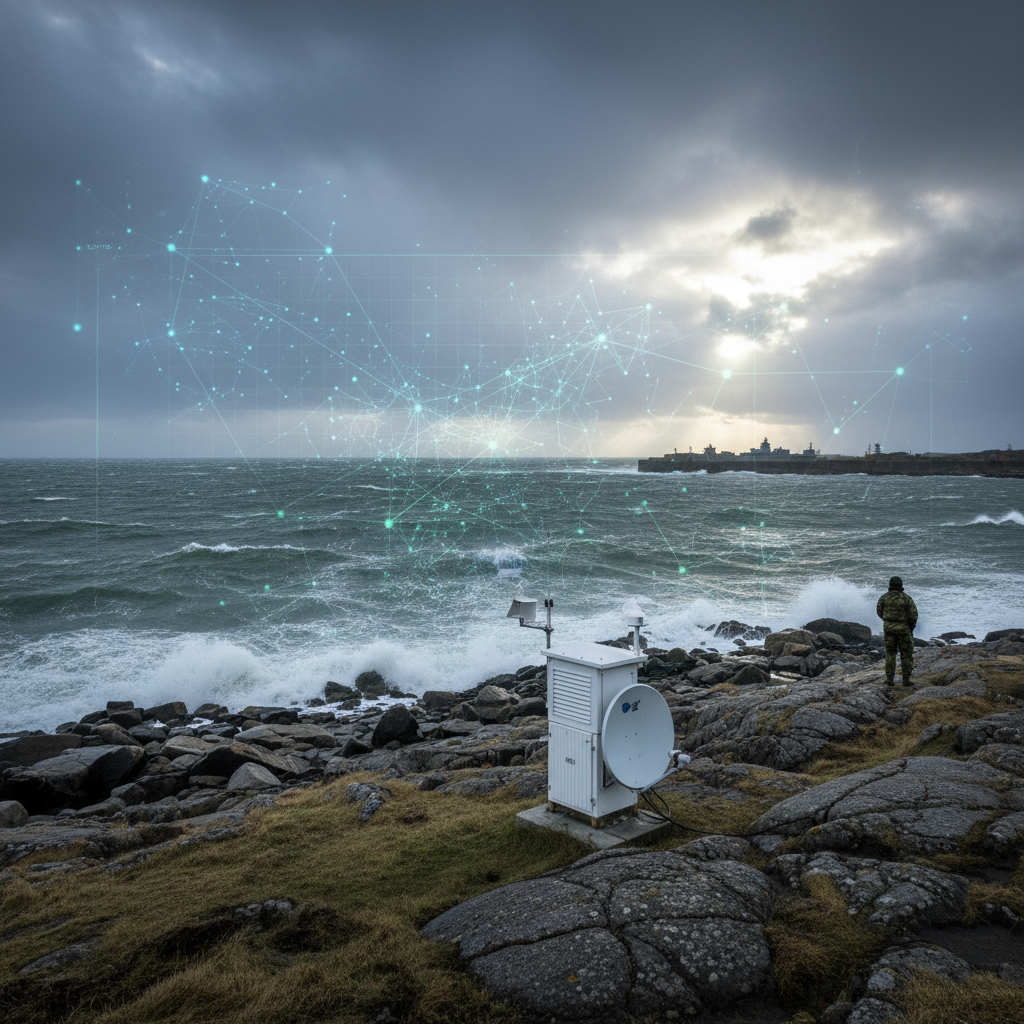
The forecasts are growing increasingly dire. From the unprecedented wildfires that scorched parts of Sweden in 2018 to the recent flooding events that have challenged our infrastructure, the climate crisis is not an abstract concept here; it is a tangible, immediate threat. Against this backdrop, the emergence of AI-powered climate modeling, particularly systems like Google DeepMind's GraphCast, has been hailed as a potential game-changer. The promise is clear: predict extreme weather events with a precision previously unimaginable, offering crucial lead times for preparedness and mitigation.
However, as a journalist based in Sweden, I find it imperative to look beyond the enthusiastic headlines and examine the practical implications, the underlying data, and the inherent limitations of such advanced systems. The question is not merely if these models work, but how well, for whom, and what are the unseen trade-offs. Scandinavian data paints a clearer picture, and it often reveals complexities that Silicon Valley's optimistic narratives tend to gloss over.
Google DeepMind, a subsidiary of Alphabet, made significant waves with GraphCast, a neural network model designed for medium-range weather forecasting. Unlike traditional numerical weather prediction (NWP) models that rely on complex physics equations, GraphCast learns directly from historical weather data. It processes vast datasets, identifying patterns that allow it to predict future atmospheric conditions with remarkable speed and, in some cases, superior accuracy to established systems. Initial reports, including those published in Science, indicated that GraphCast could outperform the European Centre for Medium-Range Weather Forecasts (ECMWF)'s high-resolution operational forecast on 90 percent of 1,380 test variables, and do so in a fraction of the computational time. This is not a minor improvement; it represents a fundamental shift in methodology.
For a nation like Sweden, with its extensive coastline, dense forests, and reliance on hydropower, accurate weather forecasting is not a luxury, it is an economic and societal imperative. Extreme weather events, whether blizzards, heatwaves, or torrential rains, directly impact agriculture, energy production, transportation, and public safety. A few extra hours, or even days, of warning can mean the difference between minor disruption and catastrophic loss. Imagine the impact on our Baltic Sea shipping lanes, for example, if severe storms could be predicted with high confidence days in advance, allowing vessels to reroute or shelter more effectively.
“The potential for AI models like GraphCast to enhance our national resilience is undeniable,” states Dr. Elin Gustafsson, head of climate adaptation at the Swedish Meteorological and Hydrological Institute (smhi). “We are actively exploring how these new capabilities can complement our existing, highly robust NWP systems. The speed of these AI models is particularly attractive for rapid updates and ensemble forecasting, but the interpretability of their predictions remains a critical area of research for us.” Dr. Gustafsson’s emphasis on interpretability highlights a recurring concern with black-box AI systems: their internal workings are often opaque, making it difficult to understand why a particular prediction was made, or when it might be unreliable.
This lack of transparency is not merely an academic curiosity. In defense and security contexts, where climate modeling informs strategic decisions, understanding the provenance and certainty of a forecast is paramount. Nato, for instance, has increasingly focused on climate change as a threat multiplier, impacting everything from troop deployment to resource allocation. If an AI model predicts an unprecedented weather event that could jeopardize military operations or critical infrastructure, commanders need to know the confidence level of that prediction, and the potential failure modes of the AI itself. The Swedish model suggests a different approach, one that prioritizes robust validation and transparent methodologies, especially when lives and national security are at stake.
Let's look at the evidence. While GraphCast's performance has been impressive, it is important to remember that these models are still in their nascent stages of operational deployment. Traditional NWP models, developed over decades, incorporate a deep understanding of atmospheric physics and are continuously refined by meteorologists globally. AI models, by contrast, are data-driven; their accuracy is intrinsically linked to the quality and breadth of the historical data they are trained on. If the training data does not adequately represent future climate anomalies or novel weather patterns, the AI's predictive power could diminish. As climate change accelerates, we are entering uncharted meteorological territory, which poses a significant challenge for purely data-driven approaches.
“While the computational efficiency of models like GraphCast is revolutionary, we must exercise caution,” cautions Professor Lars Johansson, a climate scientist at Stockholm University. “The sheer volume of data required to train these models, and the energy consumption associated with that training, cannot be overlooked. We must also consider the potential for algorithmic bias. If historical data disproportionately represents certain regions or weather phenomena, the model might perform less accurately in underrepresented areas, or for events it has not 'seen' before. This is particularly relevant for diverse geographies like Sweden, where local microclimates can vary dramatically.” Professor Johansson's point underscores the ethical and practical dimensions of deploying such powerful AI systems.
The computational demands are indeed substantial. Training a large-scale AI model like GraphCast requires immense processing power, often relying on specialized hardware like NVIDIA's GPUs. This not only comes with a significant carbon footprint, a concern for Sweden’s sustainability goals, but also raises questions about access and equity. Will smaller nations or research institutions be able to leverage these cutting-edge tools, or will they remain largely within the domain of tech giants with vast computational resources? MIT Technology Review has frequently highlighted the growing energy consumption of AI, a critical consideration for any climate-focused application.
Furthermore, the integration of these AI models into existing operational frameworks presents its own set of hurdles. Smhi, like other national meteorological services, operates a complex ecosystem of models, observation networks, and human expertise. Replacing or even fully integrating a black-box AI into this system requires extensive validation, calibration, and trust-building. It is not simply a matter of plugging in a new algorithm. The human element, the experienced meteorologist who interprets forecasts, understands local conditions, and communicates risks to the public, remains irreplaceable.
Consider the recent discussions around the EU AI Act, which aims to regulate high-risk AI systems. Climate modeling, especially when used for public safety and critical infrastructure decisions, would undoubtedly fall under this category. This means developers and deployers of such AI systems would face stringent requirements for data governance, transparency, human oversight, and robustness. For companies like Google DeepMind, navigating these regulatory landscapes, particularly in Europe, will be as crucial as their scientific breakthroughs. Reuters has covered extensively the implications of the EU AI Act for global tech companies.
Ultimately, the promise of AI-powered climate modeling is immense, but its deployment must be approached with a healthy dose of Scandinavian pragmatism. The ability to predict extreme weather with unprecedented accuracy could save lives, protect property, and enhance societal resilience. However, we must ensure these powerful tools are developed and implemented responsibly, with transparency, rigorous validation, and a clear understanding of their limitations. The pursuit of technological advancement should not overshadow the need for ethical governance and robust human oversight. Only then can Sweden, and indeed the world, truly harness the potential of AI to confront the escalating climate crisis.