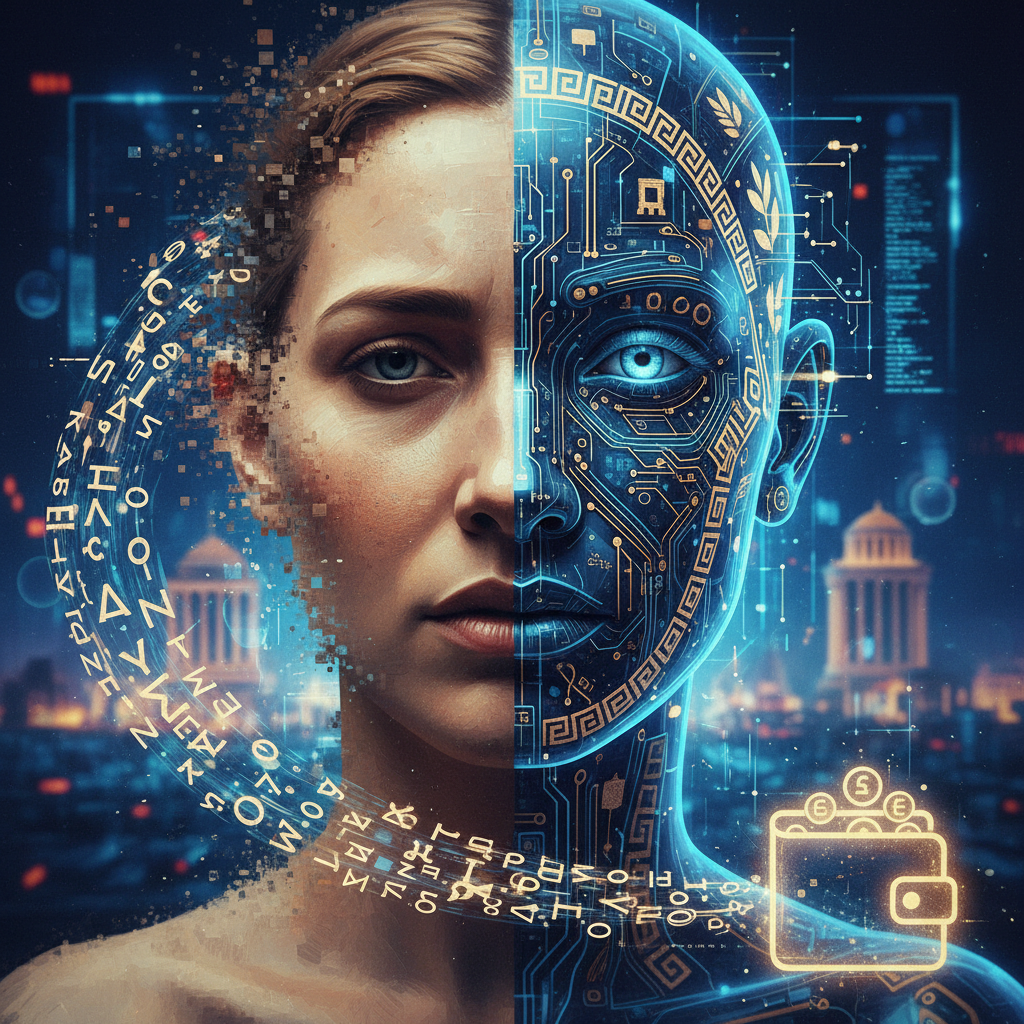

My niece, Eleni, a bright young woman with eyes that still hold the Aegean’s sparkle, recently showed me her latest obsession. It wasn’t a pop star from Athens or a TikTok dancer from Mykonos. It was ‘Aella,’ a perfectly rendered digital being with flawless skin, eyes that shimmer like the sea at sunset, and a voice like liquid honey. Aella, Eleni explained, offered fashion advice, shared motivational quotes, and even seemed to understand her struggles with school pressure. “She’s so real, Theo,” Eleni insisted, using the casual Greek term for uncle, her face aglow with an admiration that felt, to me, unsettlingly genuine. This interaction, a quiet moment in a bustling Athenian cafe, brought into sharp focus a question that has been simmering in my mind for months: What happens to us, to our very psychology, when our idols are not flesh and blood, but lines of code and pixels?
The phenomenon of AI influencers, or virtual celebrities, has exploded globally, and Greece, with its deep connection to storytelling and visual culture, is no exception. These digital entities, often indistinguishable from humans to the casual observer, are designed using advanced generative AI models, like those from Meta’s Llama or OpenAI’s GPT, to create compelling personalities and engaging content. They post on Instagram, TikTok, and YouTube, garnering millions of followers, securing lucrative brand deals, and shaping trends. Lil Miquela, arguably the pioneer in this space, boasts millions of followers and has collaborated with major fashion houses, reportedly earning significant sums. But beyond the glitz and the commercial success, what are the cognitive and emotional repercussions of this digital embrace?
Recent research is beginning to shed light on this complex interplay. A study published in MIT Technology Review highlighted that users often form parasocial relationships with AI influencers that are remarkably similar to those formed with human celebrities. This means feelings of attachment, trust, and even intimacy can develop, despite the user knowing the influencer is not real. The algorithms behind these virtual beings are incredibly sophisticated, designed to learn from interactions, personalize responses, and even simulate empathy. They can remember past conversations, adapt their tone, and present an idealized, always-available persona, free from the inconsistencies and flaws of human interaction.
Dr. Sofia Kontou, a prominent social psychologist at the University of Athens, has been vocal about the potential long-term effects. “We are witnessing a fascinating, yet potentially perilous, experiment in human connection,” she told me during a recent symposium. “These AI influencers are engineered for perfection, for constant positive reinforcement. They never have a bad day, they never disappoint, and they are always ‘on.’ For young people especially, who are still developing their sense of self and navigating complex social dynamics, this can create an unrealistic benchmark for human relationships. It risks fostering a preference for curated, flawless digital interaction over the messy, authentic, and ultimately more rewarding connections with real people.” Dr. Kontou emphasized that the continuous exposure to such idealized figures could subtly shift our expectations of what a ‘friend’ or ‘role model’ should be, leading to increased dissatisfaction with genuine human relationships.
From a cognitive perspective, our brains are remarkably adept at suspending disbelief, particularly when presented with highly realistic stimuli. The uncanny valley effect, where something almost human but not quite, triggers unease, is rapidly being overcome by advancements in AI graphics and natural language processing. When an AI influencer offers a comforting word or a piece of advice, our brains process it, at least initially, in a similar way to human communication. The constant availability and personalized nature of these interactions can create a powerful sense of connection, blurring the lines between the digital and the real. This is particularly concerning when considering the persuasive power these entities wield. If an AI influencer endorses a product or a lifestyle, the perceived trustworthiness, even if subconsciously, can be immense.
The broader societal implications are vast and multifaceted. In Greece, where community and personal relationships have always been the bedrock of our culture, this shift towards digital companionship raises profound questions. Will the younger generations, accustomed to the curated perfection of AI friends, find it harder to engage in the give and take of real-world friendships? Will the emphasis on external validation, already amplified by social media, become even more acute when our digital idols are literally designed to be adored? The Mediterranean approach to AI is fundamentally different, I believe. We tend to prioritize the human element, the ethical considerations, and the societal impact above pure technological advancement. We ask not just ‘Can we build it?’ but ‘Should we build it, and how will it serve our communities?’
There is also the economic dimension. The virtual influencer market is projected to be worth billions globally, with companies like Meta and Google investing heavily in the underlying AI technologies. Brand partnerships with these digital entities offer a controlled, controversy-free marketing channel. However, this also means that the narratives and values promoted by these influencers are often dictated by corporate interests, not genuine human experience. As Dr. Andreas Pappas, a media ethics professor at the Aristotle University of Thessaloniki, noted, “When our cultural touchstones are designed by algorithms and funded by brands, we risk a homogenization of thought and a subtle erosion of independent critical thinking. The illusion of choice can be very powerful, but it is still an illusion.”
So, what practical advice can we offer to navigate this brave new world? First, cultivate critical media literacy. Understand that AI influencers are products, meticulously crafted to engage and persuade. Question the source, the intent, and the authenticity of the content. Encourage open conversations, especially with younger individuals, about the nature of these digital relationships and the differences between virtual and real connection. Second, prioritize genuine human interaction. Make time for face-to-face conversations, for shared experiences that build empathy and understanding. Remember the warmth of a Greek family meal, the spirited debates in a kafenio, the simple joy of a walk with a friend along the Athenian Riviera. These are irreplaceable. Third, support human creators and artists. In a world increasingly saturated with AI-generated content, valuing and investing in the unique perspectives and imperfections of human creativity becomes even more vital. We need to remember that Athens was the birthplace of democracy, now it is reimagining AI governance, and part of that involves safeguarding our humanity.
The rise of AI influencers is not merely a passing fad; it is a fundamental shift in how we perceive and interact with celebrity, community, and even ourselves. It is a mirror reflecting our desires for connection, perfection, and constant validation. As we move further into this digital age, the challenge for us, particularly here in Greece with our rich history of humanism, is to ensure that while technology advances, our humanity does not recede. We must learn to discern the authentic from the artificial, to embrace the beautiful imperfections of real life, and to remember that true connection, like the ancient olive trees that dot our landscape, takes time, effort, and deep roots to flourish. The future, as always, is not just about what we build, but about who we become in the process. For more insights into the societal impact of AI, you can explore articles on Wired's AI section. We must not let the allure of digital perfection overshadow the profound beauty of human reality. The conversation, like our history, is long and complex, and it has only just begun. For a broader perspective on AI's business implications, Reuters Technology offers valuable reporting.