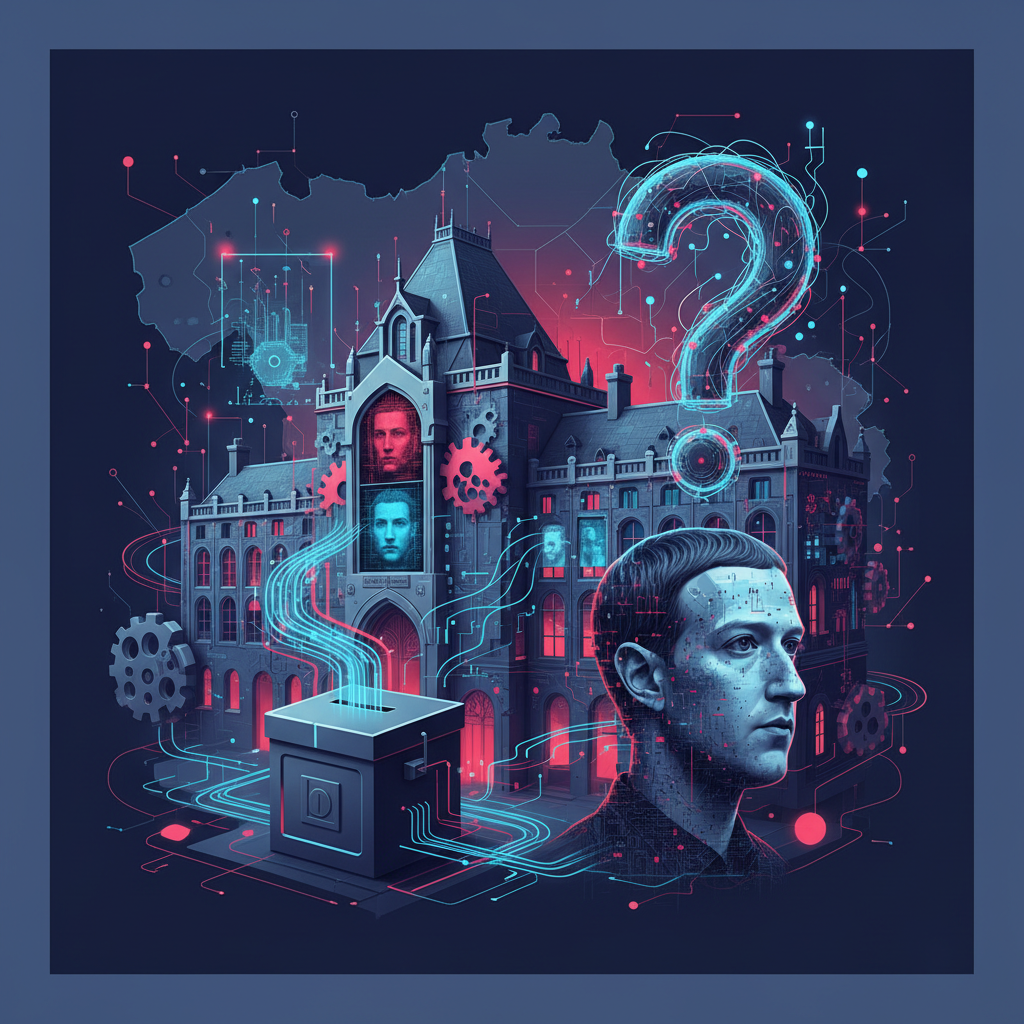

The digital landscape of political discourse has always been fraught with peril, yet the advent of sophisticated AI-generated deepfakes introduces a new, insidious dimension. We are no longer merely contending with misinformation, but with fabricated realities that blur the lines between truth and deception. Is this a fleeting technological novelty or the new, grim normal for democratic elections worldwide, including our own in Belgium?
Historically, political campaigns have employed various forms of propaganda, from doctored photographs to carefully edited speeches. The infamous 'Daisy' advertisement from the 1964 US presidential election, while not a deepfake, demonstrated the potent emotional impact of manipulated media. In Belgium, our political history, often characterized by intricate coalition building and nuanced linguistic divides, has largely been spared the overt, aggressive disinformation campaigns seen in larger nations. Our public sphere, while vibrant, tends towards a more measured, if sometimes convoluted, debate. However, the current capabilities of generative AI, particularly models from entities like OpenAI and Meta, promise a scale and sophistication of deception previously unimaginable.
Consider the recent data. A report by the European Union Agency for Cybersecurity, Enisa, published in late 2025, noted a 450% increase in detected deepfake content related to political figures globally in the preceding 12 months. While a significant portion of this content was quickly identified and removed by platform providers, the sheer volume and speed of generation are alarming. According to a separate analysis by the Oxford Internet Institute, deepfake videos and audio clips targeting electoral processes were viewed an estimated 3.7 billion times across major social media platforms in 2025 alone, a staggering figure that underscores the challenge.
Brussels has questions and so should you. The European Parliament, in its ongoing deliberations on the implementation of the AI Act, has specifically identified deepfakes in electoral contexts as a 'high-risk' application of artificial intelligence. This classification mandates stringent transparency requirements, including clear labeling of AI-generated content, and robust risk mitigation systems for developers and deployers of such AI. But is regulation alone enough when the technology is advancing at an exponential rate?
“The speed at which these deepfakes can be created and disseminated far outstrips the capacity of human moderators, or even current automated detection systems, to keep pace,” stated Dr. Elise Dubois, a lead researcher at the Belgian Institute for Digital Governance, during a recent symposium in Ghent. “We are talking about highly convincing simulations of speech, appearance, and mannerisms that can be produced for pennies, making widespread, targeted disinformation campaigns incredibly accessible.” Dr. Dubois’s team recently demonstrated how a commercially available AI tool, similar to those offered by Google DeepMind or Adobe, could generate a plausible, albeit entirely fabricated, video of a prominent Belgian politician endorsing a fringe party, all within an hour.
The implications for a multilingual nation like Belgium are particularly acute. Deepfakes can be generated in Dutch, French, and German with increasing fluency, exploiting linguistic nuances and regional sentiments. The potential for a deepfake to sow discord between communities, or to falsely attribute inflammatory statements to a leader, could destabilize the delicate balance of our political landscape. “It is not merely about identifying a fake, but about the erosion of public trust that occurs even when a deepfake is debunked,” observed Professor Marc Van der Velde, a political communication expert at the Université libre de Bruxelles. “The doubt, once planted, is difficult to remove. This is the true threat to our democratic foundations.”
Indeed, the challenge extends beyond mere detection. Major tech companies, including Meta and Google, have invested heavily in deepfake detection technologies and content moderation teams. Mark Zuckerberg, CEO of Meta, has publicly affirmed his company's commitment to combating electoral interference, stating in a recent policy brief, “We are continually enhancing our AI systems to identify and flag manipulated media, working closely with electoral commissions and fact-checking organizations globally.” Yet, the cat-and-mouse game continues, with generative AI models constantly evolving to bypass existing safeguards.
The EU's approach deserves more credit than it gets. The Digital Services Act, for instance, places significant responsibility on large online platforms to mitigate systemic risks, including those arising from disinformation. Coupled with the AI Act, this creates a comprehensive, albeit complex, regulatory framework. However, enforcement remains a formidable hurdle. How does a small Belgian municipality, preparing for local elections, effectively monitor and respond to a sophisticated deepfake campaign originating from outside its borders, perhaps even from a state actor? The resources and expertise required are substantial.
My verdict is this: AI-generated deepfakes in elections are unequivocally the new normal. This is not a fad that will dissipate with improved detection algorithms. It is a fundamental shift in the information warfare landscape. The ease of creation, the persuasive power, and the difficulty of definitive debunking mean that every future election will contend with this threat. Belgian pragmatism meets AI hype, and the former must now adapt with unprecedented speed and foresight.
For our democracy to endure this algorithmic assault, a multi-pronged strategy is essential. This includes continued investment in robust, open-source deepfake detection technologies, fostering media literacy among the populace, and establishing clear, legally enforceable penalties for those who create and disseminate malicious deepfakes targeting electoral processes. Furthermore, international cooperation, particularly within the European Union, is paramount. No single nation, least of all one as interconnected as Belgium, can tackle this challenge in isolation. The integrity of our democratic institutions depends on our collective ability to distinguish reality from its increasingly convincing digital simulacrum. For more on the broader implications of AI on society, one might consult analyses on MIT Technology Review or follow the latest developments in AI policy on Reuters. The battle for truth in the digital age is just beginning, and it demands our full, unwavering attention. We cannot afford to be complacent, not when the very fabric of our democratic process is at stake. The challenge is immense, but the alternative is unthinkable, a future where reality itself is up for popular vote, manipulated by unseen algorithms. For a broader perspective on how AI impacts various sectors, consider the discussions on TechCrunch.