
The world of artificial intelligence often feels like a distant thunder, rumbling from the data centers of California or the research labs of Beijing. We here in Iceland, perched on the edge of the Arctic, tend to watch these developments with a pragmatic eye. We've seen enough technological fads come and go to know that real impact, the kind that changes how we live and work, usually comes quietly, almost unnoticed, until it's too late to ignore. This time, it's about language, and it's anything but quiet.
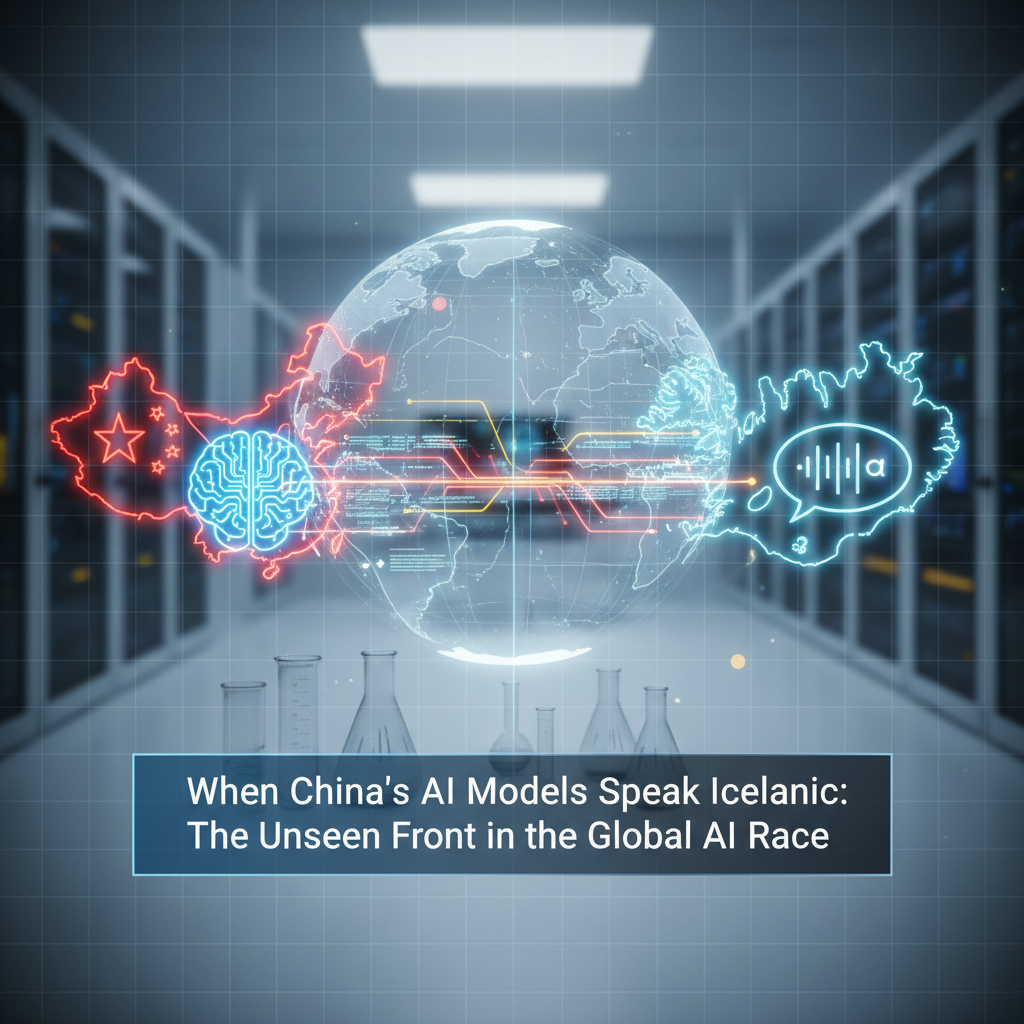
Recently, a research paper from Tsinghua University caught my attention. It wasn't about a new, impossibly large foundation model or a breakthrough in quantum computing. No, this was about something far more subtle, yet potentially more impactful for a small nation like ours: cross-lingual model adaptation. Specifically, the team, led by Professor Jie Tang, demonstrated remarkable progress in efficiently adapting large language models, originally trained on massive English or Mandarin datasets, to perform complex tasks in low-resource languages. Imagine a Chinese-developed AI, not just translating Icelandic, but understanding the nuances of our sagas, the subtle humor of our everyday speech, and the specific context of our unique culture. That's what they are getting closer to.
The Breakthrough in Plain Language
For years, the biggest hurdle for AI in languages like Icelandic has been data. Large language models, or LLMs, are data-hungry beasts. They learn by devouring vast amounts of text. English, with its billions of web pages, books, and articles, is a feast. Icelandic, with its 370,000 speakers, is more like a single, carefully rationed fish. Training a powerful LLM from scratch on Icelandic data alone is computationally expensive, if not impossible, given the limited resources. This is where the Tsinghua research, published in a recent Nature Machine Intelligence issue, offers a clever workaround.
Their approach, which they term 'Parameter-Efficient Cross-Lingual Transfer', focuses on fine-tuning only a small fraction of a pre-trained model's parameters, rather than retraining the entire behemoth. Think of it like this: instead of building a new car for every country, they've figured out how to quickly swap out the steering wheel and adjust the suspension for local roads, using the same powerful engine. This method drastically reduces the computational cost and the amount of language-specific data needed. They showed that by using smart architectural modifications and targeted linguistic injection, they could achieve performance in tasks like sentiment analysis, question answering, and summarization in languages with very few training examples, approaching the levels of models trained on much larger datasets. This is a game-changer for languages like Icelandic, which historically have been left behind in the AI race.
Why It Matters: Beyond Translation
This isn't just about better translation software. It's about sovereignty, cultural preservation, and economic opportunity. If the most advanced AI tools can only truly function in English or Mandarin, then the future of information, commerce, and even governance risks being shaped exclusively by those linguistic and cultural perspectives. That's a future we in Iceland, and many other small nations, need to consider carefully.
“The ability to adapt powerful AI models to diverse languages is not just a technical challenge, it’s a geopolitical one,” stated Dr. Anna-Maria Wagner, a computational linguist at the University of Helsinki, in a recent interview with a European tech publication. “Nations that can effectively deploy AI in their native tongues will have a significant advantage in areas from education to national security.” Her point is well taken. Imagine an AI assistant for our Althingi, our parliament, that understands the nuances of Icelandic legal texts, or an AI tutor that can explain complex subjects to our children in their mother tongue, respecting our unique pedagogical approaches. These are not trivial applications.
The Technical Details (Accessible)
The core of the Tsinghua team's work revolves around a technique called 'adapter modules'. Instead of modifying the entire neural network of a large pre-trained model, they insert small, specialized neural network layers, or 'adapters', into the model's architecture. These adapters are then trained on the target language data, while the vast majority of the original model's parameters remain frozen. This means the model retains its general knowledge learned from massive datasets, but gains specific linguistic proficiency without needing to be rebuilt from the ground up.
They also experimented with different strategies for 'cross-lingual alignment', essentially teaching the model how concepts in one language map to concepts in another. One particularly effective method involved using a small, high-quality parallel corpus (texts translated between the source and target language) to align the semantic spaces. This allows the model to leverage its existing knowledge base more effectively. The results published in their paper indicated that for several low-resource languages, including some European ones, their adapted models achieved up to 80% of the performance of models trained natively on large datasets, using only a fraction of the computational resources and data. This is a significant leap forward in efficiency.
Who Did the Research
The primary research was conducted by a team at Tsinghua University's Department of Computer Science and Technology, with Professor Jie Tang as a senior author. Their work builds upon years of research in natural language processing and machine learning, particularly in the domain of transfer learning and multilingual models. Tsinghua has consistently been a leader in AI research, often publishing groundbreaking work in top-tier conferences and journals. Their focus on practical applications and efficiency is notable, reflecting a broader trend in Chinese AI research towards deployable, impactful technologies. You can often find their latest papers on arXiv.
Implications and Next Steps
For Iceland, and indeed for all small nations, this research presents both a challenge and an opportunity. The challenge is that the 'AI arms race' is not just about who builds the biggest model first, but who can make their models speak the most languages, and most effectively. If a major power can deploy culturally attuned AI across the globe, it influences everything from media consumption to political discourse. This is a form of soft power, and it's potent.
However, it also offers an opportunity. Small nations have big advantages in AI when it comes to focused, high-quality data. Our language, while small in speaker count, is rich and well-documented. We have a strong tradition of linguistic preservation and digital archiving. By leveraging these strengths, and by collaborating with research institutions that are developing these parameter-efficient methods, we can ensure that Icelandic AI is not just a translation layer, but a truly native experience.
In Iceland, we think differently about this. We understand that our language is not just a means of communication, it's a cornerstone of our identity. Protecting it in the age of AI means actively participating in its development, not just being passive recipients of technology developed elsewhere. This means investing in local AI talent, supporting research into Icelandic language models, and advocating for open standards that allow for easy adaptation and fine-tuning.
Consider the Icelandic startup, Miðeind ehf., which has been at the forefront of developing Icelandic language technology for years. Their work on tools like Greynir, an Icelandic parser, and their contributions to open-source Icelandic datasets, are invaluable. This new research from Tsinghua could provide them with powerful new methods to scale their efforts, making sophisticated Icelandic AI more accessible and affordable. The future of AI in Iceland, and for other small linguistic communities, will depend on how effectively we can harness these global breakthroughs while maintaining our unique linguistic and cultural integrity. It's a delicate balance, but one we are well-equipped to manage, perhaps with a touch of that geothermal approach to computing, powering our efforts sustainably and uniquely. The race is on, and it's speaking more languages than ever before.