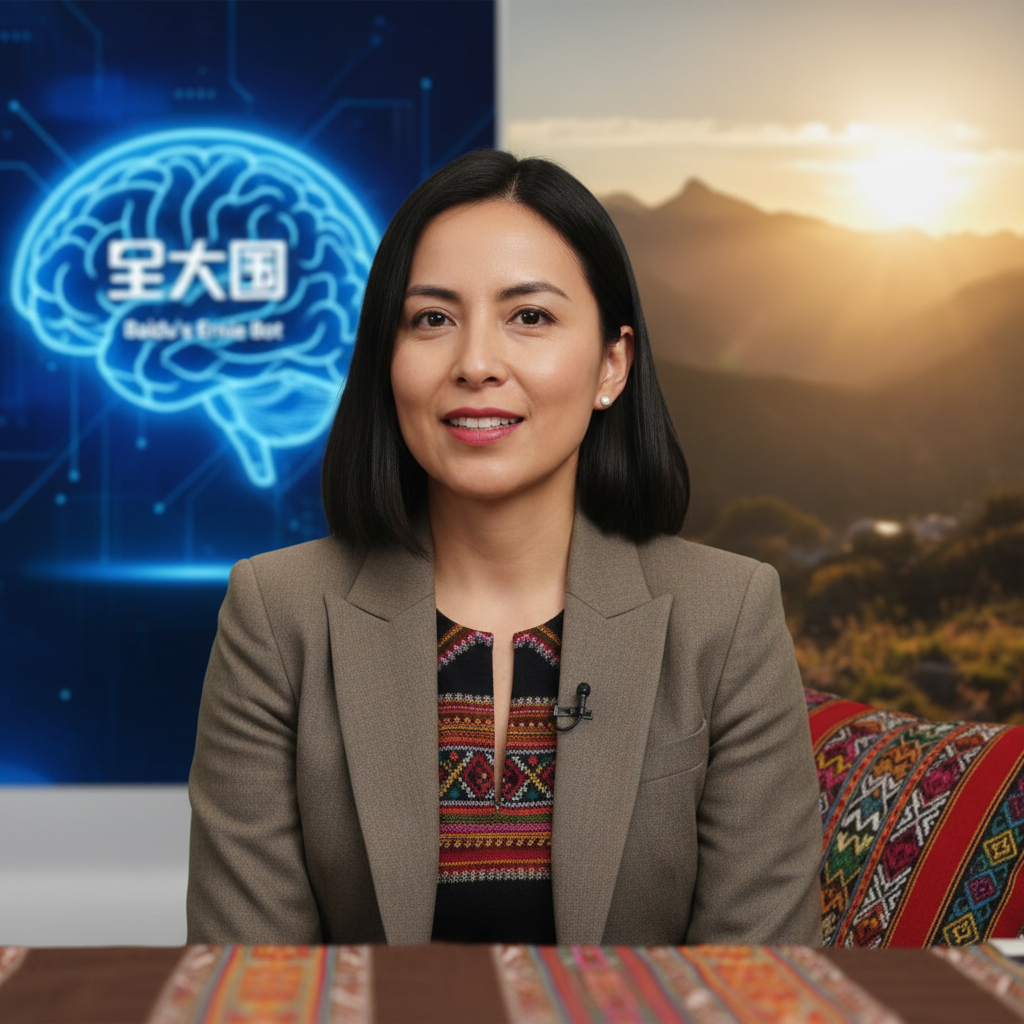

The air in Miraflores was thick with the scent of ceviche and the distant murmur of the Pacific Ocean, a familiar comfort that always grounds me. But inside the sleek, minimalist office of Dr. Elena Rojas, the atmosphere hummed with a different kind of energy, one that spoke of algorithms, data, and the future of nations. Dr. Rojas, a Peruvian-born, MIT-trained AI ethicist who spent a decade working in Beijing, now leads the newly formed Centro Peruano de Innovación Digital, a think tank advising the Peruvian government on technology policy. Her eyes, framed by stylish glasses, held both the sharp intellect of a researcher and the quiet contemplation of someone who has seen the world from many angles.
“Ximènà, it’s a pleasure to finally meet you,” she said, her voice soft but firm, offering me a cup of coca tea. “I’ve followed your work on indigenous knowledge and AI. It’s vital.” She showed me something that changed my understanding of how a nation can approach technological advancement, particularly in the realm of artificial intelligence.
We were there to discuss China’s AI governance model, a topic often viewed with suspicion in the West, yet one Dr. Rojas believes holds valuable lessons for developing nations like Peru. “We cannot simply import Silicon Valley’s libertarian ideals without considering our own societal fabric, our history, and our priorities,” she began, gesturing towards a large screen displaying a complex infographic comparing AI regulatory frameworks. “China’s model, while undoubtedly centralized, has facilitated an incredible pace of innovation. Companies like Baidu, Tencent, and Alibaba have not just grown, they have transformed daily life for hundreds of millions of people, often with explicit state guidance and support.”
I pressed her on the implications for individual freedoms and data privacy, concerns that often surface when discussing state-controlled AI. “It’s a valid concern, and one we must address with our own Peruvian lens,” Dr. Rojas acknowledged. “However, consider the sheer scale of data China generates and utilizes. Their approach to data collection and integration, while controversial elsewhere, allows for rapid iteration and improvement of AI models. For instance, Baidu’s Ernie Bot, their large language model, has benefited immensely from access to vast datasets, enabling it to compete with the likes of OpenAI’s GPT models. This kind of data-driven development is a powerful engine.”
She explained that the Chinese government often acts as a strategic partner, not just a regulator. “They identify national priorities, whether it’s smart cities, agricultural efficiency, or healthcare, and then direct resources and policies to accelerate AI development in those areas. This isn’t just about surveillance, although that’s part of the narrative. It’s also about national competitiveness and public service delivery.” She cited examples of AI being deployed for disaster prediction, traffic management, and even personalized education platforms, all under a unified national strategy.
“But what about the human element, Dr. Rojas?” I asked, thinking of the communities in the highlands of Peru, where ancient agricultural practices still thrive. “How does a top-down, state-controlled model account for the nuanced needs and cultural diversity of a country like ours, with its rich tapestry of indigenous communities?”
Her expression softened. “This is precisely where Peru must innovate, not imitate. We can learn from China’s efficiency in scaling AI, but we must embed our own values. Imagine AI tools, perhaps developed with the support of our Ministry of Agriculture and local universities, helping Quechua-speaking farmers predict weather patterns or optimize crop yields, using models trained on local ecological data. The state’s role could be to ensure equitable access, provide infrastructure, and protect against data exploitation, rather than simply enforcing a singular vision.”
Dr. Rojas introduced me to Dr. Mateo Quispe, a senior researcher at the Instituto Nacional de Investigación Agraria (inia), who is exploring how AI can support Peru’s diverse agricultural sector. “We are looking at how satellite imagery combined with local knowledge, passed down through generations, can inform AI models,” Dr. Quispe explained, his voice resonating with a deep respect for tradition. “For example, we are piloting a project in Cusco where AI analyzes soil data and historical climate records to advise on optimal planting times for native potato varieties. The goal is to enhance, not replace, the wisdom of our campesinos.” He emphasized that such projects require significant investment and a coordinated national effort, something he believes China’s model demonstrates effectively.
“The key,” Dr. Rojas interjected, “is that the state’s involvement should be about empowerment and preservation, not control for its own sake. We need a national AI strategy that reflects our unique identity. We can leverage public-private partnerships, perhaps with companies like Baidu or Tencent, but with strict data sovereignty clauses. Our data, especially that which reflects our biodiversity and cultural heritage, must remain ours.” She pointed out that while China’s model is often associated with surveillance, it also prioritizes national self-sufficiency in technology, a goal that resonates deeply in many developing countries.
Our conversation shifted to the practicalities. Dr. Rojas revealed that her center is advocating for the creation of a Consejo Nacional de Inteligencia Artificial, a multi-stakeholder body comprising government, academia, industry, and civil society, including indigenous representatives. “This council would be tasked with drafting Peru’s first comprehensive AI strategy, learning from global examples but always prioritizing Peruvian needs and values. We need to define our ‘red lines’ for data usage and algorithmic ethics from the outset,” she stated firmly. “We cannot afford to be passive recipients of technology developed elsewhere.”
I asked her about the challenges of implementing such a model in Peru, a country with its own political complexities and resource constraints. “It won’t be easy,” she admitted, a slight frown creasing her brow. “Infrastructure is a major hurdle. Digital literacy is another. But the alternative is to fall further behind. We are seeing countries like Brazil and Mexico also grappling with these questions, trying to find their own path between unchecked market forces and state overreach. The global AI landscape is not a monolith, and neither should our response be.” She believes that Peru, with its rich cultural heritage and strong community ties, could forge a unique path, marrying technological progress with social responsibility.
This is a story about ancient wisdom meeting modern AI, and the delicate dance between innovation and control. Dr. Rojas’s vision is not to replicate China’s model wholesale, but to distill its lessons on rapid development and national coordination, then infuse them with Peru’s own spirit of community and respect for tradition. “We have an opportunity to build an AI future that serves all Peruvians, from the bustling streets of Lima to the remote villages high in the Andes,” she concluded, her gaze unwavering. “It requires courage, foresight, and a deep understanding of who we are as a nation.” Her words echoed in the quiet office, a powerful reminder that technology, at its heart, is always about people, their dreams, and their future. The choices Peru makes today regarding AI governance will shape generations to come, and Dr. Rojas is determined to ensure those choices are made with wisdom and purpose, not just technological ambition. For more insights into global AI governance, consider exploring resources like MIT Technology Review or Reuters' AI section. The conversation around AI's societal impact is only just beginning, and Peru has a vital voice in it. You can also find more about emerging AI trends on TechCrunch's AI category.
Dr. Rojas’s perspective offers a compelling counter-narrative to the often black-and-white discussions around AI. It suggests that a nation’s unique context, its cultural values, and its developmental goals must guide its technological journey. For Peru, this means a careful consideration of how to harness the power of AI, perhaps even from models like Baidu’s Ernie Bot, while safeguarding its sovereignty, its people, and its profound heritage. The challenge is immense, but the potential rewards, if navigated wisely, are even greater. It’s a vision of AI that is not just smart, but also deeply peruano.