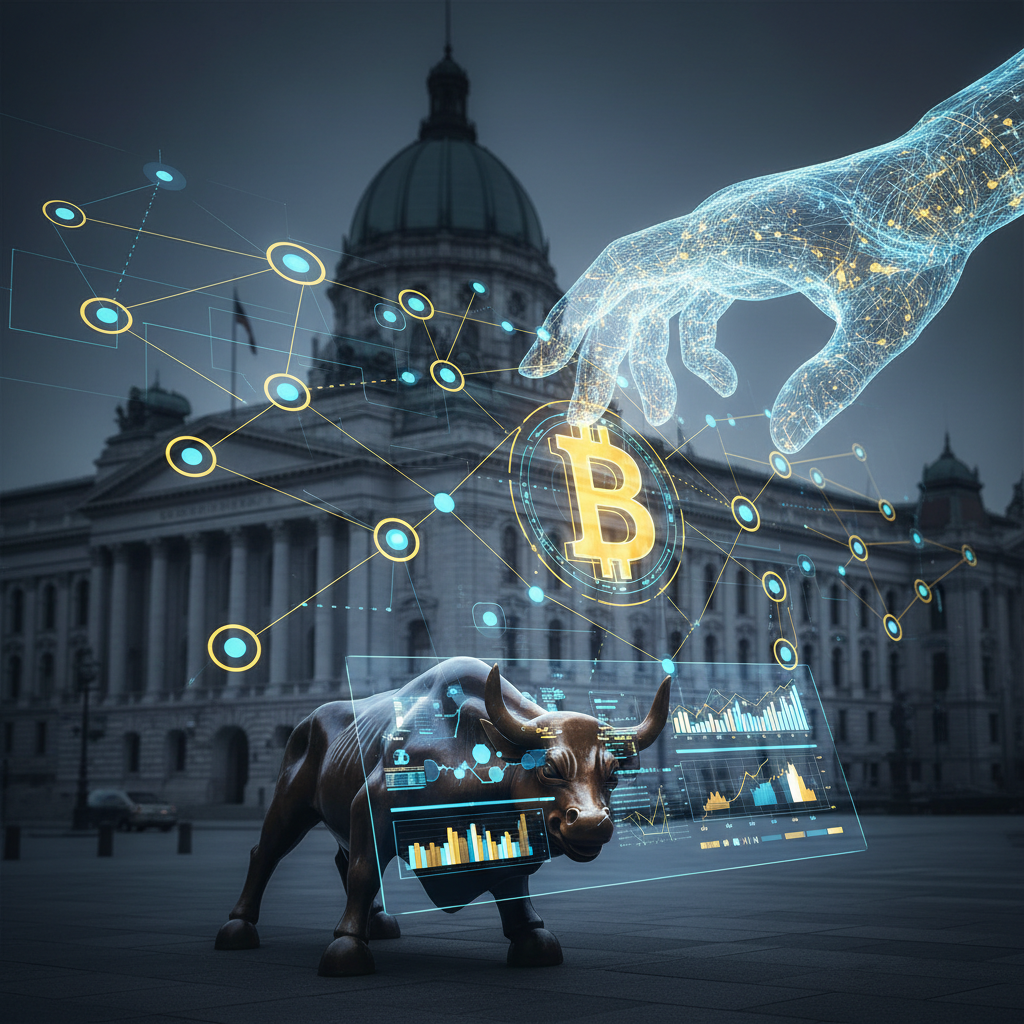
The clatter of the trading floor, the shouting, the frantic hand signals, it is all a romanticized relic of a bygone era. If you picture Wall Street or even the Budapest Stock Exchange today, you should be imagining silent server farms, humming with the invisible ballet of artificial intelligence. We are talking about algorithmic trading, a concept that has quietly, yet profoundly, reshaped global finance. But what exactly is this digital puppet master, and why should anyone outside the gilded cages of high finance care?
What is Algorithmic Trading?
At its heart, algorithmic trading, often shortened to algo-trading, is the use of computer programs to execute trades based on a predefined set of rules. These rules, or algorithms, can be simple, like 'buy 100 shares of Company X if its price drops below Y and sell if it rises above Z.' Or they can be incredibly complex, incorporating machine learning models that analyze vast datasets, predict market movements, and execute orders faster than any human ever could. It is not just about speed, although that is a huge part of it. It is about precision, consistency, and the ability to process information on a scale that defies human comprehension.
Why Should You Care?
Because whether you are a pension fund manager in Frankfurt, a small investor in Szeged, or simply someone whose economic well-being is tied to the stability of the global financial system, algo-trading affects you. It influences stock prices, market liquidity, and even volatility. When a flash crash happens, like the one in 2010 that wiped billions off the market in minutes, algorithms are often at the center of the storm. They can amplify trends, both up and down, and create feedback loops that are difficult for human regulators to understand, let alone control. The Hungarian perspective nobody wants to hear often points out that these sophisticated systems, while efficient, also centralize risk in ways we are only beginning to grasp.
How Did It Develop?
The journey to today's algorithmic dominance began subtly. Early forms of automated trading emerged in the 1970s with the advent of electronic communication networks, but these were largely about automating order routing, not decision-making. The real shift came with increased computing power, faster internet speeds, and the development of sophisticated mathematical and statistical models in the late 20th and early 21st centuries. Firms like Renaissance Technologies, founded by former NSA codebreaker Jim Simons, were pioneers, demonstrating that quantitative models could consistently outperform human traders. Their Medallion Fund, for instance, has generated average annual returns of over 66 percent before fees since 1988, a staggering testament to the power of algorithms. Bloomberg Technology often covers the secretive world of these quant funds.
Today, the landscape is dominated by high-frequency trading firms, large institutional investors, and even retail platforms that offer algorithmic tools. The lines between traditional trading and algorithmic execution have blurred almost entirely.
How Does It Work in Simple Terms?
Imagine a highly skilled chess player. Now imagine that player can analyze every possible move, every counter-move, and every future outcome for thousands of games simultaneously, all in the blink of an eye. That is a crude analogy for an algo-trader. It does not have emotions, it does not get tired, and it does not second-guess itself. It simply follows its programmed rules.
These rules can range from simple arbitrage strategies, exploiting tiny price differences between exchanges, to complex statistical arbitrage, identifying mispricings between related securities. Other algorithms might look for patterns in trading volume, news sentiment, or even satellite imagery of retail parking lots to predict company performance. The core idea is to identify opportunities and execute trades faster and more efficiently than human competitors. Think of it as a digital sniper, waiting for the perfect moment, then firing with unparalleled speed and precision.
Real-World Examples
-
High-Frequency Trading (HFT): This is perhaps the most visible and controversial application. HFT firms use ultra-low latency technology to execute millions of trades in fractions of a second. They might profit from tiny price discrepancies, provide liquidity, or even engage in strategies like 'spoofing' or 'layering' which regulators are constantly battling. Companies like Virtu Financial and Citadel Securities are titans in this space, reportedly executing a significant portion of all US equity trades.
-
Smart Order Routing (SOR): When you place an order with your broker, an SOR algorithm might decide the best exchange or trading venue to send your order to, considering factors like price, liquidity, and execution speed. This ensures you get the best possible price for your trade, even if you are not aware of the underlying complexity.
-
Algorithmic Risk Management: Beyond just executing trades, AI is crucial for managing the risks associated with these fast-paced strategies. Algorithms can monitor portfolios in real-time, detect unusual trading patterns, and even automatically halt trading if certain risk thresholds are breached. This is a critical safety net, though not always foolproof.
-
Robo-Advisors: While a distinct category, robo-advisors like those offered by Betterment or Wealthfront, or even some Hungarian fintech startups, rely heavily on algorithms. They use algorithms to build and rebalance diversified portfolios based on a client's risk tolerance and financial goals, offering automated investment advice at a lower cost than traditional human advisors. This democratization of investment management is a significant development, bringing sophisticated strategies to the average person.
Common Misconceptions
One common misconception is that algo-trading is inherently manipulative or unfair. While abuses certainly exist, and regulators are constantly playing catch-up, the majority of algorithmic trading serves legitimate functions like increasing market liquidity and efficiency. Another myth is that algorithms are infallible. They are not. They are only as good as the data they are fed and the rules they are programmed with. A flawed algorithm, or one operating on incorrect assumptions, can lead to significant losses or even market instability. The human element, albeit in programming and oversight, remains crucial.
Furthermore, many believe that algorithms understand the 'why' behind market movements. They do not. They are pattern recognition machines. They see correlations, not necessarily causation. This distinction is vital when considering their limitations, especially during unprecedented market events where historical data might be irrelevant.
What to Watch For Next
The future of algorithmic trading will be defined by several key trends. Expect even more sophisticated AI and machine learning models, capable of adapting and learning in real-time. This could lead to hyper-personalized trading strategies and more resilient risk management systems. Quantum computing, while still nascent, promises to revolutionize the speed and complexity of financial calculations, potentially making today's algorithms seem primitive. MIT Technology Review regularly explores these cutting-edge developments.
We will also see continued regulatory scrutiny. Brussels has a message for Wall Street: transparency and accountability are paramount. The EU's AI Act, for instance, will likely have ripple effects on how financial algorithms are designed, tested, and deployed, particularly those deemed 'high-risk.' The debate over whether algorithms should be required to explain their decisions, known as explainable AI or XAI, will intensify, especially as these systems become more autonomous.
Ultimately, the rise of algorithmic trading is not just a technological shift, it is a philosophical one. It challenges our understanding of markets, efficiency, and human control. Contrarian? Maybe. Wrong? Prove it. The question is no longer if algorithms will dominate finance, but how we, as a society, will learn to live with, regulate, and ultimately benefit from these powerful, unseen hands guiding the world's wealth.