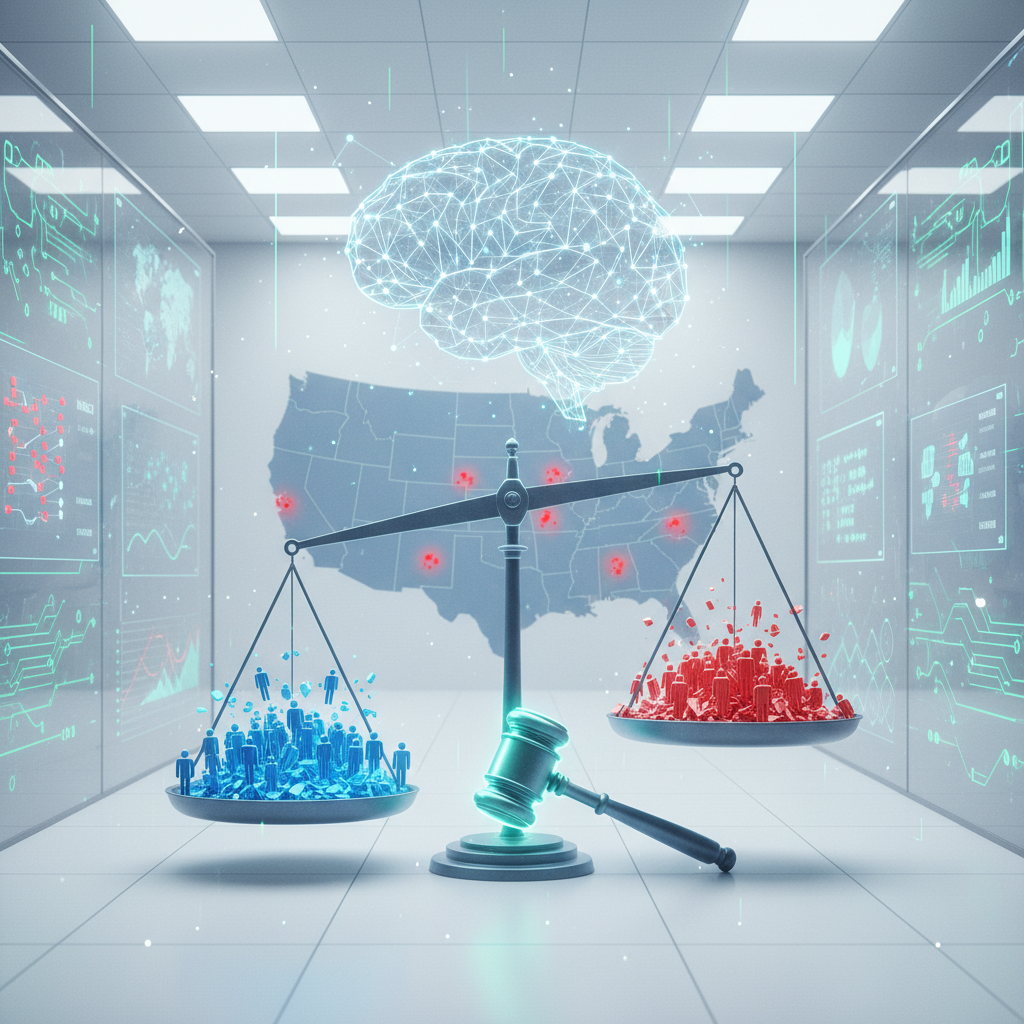

Walk into almost any police department in a major American city today, from Los Angeles to New York, and you'll find a silent partner working alongside officers: an artificial intelligence algorithm. These aren't just tools for crunching numbers anymore, they are actively shaping where police patrol, who gets stopped, and even influencing sentencing recommendations. For years, we've heard the promises of AI making justice more efficient and objective, but a groundbreaking new study out of Stanford University is forcing us to confront the uncomfortable reality that these systems might be amplifying existing biases, not eradicating them.
Let me decode this for you. The core idea behind predictive policing is simple, almost elegant. Take historical crime data, feed it into a machine learning model, and let the algorithm identify patterns and forecast where and when future crimes are most likely to occur. It's like a weather forecast, but for crime. On paper, this sounds like a smart way to allocate scarce police resources, directing officers to hot spots before incidents even happen. But as anyone who has lived in a community targeted by these systems can tell you, the reality is far more complex and often, far more problematic.
The Breakthrough in Plain Language: Unpacking Stanford's Findings
The recent research, spearheaded by Dr. Jennifer Skeem and her team at Stanford's Computational Social Science Lab, meticulously analyzed anonymized data from several large metropolitan police departments across the United States that have deployed predictive policing software for over five years. What they found was a stark, data-driven confirmation of what many civil rights advocates have long suspected: these algorithms, while designed to be neutral, often perpetuate and even intensify existing patterns of over-policing in communities of color.
Imagine a feedback loop, a vicious cycle. Historical crime data, which is often skewed by disproportionate policing in certain neighborhoods, becomes the training data for the AI. The algorithm learns these patterns, identifies those same neighborhoods as high-risk, and then directs more police presence there. More police presence leads to more arrests for minor offenses, which in turn generates more data, reinforcing the algorithm's initial 'prediction.' It's like teaching a student using a biased textbook, and then being surprised when their worldview reflects those biases. The architecture tells the real story here, and it's one of unintended consequences.
Dr. Skeem, a leading expert in psychology and law, articulated this clearly in a recent interview. "Our study demonstrates that even with sophisticated machine learning techniques, if your input data reflects systemic biases in policing practices, your output will inevitably reflect those same biases, often with greater efficiency and scale," she stated. "We're not just talking about minor discrepancies, we're seeing statistically significant disparities in police deployments and subsequent arrests that correlate directly with demographic factors, even when controlling for actual crime rates." This isn't just theory, it's hard data from the front lines of American law enforcement.
Why It Matters: Justice on the Digital Brink
This research isn't just an academic exercise, it has profound implications for the very fabric of justice in the USA. When AI dictates where police patrol, it impacts everything from individual liberty to community trust. Think about it: if an algorithm consistently directs police to a particular neighborhood, residents there are statistically more likely to be stopped, searched, or arrested, regardless of their individual behavior. This erodes trust between law enforcement and the communities they serve, making genuine crime prevention more difficult. It also raises serious questions about due process and equal protection under the law, cornerstones of our legal system.
Beyond predictive policing, AI is also seeping into other critical areas of criminal justice, notably sentencing algorithms. Tools like Compas, developed by Northpointe Inc., have been used in courts across the country to assess a defendant's risk of recidivism, informing judges' decisions on bail and sentencing. While proponents argue these tools offer objective, data-driven insights, studies, including one by ProPublica years ago, have shown these algorithms to disproportionately flag Black defendants as higher risk, even when controlling for similar criminal histories. This new Stanford research reinforces the urgent need to scrutinize all AI applications in justice, not just predictive policing.
As Professor Ruha Benjamin of Princeton University, a prominent voice on race, technology, and justice, often reminds us, "We have to ask not just what technologies do, but what they do to us and to our society." This isn't about blaming the technology itself, but about critically examining the human choices embedded within its design and deployment. This is about what's actually happening inside police departments and courtrooms across the country, often without public oversight or even full understanding from the officials using these tools.
The Technical Details: Unpacking the Algorithmic Bias
The Stanford team employed a multi-faceted approach, combining statistical analysis with qualitative data from interviews with police officers and community leaders. They focused on several commercially available predictive policing platforms, though they did not name specific vendors due to non-disclosure agreements. The key technical insight lies in the feature engineering and data preprocessing. Most predictive policing algorithms rely heavily on historical arrest data, not necessarily reported crime data. This is a crucial distinction.
Here's why: arrest data is a product of human decision-making and existing policing patterns. If police have historically focused their efforts on certain areas, they will naturally make more arrests in those areas. When an AI is trained on this arrest data, it essentially learns to replicate and amplify those historical patterns. The algorithm doesn't 'know' about socioeconomic factors, historical discrimination, or the nuances of community dynamics. It only sees correlations in the data it's fed. If 80% of drug arrests occur in neighborhood A, the algorithm will conclude neighborhood A is an 80% higher risk for drug crime, even if drug usage rates are similar across different neighborhoods.
The researchers used techniques like causal inference and counterfactual analysis to isolate the impact of the algorithm's predictions from other variables. They simulated scenarios where police deployment was randomized versus algorithm-directed, and observed the resulting arrest patterns. The results consistently pointed to the algorithms reinforcing existing disparities. For a deeper dive into the technical methodologies, you can often find pre-print versions of similar studies on arXiv.
Who Did the Research: Stanford's Computational Social Science Lab
The research was primarily conducted by Dr. Jennifer Skeem, a professor in the Department of Psychology at Stanford University, known for her work on risk assessment and decision-making in criminal justice. Her team included graduate students and postdoctoral researchers specializing in machine learning, statistics, and public policy. This interdisciplinary approach is crucial for understanding the complex interplay between technology and society. Their work builds on a growing body of literature from institutions like MIT and Harvard, challenging the presumed neutrality of AI in sensitive domains. You can often find their latest publications and discussions on the broader ethical implications of AI at places like MIT Technology Review.
Implications and Next Steps: Reforming the Digital Patrol
The implications of this Stanford study are clear: we cannot blindly trust AI to deliver unbiased justice if the data it learns from is already biased. This calls for urgent reforms and a critical re-evaluation of how these technologies are developed, deployed, and overseen in the USA.
First, there needs to be greater transparency. Police departments and vendors must be more open about the algorithms they use, the data they're trained on, and the metrics they optimize for. Without this, meaningful oversight is impossible. Second, there's a pressing need for independent audits of these systems. Just as we audit financial records, we need to audit algorithms for fairness and accuracy, especially when they impact fundamental rights. Organizations like the AI Now Institute at New York University have been advocating for this for years.
Third, and perhaps most importantly, we need to shift our focus from simply predicting crime to preventing it. This means investing in social programs, education, and community resources, rather than solely relying on technology that can exacerbate existing inequalities. As one community organizer in Chicago told me, "You can predict where poverty will lead to crime, or you can address the poverty itself. The algorithm just shows you where the cracks are, it doesn't fix them."
Finally, this research underscores the need for robust regulatory frameworks. While some states and cities are beginning to grapple with this, a comprehensive federal approach, perhaps from agencies like the Department of Justice, is essential. We need policies that mandate fairness, accountability, and human oversight in all AI applications within criminal justice. The promise of AI in justice is still there, but it must be tempered with a profound commitment to equity and human rights. Otherwise, we risk automating injustice on a scale we've never seen before. The conversation around this is only just beginning, and it's one we, as a nation, absolutely must have. For more on the ongoing debates and policy discussions, TechCrunch frequently covers the intersection of AI and public policy, particularly in the startup space where many of these tools originate.