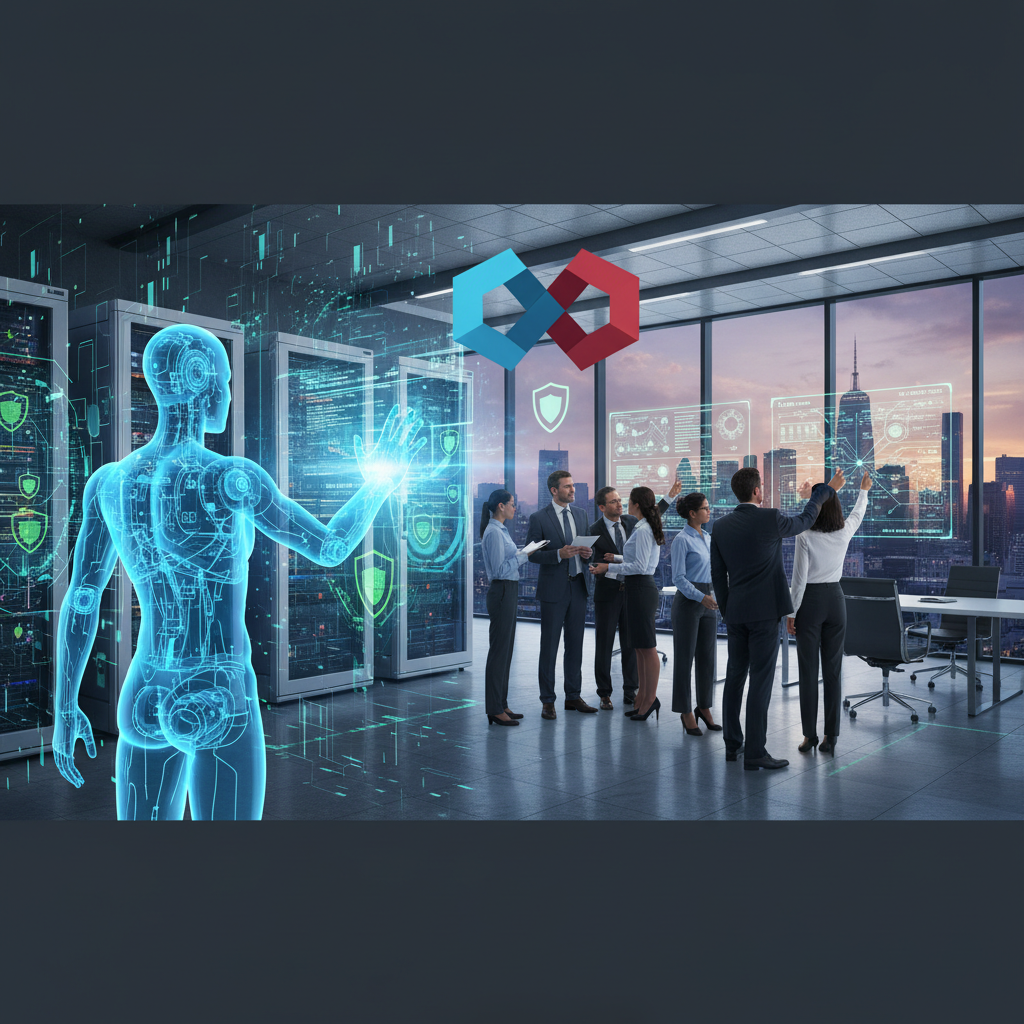

The fluorescent hum of the server room at a major financial institution in downtown Chicago used to be a beacon for late-night security analysts, their eyes glued to screens, sifting through an endless deluge of alerts. It was a Sisyphean task, a constant race against sophisticated attackers, often feeling like they were trying to catch raindrops in a sieve. Today, that scene is evolving. The screens are still there, but the human analysts are no longer drowning in false positives. Instead, they're orchestrating a symphony of AI-powered defenses, much like a conductor leading a highly trained orchestra.
This isn't some futuristic fantasy, folks; this is April 2026, and AI-powered cybersecurity is rapidly becoming the backbone of enterprise defense across the USA. For years, we've heard the buzz, but now, the data is undeniable. According to a recent report by McKinsey & Company, 60% of US enterprises have either fully implemented or are actively piloting AI solutions in their cybersecurity operations, a significant jump from just 25% two years ago. The driver is clear: the sheer volume and complexity of cyber threats have outpaced human capacity. We're talking about ransomware attacks that can cripple entire hospital systems, sophisticated phishing campaigns that bypass traditional filters, and nation-state actors probing critical infrastructure. The stakes couldn't be higher.
Let me decode this for you: traditional cybersecurity often relies on signature-based detection, essentially looking for known bad patterns. It's like having a wanted poster for every known criminal. But what happens when a new criminal emerges, one you've never seen before? That's where AI steps in. Machine learning algorithms can analyze vast datasets of network traffic, user behavior, and system logs to identify anomalies that signal a new threat, not just a known one. It's about predictive intelligence, not just reactive defense. The architecture tells the real story. These systems aren't just looking for a specific virus signature; they're learning what 'normal' looks like for your network and flagging anything that deviates from that baseline, often in milliseconds.
This shift is yielding tangible results. Gartner reports that organizations leveraging AI for threat detection are experiencing a 30% reduction in false positives and a 20% faster mean time to detect and respond to incidents. That translates directly into saved dollars and reduced downtime. When a breach can cost a company millions, sometimes tens of millions, of dollars, these efficiencies are not just nice to have; they're existential. We're seeing companies like Microsoft, with its formidable Microsoft Defender suite, and Palo Alto Networks, with its Cortex XDR platform, leading the charge. They're integrating advanced AI and machine learning capabilities directly into their security offerings, making them smarter, faster, and more autonomous.
Microsoft's commitment is particularly evident. Satya Nadella has consistently emphasized AI's role across all their products, and cybersecurity is no exception. Their recent acquisition of a specialized AI threat intelligence startup, reported by Reuters, further solidifies their position. "The scale of cyber threats demands a response that leverages the full power of artificial intelligence," stated Charlie Bell, Executive Vice President of Security, Compliance, Identity, and Management at Microsoft, in a recent interview. "Our goal is to empower every organization to defend itself with intelligence that outpaces attackers." This isn't just marketing speak; it's a strategic imperative.
But who are the winners and losers in this rapidly evolving landscape? The clear winners are enterprises that embrace these technologies, particularly those in highly regulated industries like finance and healthcare. They're seeing improved security postures, reduced operational costs, and better compliance. Companies that cling to outdated, manual security practices are finding themselves increasingly vulnerable, playing a losing game of whack-a-mole with ever-smarter adversaries. Smaller businesses, often lacking the resources to implement complex AI solutions, are also at a disadvantage, becoming easier targets for opportunistic attackers. This creates a widening security gap that we, as a nation, need to address.
From a worker perspective, the narrative is complex. There's understandable apprehension about job displacement. Will AI replace human security analysts? Not entirely, but it will certainly change their roles. The mundane, repetitive tasks of sifting through logs and chasing down low-priority alerts are increasingly being automated. This frees up human experts to focus on higher-level strategic analysis, incident response, and threat hunting, essentially becoming the 'generals' of the digital battlefield rather than the 'foot soldiers.'
Take Sarah Chen, a lead security analyst at a major tech firm in Silicon Valley. "A few years ago, I spent 70% of my day triaging alerts, many of them false positives," she told me during a recent visit. "Now, the AI handles that. I spend my time on proactive threat intelligence, developing new defensive strategies, and mentoring junior analysts. It's far more challenging and rewarding." This sentiment is echoed by many. The job isn't going away; it's evolving into something more strategic and less tedious. However, it does require upskilling, and companies need to invest in training their existing workforce to navigate this new AI-driven security paradigm.
Expert analysis from organizations like the Sans Institute consistently highlights the need for a hybrid approach. "AI is a force multiplier, not a silver bullet," warns Alan Paller, Director of Research at the Sans Institute. "Human expertise combined with AI's analytical power creates a defense that is far greater than the sum of its parts." This isn't just about technology; it's about people and processes adapting to a new reality. The human element remains crucial for interpreting nuanced threats, making ethical decisions, and responding to unforeseen circumstances that even the most advanced AI might miss.
What's coming next? We're already seeing the emergence of 'AI agents' in cybersecurity, autonomous systems capable of not just detecting but also responding to threats with minimal human intervention. Imagine an AI that can isolate an infected system, patch vulnerabilities, and even trace the attack vector back to its origin, all in real-time. Here's what's actually happening inside OpenAI and other leading AI labs: they're not just building large language models; they're developing foundational AI that can be adapted for highly specialized tasks like autonomous cyber defense. We'll also see more sophisticated predictive AI that can anticipate attack patterns based on global threat intelligence, effectively moving from reactive defense to proactive deterrence.
The integration of AI into cybersecurity is not merely a technological upgrade; it's a fundamental shift in how we conceive of and execute digital defense. It's a race against increasingly sophisticated adversaries, and AI is our most powerful tool. For businesses across the USA, embracing this transformation isn't an option; it's a necessity for survival in the digital age. The future of enterprise security is intelligent, adaptive, and, yes, AI-powered. It's a new frontier, and the journey has only just begun. For more insights into how AI is reshaping industries, you can always check out MIT Technology Review. The landscape is changing fast, and staying informed is your best defense. For a broader look at AI's impact across various sectors, TechCrunch also provides excellent coverage.