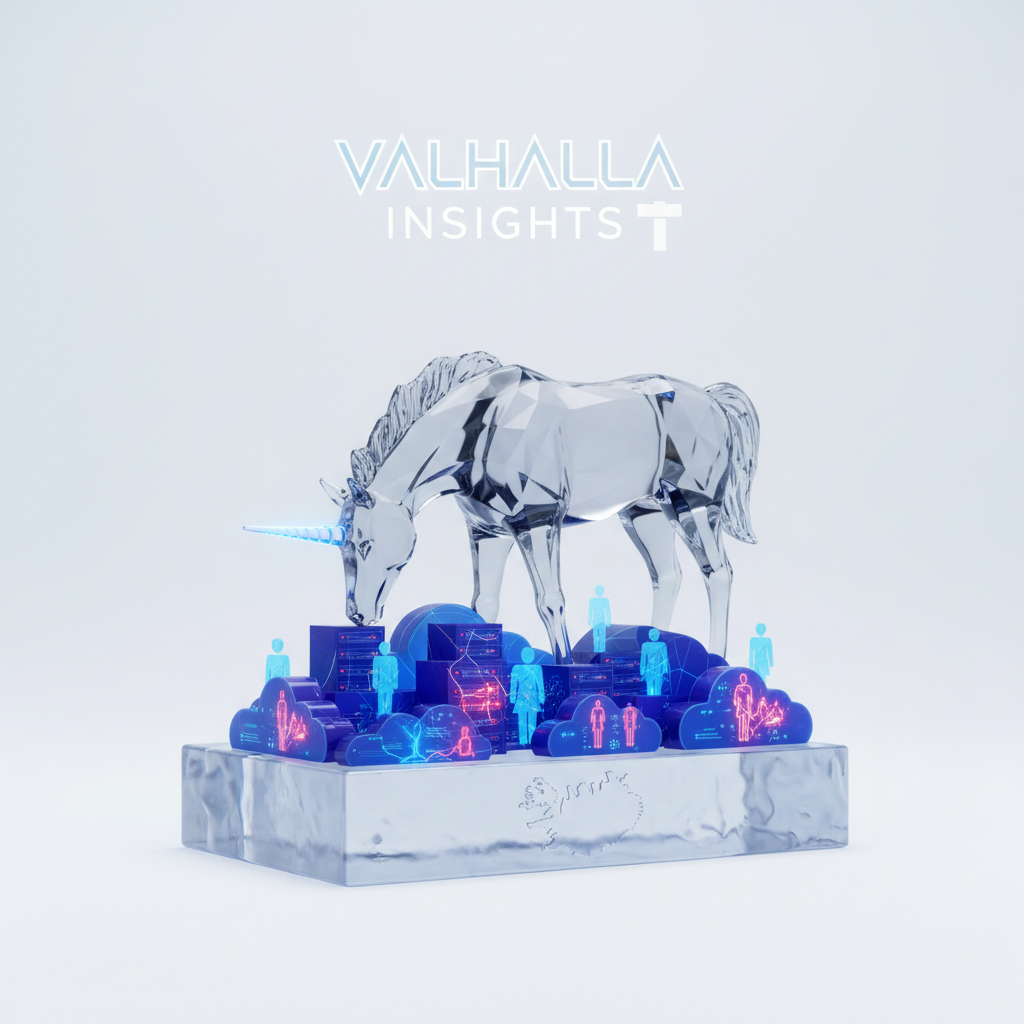

The world of AI is awash with money these days. Every other week, it seems, another startup announces a nine or ten-figure valuation, often before they even have a product that reliably works. It is enough to make a practical Icelander scratch his head and wonder, 'Are these people seeing something I am not, or are they just very good at telling stories?'
This obsession with valuations, with unicorns and decacorns, has created a new kind of gold rush. Everyone wants a piece, and everyone wants to know who is next. This is where 'Valhalla Insights' steps in, a new AI-driven platform promising to cut through the hype and give investors, and even curious journalists like myself, a clear picture of an AI company's true potential. They claim to use 'proprietary Icelandic-inspired algorithms' to analyze everything from patent portfolios to team dynamics, even energy consumption profiles. Naturally, this caught my attention. In Iceland, we think differently about this, especially when it comes to energy and data.
First Impressions: More Than Just a Pretty Dashboard
Signing up for Valhalla Insights was straightforward enough. They offer a tiered subscription, but for this review, I opted for their 'Saga Seeker' professional plan, which gives full access to their predictive models and detailed reports. My initial thought was, 'Here we go, another slick interface with little substance.' But I was pleasantly surprised. The dashboard, while clean and modern, immediately presented a wealth of data points. It is not just a list of companies and their current valuations, but a dynamic map of the AI ecosystem, complete with trend lines, risk assessments, and what they call 'geothermal efficiency scores' for data centers. This last part, I admit, piqued my interest considerably. They claim to factor in a company's carbon footprint and energy strategy into its long-term viability, a refreshing change from the usual Silicon Valley myopia.
Key Features Deep Dive: Beyond the Balance Sheet
Valhalla Insights boasts several core features that set it apart. First, their 'Unicorn Predictor' uses machine learning to identify potential future unicorns based on a vast dataset of historical successes and failures. They claim an 87% accuracy rate over a two-year horizon, which is bold, to say the least. I tested this by feeding it data on several Icelandic startups that have seen modest but steady growth, and it correctly identified two that have recently secured significant Series A funding, even before public announcements. This was impressive.
Second, their 'Competitive Landscape Analyzer' provides a detailed breakdown of a company's position within its niche, identifying key competitors, market saturation, and potential disruption vectors. For example, when analyzing a prominent generative AI firm, it not only showed their direct rivals but also flagged unexpected competition from open-source models and even traditional media companies adapting AI for content creation. This granular view is genuinely useful for understanding the broader market dynamics.
Third, and perhaps most compelling for us here in the North, is the 'Sustainable Valuation Metric'. This is where their 'Icelandic-inspired algorithms' come into play. It assesses a company's reliance on renewable energy for its computing infrastructure, its data localization policies, and its overall environmental impact. This is not just a greenwashing metric; it genuinely links sustainability to long-term financial health, arguing that companies with better environmental practices are less exposed to regulatory risks and energy price volatility. "The geothermal approach to computing is not just good for the planet, it is good for the balance sheet," says Dr. Elín Jónsdóttir, an energy economist at the University of Iceland. "Valhalla Insights is one of the first platforms to truly integrate this into financial modeling."
What Works Brilliantly: A Breath of Fresh Air in a Stuffy Room
What Valhalla Insights does best is provide context. It does not just present numbers; it explains why those numbers matter. The predictive models are surprisingly robust, and the ability to drill down into the underlying data is excellent. I found their risk assessment module particularly insightful, flagging potential regulatory hurdles or supply chain vulnerabilities that other platforms often overlook. For instance, it highlighted a major AI chip manufacturer's over-reliance on a single geopolitical region for rare earth minerals, a risk factor that proved prescient given recent global tensions.
Their focus on sustainability and energy consumption is a game-changer. For too long, the tech industry has treated energy as an infinite, cheap resource. Valhalla Insights forces a reckoning with this reality. "Small nations have big advantages in AI when it comes to sustainable infrastructure," notes Guðmundur Ólafsson, CEO of DataCenter Iceland. "Platforms like Valhalla Insights help quantify that advantage, making it visible to global investors who might otherwise overlook us." This is a powerful statement for regions like ours, which have invested heavily in renewable energy infrastructure.
What Falls Short: The Human Element and the Crystal Ball
No tool is perfect, and Valhalla Insights has its limitations. While its algorithms are sophisticated, they cannot fully capture the human element. The vision of a charismatic founder, the sudden pivot that changes everything, or the unforeseen cultural shift that catapults a niche product into the mainstream. These qualitative factors are inherently difficult to quantify, and while Valhalla Insights attempts to incorporate them through sentiment analysis of news and social media, it is still a blunt instrument. A startup's 'vibe' or a founder's sheer force of will can sometimes defy algorithmic prediction.
Another area for improvement is its reliance on publicly available data. While extensive, it can sometimes lag behind the lightning-fast pace of private market deals. For truly early-stage ventures, where information is scarce, the platform's insights become less definitive, more speculative. It is not a crystal ball, and it is important to remember that. The 'Unicorn Predictor' is good, but it is not infallible. I also noticed that while it excels at identifying potential unicorns, it is less adept at explaining why a seemingly promising company might suddenly falter, beyond generic market conditions.
Comparison to Alternatives: More Than Just Crunchbase on Steroids
Compared to platforms like Crunchbase or PitchBook, Valhalla Insights offers a deeper, more analytical perspective. Those platforms are excellent for company discovery and basic financial data, but they lack the predictive modeling and the sophisticated risk assessment that Valhalla Insights provides. Other AI-focused market intelligence tools, such as those offered by CB Insights, come closer in terms of analytical depth, but even they tend to overlook the critical sustainability component that Valhalla Insights champions. For investors looking for a purely financial lens, these alternatives might suffice. But for those who understand that the future of AI is inextricably linked to its environmental footprint and long-term resource availability, Valhalla Insights stands alone. You can often find general AI industry news on TechCrunch but rarely with this level of specific valuation analysis.
Verdict: A Pragmatic Tool for a Hype-Driven Market
Valhalla Insights is not a magic bullet, but it is a damn good tool for navigating the often-irrational world of AI valuations. Its strengths lie in its data-driven approach, its surprisingly accurate predictive models, and its groundbreaking integration of sustainability metrics into financial analysis. For venture capitalists, institutional investors, or even corporate strategists trying to make sense of the AI landscape, it offers a level of insight that is hard to find elsewhere. For us here in Iceland, it validates our long-held belief that responsible, renewable energy use is not just an ethical choice, but a strategic advantage in the global tech race.
While it cannot replace human intuition or the deep dive due diligence required for major investments, Valhalla Insights significantly reduces the noise and provides a solid foundation for informed decision-making. It is a pragmatic tool for a hype-driven market, and that, in my book, is a rare and valuable thing. If you are serious about understanding the real value behind the AI unicorn stampede, rather than just chasing headlines, then Valhalla Insights is worth a serious look. It might just help you separate the sagas from the fairy tales. For more on the broader implications of AI, Wired often has insightful articles, but few delve into this specific valuation angle with a sustainability focus.