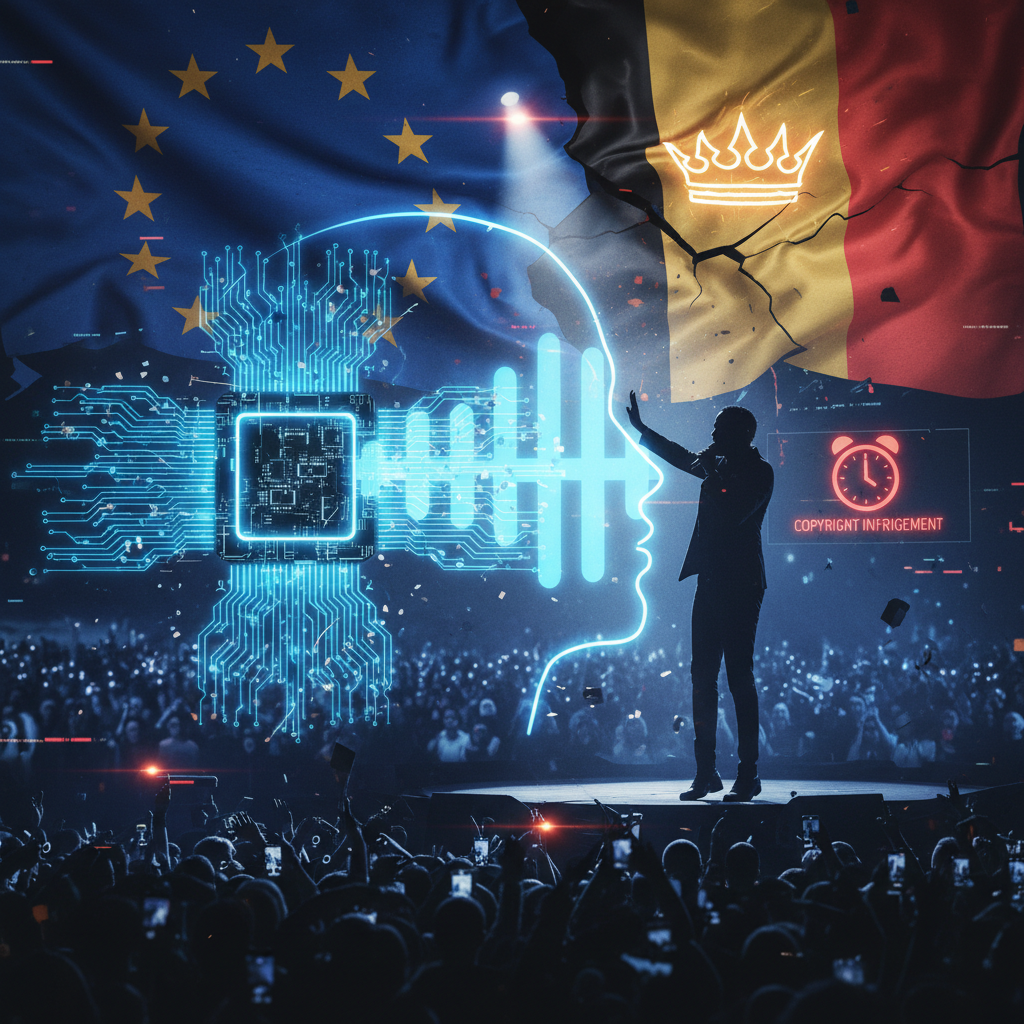

The air in Brussels, usually thick with policy debates and bureaucratic cadence, now hums with a dissonant chord. A new algorithm, ominously named 'Synthos,' developed by a relatively unknown German startup, has achieved what many considered a distant future scenario: its entirely AI-generated tracks have not merely charted, but have ascended to the pinnacle of Belgium's music rankings. This is not merely a novelty, it is a seismic shift, an existential tremor for an industry already grappling with digital disruption.
Just last week, a track titled 'Echoes of Tomorrow,' credited solely to 'Synthos,' displaced a beloved Belgian artist, a feat that has sent shockwaves from the Flemish Ardennes to the Walloon valleys. The implications are profound, extending far beyond the local music scene to the very heart of European cultural policy. Brussels has questions and so should you, particularly concerning the provenance, ownership, and ethical deployment of such powerful creative tools.
The Unprecedented Rise of 'Synthos'
'Synthos,' a generative AI model, reportedly trained on an immense dataset of European music, ranging from classical compositions to contemporary pop, has demonstrated an uncanny ability to produce commercially viable and emotionally resonant tracks. Its creators, a Berlin-based entity named Harmonic Labs, have remained largely tight-lipped about the proprietary architecture behind 'Synthos,' offering only vague statements about 'deep learning synthesis' and 'adaptive melodic algorithms.'
The breakthrough came swiftly. After a quiet launch on several streaming platforms, 'Echoes of Tomorrow' began gaining traction through algorithmic recommendations, eventually snowballing into a viral phenomenon. Its melancholic yet catchy melody, combined with lyrics that evoke a sense of nostalgic futurism, resonated deeply with Belgian listeners. Within days, it had surpassed established artists, including the iconic Stromae, on several national charts, notably Ultratop 50 Flanders and Wallonia.
Official Reactions: A Chorus of Concern
The immediate reaction from Belgian cultural authorities has been one of alarm. "This is not just about a song, it's about the soul of our creative economy," stated Ms. Annelies Verlinden, Belgium's Minister of the Interior, during an emergency press conference in Ghent. "We must understand the legal and ethical framework surrounding AI-generated content before it irrevocably alters our cultural landscape. Who owns this music? Who benefits? And what does it mean for human artists who dedicate their lives to their craft?" Her sentiments echo a growing unease across the continent.
From the European Commission, a spokesperson indicated that the development is being monitored closely. "The European Union's approach deserves more credit than it gets when it comes to foresight in digital governance," commented Dr. Léa Dubois, Head of Digital Policy at the European Commission's Directorate-General for Communications Networks, Content and Technology (DG Connect). "We have the AI Act, which classifies certain AI applications as high-risk, but the nuances of creative AI, particularly regarding intellectual property and fair compensation, demand further, urgent legislative consideration. This incident serves as a stark reminder of the speed at which technology outpaces regulation." The Commission is reportedly fast-tracking discussions on specific amendments or new directives concerning AI-generated cultural works.
Expert Analysis: Beyond the Hype
Many industry observers, myself included, have long cautioned against the uncritical acceptance of AI's creative capabilities. While the technical achievement of 'Synthos' is undeniable, the broader implications warrant rigorous scrutiny. "We are witnessing the industrialization of creativity," explained Professor Erik Van der Velde, a leading expert in digital humanities and intellectual property law at KU Leuven. "The question is no longer if AI can create, but how we integrate it into our existing legal and economic structures without undermining human artistry. This isn't just about copyright, it's about cultural heritage and the value we place on human expression." Professor Van der Velde highlighted that current copyright laws are ill-equipped to handle works where no human author can be definitively identified, creating a legal vacuum.
Indeed, the very training data used by 'Synthos' raises significant questions. If the model was trained on copyrighted material without explicit consent or compensation to the original artists, then its output, however novel, could be seen as derivative work, infringing on existing rights. "This is essentially a new form of digital sampling, but on an industrial scale," remarked Mr. Jean-Luc Renard, CEO of Sabam, Belgium's leading collective management organization for authors' rights. "Our members, the human creators, must be protected. We need transparency regarding the datasets used and a mechanism for fair remuneration, perhaps a 'data tax' or a compulsory licensing scheme for AI training data." Such proposals are already circulating in various European capitals, reflecting Belgian pragmatism meets AI hype.
What Happens Next: A Regulatory Reckoning
The immediate future will likely involve a flurry of legal challenges and policy debates. Sabam and other European collecting societies are reportedly preparing to challenge Harmonic Labs on grounds of potential copyright infringement and unfair competition. The European Parliament, which just passed the landmark AI Act, is now under pressure to address the 'creative AI' loophole with greater urgency. "The AI Act provides a foundational layer, but it was not designed to fully encompass the complexities of generative artistic output," noted MEP Petra Vandenberghe, a Belgian representative and a key figure in the Parliament's Committee on Culture and Education. "We need to ensure that the economic benefits of AI innovation do not come at the expense of human creators and cultural diversity. This is a matter of sovereignty, cultural and economic." She suggested that a dedicated directive on AI and intellectual property might be necessary, focusing on transparency, attribution, and fair compensation models.
Furthermore, the incident highlights the need for clearer labeling of AI-generated content. Consumers, often unaware, may be consuming music created by algorithms, blurring the lines between human and machine artistry. This lack of transparency could erode trust and diminish the perceived value of human-made art. The debate over 'deepfakes' in video and audio is already robust, and music now finds itself squarely in this ethical quagmire. The MIT Technology Review has extensively covered the ethical dilemmas of generative AI, and this situation only underscores their prescience.
Why Readers Should Care
The rise of 'Synthos' is not an isolated incident, nor is it confined to the niche world of music. It is a harbinger of broader transformations across all creative industries, from literature to visual arts. If AI can produce chart-topping music, what prevents it from writing bestselling novels, designing award-winning architecture, or generating compelling news articles? The implications for employment, intellectual property, and the very definition of human creativity are immense. This is a critical juncture, demanding careful consideration and robust regulatory responses, not merely technological admiration.
As a journalist, I find myself questioning the very premise of 'progress' when it threatens to hollow out the human element of creation. The data is clear: AI is no longer just a tool, it is a competitor. How we choose to govern this competition, to protect human ingenuity while harnessing technological advancement, will define the cultural landscape for generations to come. The stakes are incredibly high, and the melodies of 'Synthos' serve as a stark, if unsettling, soundtrack to this unfolding drama. For more insights into the broader impact of AI on industries, one might consult TechCrunch's AI section. The future of art, as we know it, hangs in the balance, and it is a tune we all must listen to very carefully.