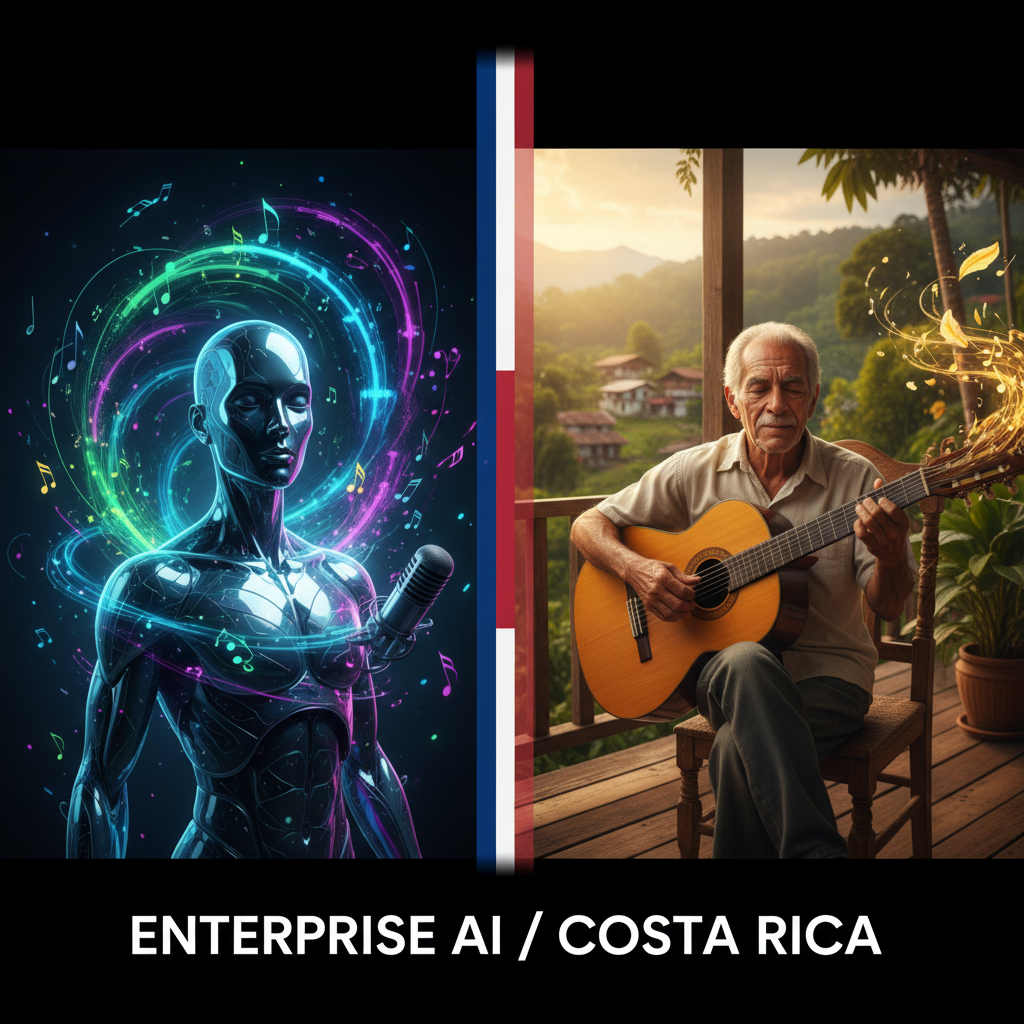
The airwaves are buzzing, but it is not always human voices we hear anymore. Just last month, a track titled “Synthetic Serenade” by an artist known only as ‘Aura’ shot to the top of global streaming charts, dethroning established pop icons. Aura, as we now know, is not a person but an advanced music generation AI developed by a subsidiary of Google DeepMind, trained on billions of data points of human-created music. This is not just a novelty; it is a seismic shift, and the tremors are felt even here in Costa Rica.
For years, we have seen AI assist in music production, helping with mastering, generating beats, or even suggesting harmonies. But this is different. Aura’s success, and similar breakthroughs from companies like OpenAI’s Jukebox and Meta’s AudioCraft projects, represent a new frontier. These systems are not just tools; they are creators, capable of producing compositions that resonate deeply with listeners, sometimes better than human artists. Data from Spotify indicates that AI-generated tracks now account for nearly 15% of new submissions monthly, a figure that has tripled in the last year alone. Of these, a startling 2% are breaking into the top 100 global charts, a success rate that far outstrips independent human artists.
“This isn’t just about technology; it’s about culture, about identity,” says Dr. Sofía Valverde, a musicologist at the University of Costa Rica. “Our music, from calypso to punto guanacasteco, is steeped in our history, our 'pura vida' philosophy. Can an algorithm truly capture the soul of a marimba, the nuanced emotion of a human voice singing about the rainforest? I have my doubts.” Dr. Valverde’s concerns echo a growing sentiment among artists and cultural institutions worldwide. The fear is that a deluge of algorithmically optimized, emotionally generic music will drown out authentic human expression.
This crisis is particularly poignant for smaller nations with rich musical traditions. Costa Rica, a country celebrated for its biodiversity and commitment to sustainability, has always valued its unique cultural expressions. We may not have the massive record labels of Los Angeles or London, but our artists are vibrant, innovative, and deeply connected to our land. The idea that a machine, however sophisticated, could replicate or even surpass their work is unsettling.
“We are witnessing an unprecedented challenge to the very definition of artistry,” states Ricardo Jiménez, CEO of MusiTech CR, a local startup focused on ethical AI in creative fields. “The economic implications are enormous. If a label can produce a chart-topping hit with minimal overhead and no royalty payments to human composers or performers, what happens to the thousands of musicians, songwriters, and producers who rely on this industry? We are already seeing a 30% drop in new artist contracts with smaller labels globally, according to recent reports from Reuters Technology.”
The major players are not silent. Satya Nadella, CEO of Microsoft, recently acknowledged the disruption, stating in a recent interview, “AI is a powerful co-pilot for creativity, not a replacement. Our focus remains on empowering human artists, not displacing them.” Yet, Microsoft’s own investments in AI music generation tools tell a more complex story. Meanwhile, Spotify’s CEO, Daniel Ek, has remained largely neutral, emphasizing the platform’s role as a conduit for all forms of audio content, regardless of origin. However, the platform’s algorithms are increasingly favoring tracks that demonstrate high engagement metrics, which AI-generated music, designed for optimal listenability, often achieves with ease.
Here in Costa Rica, the conversation is more urgent. Our National System of Music Education (sinem), a beacon of cultural development, is already exploring how to adapt. “We cannot ignore this technology, but we must guide it,” says Elena Rojas, Director of Sinem. “We are looking at incorporating AI literacy into our curriculum, teaching young musicians how to use these tools ethically, how to collaborate with AI without losing their unique voice. It’s about practical innovation in paradise, finding our way through this new landscape.”
Indeed, some local artists are already experimenting. María Fernanda Solís, a rising indie artist from Heredia, used an open-source AI model, similar to those released by Meta AI, to generate backing tracks for her latest album. “It saved me months of studio time and thousands of dollars,” she explains. “But the melodies, the lyrics, the emotion, that’s all me. The AI was a brush, not the painter.” Her experience highlights a potential path forward: AI as an accelerant for human creativity, not a substitute.
However, the legal and ethical quagmire deepens daily. Who owns the copyright to an AI-generated song? If an AI is trained on copyrighted material, is its output derivative? The U.S. Copyright Office and similar bodies globally are struggling to define these boundaries. The European Union’s AI Act, while comprehensive, still leaves many questions unanswered regarding creative works. This legal uncertainty creates a Wild West scenario, where deep-pocketed tech giants can push boundaries faster than regulations can keep up.
The debate extends beyond economics and legality. It touches on the very essence of what it means to be human and creative. If machines can produce art that is indistinguishable from, or even preferred to, human art, what does that say about our unique capacities? This is not just about a few pop songs; it is about the future of creative industries and the value we place on human expression.
Costa Rica proves you don't need Silicon Valley to grapple with these profound questions. Our approach, rooted in collaboration and environmental consciousness, offers a unique perspective. We are not just asking how to compete with AI, but how to integrate it responsibly, how to ensure it serves humanity and enhances our cultural fabric, rather than eroding it. The pura vida approach to AI in music might not provide all the answers, but it certainly offers a more balanced, thoughtful way forward than simply chasing the next viral hit. The music industry’s existential crisis is global, but the solutions, perhaps, can be found in diverse, grounded perspectives like ours. The melody of the future is still being composed, and it remains to be seen how many human and algorithmic notes it will contain. For more insights into how AI is reshaping creative fields, you can explore articles on Wired.
For a deeper dive into the intersection of AI and societal impact, consider reading about Dubai's AI Ethicists Unveil 'Al-Adl' Framework: A Decisive Strike Against Algorithmic Bias in Global Hiring, Challenging Google and Microsoft Paradigms [blocked], which touches on ethical frameworks that might offer guidance for the music industry as well.