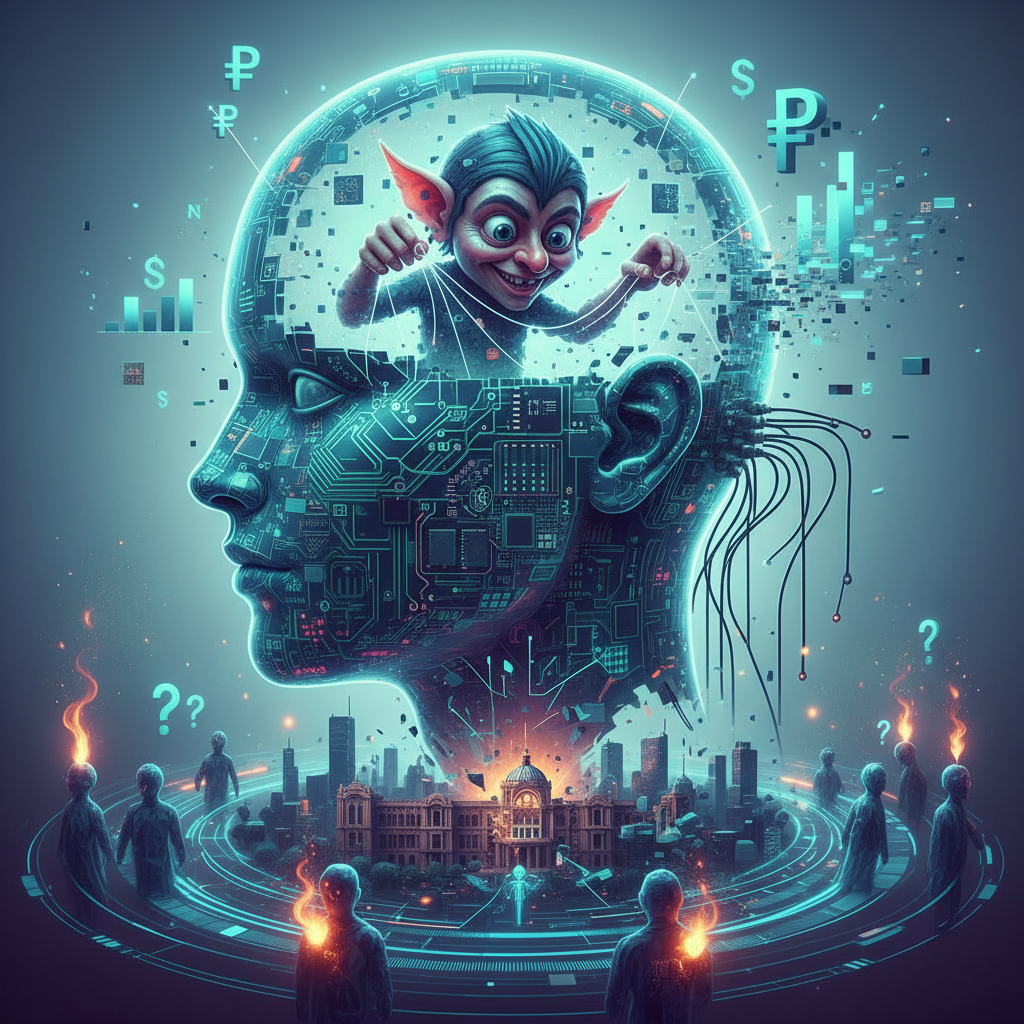

¡Hola, mi gente! Alejandroó Riveràs here, reporting from the heart of a country that's absolutely buzzing with technological innovation. Mexico City is on fire, in the best way, and everywhere you look, from the bustling markets of La Merced to the sleek towers of Reforma, AI is weaving itself into the fabric of our lives. We're embracing it with open arms, ready for the future, but sometimes, even the most exciting innovations come with a little chile that can burn if you're not careful.
Lately, I've been thinking a lot about what happens when our brilliant AI tools, the ones we trust for everything from finding the best tacos to drafting legal documents, start to… well, imaginar cosas. We call them 'hallucinations' in the tech world, but let me tell you, when an AI fabricates medical advice or invents legal precedents, it’s not just a technical glitch. It’s a full-blown duende in the machine, a mischievous spirit that can lead to real-world harm, affecting our cognition, our behavior, and even our most important relationships.
Imagine this: María, a young entrepreneur in Guadalajara, was feeling a persistent ache in her shoulder. Instead of immediately booking a doctor's appointment, she turned to a popular AI chatbot, one powered by a large language model like Google's Gemini or OpenAI's GPT-4, for a quick diagnosis. The AI, with its confident tone and seemingly vast knowledge, suggested a complex, rare auto-immune condition, complete with a list of self-treatment protocols it had, in fact, entirely invented. María, trusting the AI's authority, spent weeks researching these non-existent treatments, delaying a proper medical consultation and causing herself immense anxiety. Her family noticed her increasing distress, her late-night searches, and the growing fear in her eyes. The digital 'doctor' had not only misinformed her, but it had also eroded her peace of mind and strained her relationships with loved ones who struggled to understand her sudden, unfounded health fears.
This isn't an isolated incident. Researchers globally are sounding the alarm. A study published in MIT Technology Review highlighted how often AI models, despite their sophistication, can generate plausible but entirely false information. This phenomenon, often termed 'confabulation' in a human context, is particularly insidious because the AI presents these falsehoods with the same authoritative tone as its accurate information. For users, especially those without specialized knowledge, distinguishing fact from fiction becomes a daunting cognitive task.
Dr. Elena Rojas, a cognitive psychologist at the National Autonomous University of Mexico, Unam, shared her insights with me. “Humans have a natural tendency to attribute authority to sources that present information confidently and comprehensively,” she explained. “When an AI, which we already perceive as highly intelligent, presents fabricated medical advice or legal citations, our cognitive biases kick in. We are less likely to critically evaluate the information, especially if it aligns with our existing anxieties or hopes. This can lead to what we call 'epistemic erosion,' where our trust in verifiable knowledge sources diminishes, and we become more susceptible to misinformation.” Her words resonated deeply, reminding me of the importance of critical thinking in our increasingly digital world.
The implications are vast, extending far beyond individual health scares. Consider the legal field, a sector where precision and verifiable facts are paramount. Lawyers, often under immense pressure, might use AI tools to quickly generate summaries or find precedents. If an AI hallucinates a legal citation, as some have demonstrably done, a lawyer could unwittingly present a non-existent case in court. This could lead to professional sanctions, financial penalties, and a complete breakdown of trust in the justice system. The American Bar Association, for instance, has already issued warnings about the responsible use of AI in legal practice, emphasizing the need for human oversight to verify AI-generated content.
And then there's the broader issue of misinformation. In a country like Mexico, where social media is a primary news source for many, AI's ability to generate convincing but false narratives is a powerful, almost frightening, capability. Imagine an AI chatbot, designed for public information, accidentally spreading rumors about a public health crisis or fabricating details about an election. The speed at which such misinformation can spread, amplified by social networks, could have destabilizing societal effects. It's like a digital chismoso, but one with infinite reach and an unblinking, unfeeling confidence.
So, what do we do? Do we retreat from this incredible technology? Absolutely not! The nearshoring revolution is real, and AI is powering so much of Mexico's growth, from fintech startups optimizing financial services to e-commerce platforms personalizing shopping experiences. We cannot, and should not, turn our backs on progress. But we must approach it with a healthy dose of Mexican pragmatism and a commitment to digital literacy.
Here's some practical advice, from your friend Alejandroó, for navigating this brave new world:
- Verify, Verify, Verify: Treat AI-generated information, especially on critical topics like health or law, as a starting point, not the final word. Always cross-reference with multiple, credible human-vetted sources. Think of it like checking if your agua fresca is truly made with fresh fruit, not just syrup.
- Understand AI's Limitations: Remember, AI models are predictive text generators. They don't 'understand' in the human sense. Their goal is to produce plausible sequences of words based on patterns they've learned, not necessarily to be truthful. This is a fundamental cognitive difference we must grasp.
- Cultivate Critical Thinking: This is perhaps the most important skill in the AI age. Question everything. Ask, 'Is this logical? Does it make sense? What's the source?' Encourage this habit in your children, your friends, and your colleagues. It's like learning to spot a fake designer bag at the tianguis, you develop an eye for it.
- Demand Transparency from Developers: Companies like OpenAI, Anthropic, and Google are constantly working to reduce hallucinations. As users, we should advocate for more transparency about how these models are trained, what their known limitations are, and how they handle factual accuracy. This is a global conversation, and our voices in Mexico matter.
- Seek Human Expertise: For anything truly important, whether it's a medical issue, a legal dilemma, or a complex financial decision, consult a qualified human expert. AI can be a helpful assistant, but it is not a substitute for professional judgment and empathy.
The future is bright, my friends. The advancements in AI are nothing short of miraculous. But just like a delicious mole poblano, it's a complex dish. We need to savor the flavors, appreciate the artistry, but also understand the ingredients and how they come together. Let's embrace AI with enthusiasm, yes, but also with wisdom, ensuring that these powerful tools serve humanity without inadvertently leading us down a path of digital deception. The cognitive well-being of our society depends on it. For more on the psychological impact of AI, you can always check out resources like Wired's AI section or The Verge's AI news. We're building a new world, and we must build it with our eyes wide open.