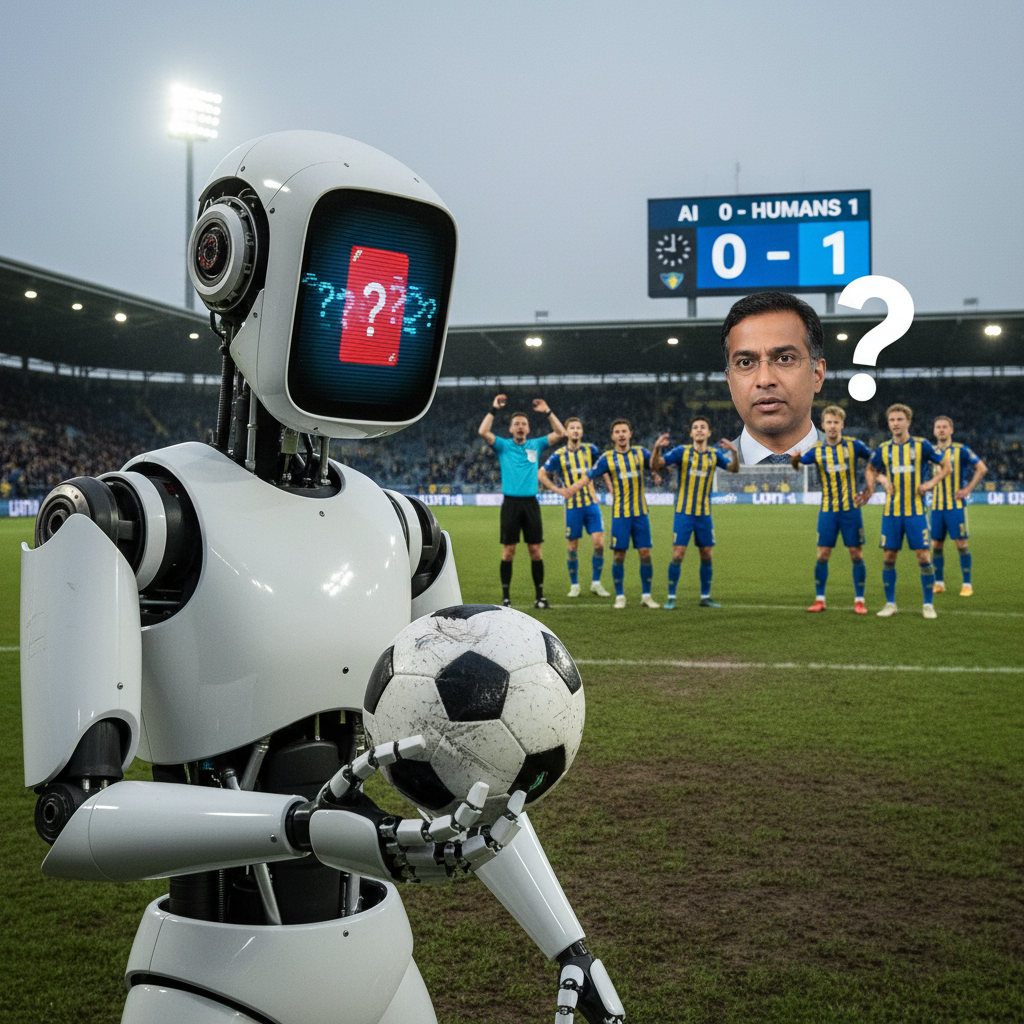

The roar of the crowd, the precision of a pass, the split-second decision that determines victory or defeat: these are the elements that define elite sports. Yet, increasingly, an unseen player influences these moments: artificial intelligence. From tactical analysis to player performance optimization, AI is deeply embedded in modern sports. In Sweden, a nation renowned for its analytical rigor and technological adoption, this integration is particularly pronounced. But as AI systems become more autonomous and their influence more profound, a fundamental question emerges: who is responsible when AI causes harm?
Consider a hypothetical, yet increasingly plausible, scenario: a prominent Swedish football club, perhaps Djurgårdens IF or Malmö FF, invests heavily in an advanced AI system, let's say a bespoke version of Google DeepMind's AlphaCode, adapted for sports analytics. This system is tasked with predicting player fatigue, optimizing substitution strategies, and even advising on transfer market acquisitions. During a crucial match, the AI's recommendation leads to a player being kept on the field despite early signs of injury, which the AI misinterprets as mere muscle stiffness. The player suffers a career-ending injury. Who is liable? Is it the club for trusting the AI, the developer for a flawed algorithm, or the data provider for incomplete information?
This is not merely a theoretical exercise. The European Union, with Sweden at its forefront, is grappling with these very questions. The proposed AI Act, while a landmark piece of legislation, still leaves significant ambiguities regarding liability, particularly in high-risk applications. Sports analytics, given its direct impact on human performance and multi-million Euro contracts, undoubtedly falls into this category. The current legal frameworks, largely designed for human-centric negligence, struggle to accommodate the distributed agency inherent in AI systems.
“The traditional chain of responsibility breaks down when an autonomous system makes a decision,” explains Dr. Elin Forsberg, a legal scholar specializing in technology law at Uppsala University. “We have product liability laws, yes, but an AI is not a static product. It learns, it adapts, and sometimes, it fails in ways its creators could not have fully foreseen. Pinpointing the exact point of failure, be it in the training data, the algorithm's design, or its deployment context, becomes an intricate forensic challenge.” Her assessment highlights the core dilemma: the opaque nature of many advanced AI models, often referred to as 'black boxes,' complicates accountability.
Let's look at the evidence. A recent report by the European Commission indicated that only 15% of European companies deploying AI systems have a clear, documented internal protocol for addressing AI-induced harm or errors. This figure is marginally better in the Nordics, standing at 22%, but still far from reassuring. The report also noted a 30% increase in reported 'near-miss' incidents involving AI in high-stakes environments, including medical diagnostics and autonomous vehicles, over the past year. While sports analytics might seem less critical than healthcare, the financial and human costs of errors are substantial.
NVIDIA, a key enabler of advanced AI through its powerful GPUs, has seen its technology adopted across various sports leagues for real-time data processing and simulation. While NVIDIA provides the computational backbone, the responsibility for the AI's output typically rests with the developers and deployers. Yet, as AI models become more complex, trained on vast datasets and fine-tuned by multiple entities, the lines blur. Is it fair to hold Google DeepMind, for instance, solely responsible for an error in a highly customized sports analytics model developed by a third party, even if it uses their foundational architecture?
“The Swedish model suggests a different approach, one rooted in collective responsibility and robust regulatory oversight,” states Fredrik Johansson, a senior policy advisor at the Swedish Agency for Digital Government. “We emphasize transparency in algorithmic design and demand clear audit trails for AI systems deployed in critical sectors. The goal is not to stifle innovation, but to ensure that societal safeguards keep pace with technological advancement.” This perspective aligns with Sweden's broader approach to technology governance, which often prioritizes public trust and ethical considerations alongside economic growth. Scandinavian data paints a clearer picture of a region striving for a balanced approach, though implementation remains a challenge.
The sports industry, eager for competitive advantage, has often been quick to adopt new technologies without fully considering the long-term implications. Take the example of AI-powered refereeing assistants. While designed to minimize human error, what happens when the AI itself makes a critical, game-altering misjudgment? The technology is not infallible. A study published in Nature Machine Intelligence last month detailed instances where AI-driven decision support systems, when faced with novel or ambiguous situations, exhibited unexpected biases or simply failed to provide coherent recommendations, leading to suboptimal outcomes.
This issue extends beyond the pitch. AI is increasingly used in player scouting, talent identification, and even injury rehabilitation. If an AI system, perhaps from a startup like Hudl or a larger player like Salesforce's Tableau, incorrectly identifies a promising young talent as having a high injury risk, leading to them being overlooked, who is accountable for that missed opportunity? The individual's career trajectory could be irrevocably altered based on an algorithmic assessment, the inner workings of which are often proprietary and inscrutable.
“We are moving towards a future where AI systems are not just tools, but active participants in decision-making processes,” observes Dr. Sofia Karlsson, a sports psychologist working with several Swedish elite teams. “The psychological impact on athletes, knowing their careers are influenced by algorithms they don't understand, is significant. This necessitates not just legal clarity, but also ethical guidelines and transparent communication from clubs and AI developers.” Her point underscores the human element that often gets lost in the technical discussions of AI liability.
The path forward is complex. It will likely involve a multi-layered approach: stricter regulatory frameworks that define 'AI product' and 'AI service' with greater precision, mandatory impact assessments for high-risk AI applications, and potentially, new insurance models specifically designed for AI-related damages. Furthermore, the development of explainable AI (XAI) will be crucial, allowing for greater transparency into how AI systems arrive at their conclusions. Without this, assigning responsibility will remain an exercise in speculation rather than evidence-based judgment.
Companies like OpenAI and Anthropic, while primarily focused on general-purpose AI, are also contributing to the foundational models that underpin many specialized applications, including those in sports. Their responsibility, therefore, extends to ensuring the safety and robustness of these base models. As Sam Altman of OpenAI often emphasizes the need for careful deployment, the question of shared liability between foundational model developers and downstream application creators will become increasingly pertinent. The entire ecosystem must evolve to meet these challenges.
The Swedish experience, with its emphasis on societal welfare and regulatory foresight, offers valuable lessons. While the allure of AI's transformative power in sports is undeniable, we must not allow the pursuit of marginal gains to overshadow fundamental questions of fairness, safety, and accountability. The game, after all, is played by humans, and their well-being must remain paramount. The responsibility for AI's impact, both positive and negative, must be clearly defined and rigorously enforced. Anything less would be a disservice to the integrity of sport and the trust placed in these powerful new technologies. The whistle has blown, and the debate on AI liability is now in full play. For further insights into the broader implications of AI regulation, one might consult resources from MIT Technology Review.