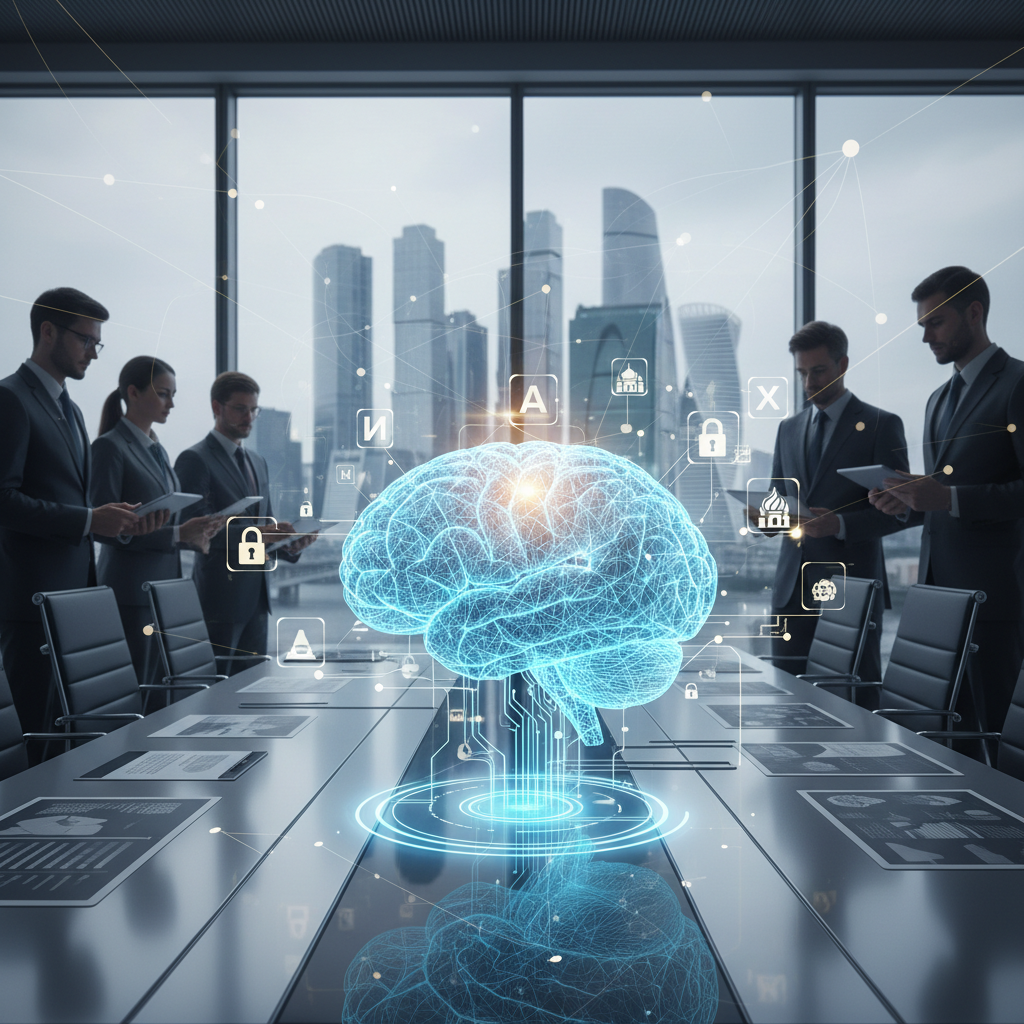
The hum of servers at Sberbank’s AI laboratories in Moscow is a constant, almost rhythmic, reminder of Russia’s ambitious, if sometimes isolated, push into artificial intelligence. Here, algorithms are not merely tools; they are increasingly becoming collaborators, generating code, designing interfaces, and even drafting marketing copy. But as these digital apprentices become more sophisticated, a fundamental question echoes through the glass corridors and secure data centers: who owns the intellectual property that an AI creates?
This is not a theoretical debate confined to academic journals. It is a very real, very pressing concern affecting businesses, developers, and artists across Russia, a nation where innovation often collides with a complex, evolving legal framework. The official story doesn't add up for many, as existing copyright and patent laws, largely conceived in a pre-AI era, struggle to accommodate the nuances of machine creativity. How do you assign authorship to a neural network, however advanced, that lacks legal personhood?
Consider the case of Yandex, Russia’s dominant tech conglomerate. Their AI teams are leveraging models like YandexGPT to accelerate content generation, from news summaries to advertising campaigns. While such tools offer undeniable efficiency gains, the legal department faces a conundrum. If YandexGPT generates a novel piece of code that significantly improves a product, is the code owned by Yandex, the engineers who trained the model, or does it exist in a legal void? This ambiguity creates significant risks, particularly for companies operating in competitive markets where intellectual property is a cornerstone of valuation and strategic advantage.
Data from various sources underscores the growing reliance on AI-driven content creation. A recent report by the Russian Association of Electronic Communications (raec) indicated that over 40 percent of large Russian enterprises surveyed in late 2025 were actively experimenting with generative AI for creative or technical output. While specific ROI figures remain guarded, anecdotal evidence suggests substantial productivity boosts, particularly in sectors like media, software development, and even industrial design. However, this adoption is often accompanied by internal legal disclaimers and a cautious approach to commercializing purely AI-generated works.
Winners and Losers in the IP Maze
Companies that have proactively attempted to define internal policies or lobby for legal clarity appear to be navigating this landscape with greater confidence. Sberbank, for instance, has reportedly established internal guidelines asserting ownership over all AI-generated content produced using its proprietary models and infrastructure, treating the AI as a tool similar to a sophisticated software compiler. This approach, while pragmatic for internal operations, offers little protection in external disputes.
Conversely, smaller startups and individual creators are finding themselves in a more precarious position. A graphic designer using an open source image generation model to create a logo for a client might face challenges if the client later attempts to trademark the AI-generated design. Without clear legal precedent, the risk of infringement claims or disputes over originality looms large. Russian AI talent deserves better than to operate in such a nebulous legal environment.
“The current legal framework in Russia, like in many other countries, simply wasn’t built for this,” stated Dr. Elena Petrova, a leading expert in intellectual property law at the Skolkovo Institute of Science and Technology. “Our civil code defines an author as a natural person. An AI is not a natural person. This creates a fundamental disconnect that requires legislative intervention, not just corporate policy adjustments.” MIT Technology Review has highlighted similar global challenges, but Russia's specific context, with its unique legal traditions and geopolitical pressures, adds additional layers of complexity.
Worker Perspectives: A Double-Edged Sword
For many Russian workers, AI is a tool that enhances their capabilities, not replaces them entirely. Developers at companies like VK (formerly Mail.ru Group) report using AI code assistants to accelerate development cycles. Artists and designers employ generative AI to brainstorm ideas or create initial drafts. The sentiment is often one of cautious optimism, tempered by concerns over job security and, increasingly, the ownership of their augmented output.
“I use AI every day to help me write marketing copy,” shared Anna K., a content specialist at a Moscow-based e-commerce firm. “It saves me hours, but sometimes I wonder, if the AI wrote the best part of the text, is it still my work? And if the company owns the AI, do they own my contribution through it?” These are not idle questions; they touch upon fundamental aspects of creative labor and compensation.
Expert Analysis: Behind the Sanctions Curtain
Behind the sanctions curtain, the development of AI in Russia continues, albeit with certain constraints on access to cutting-edge hardware and international research collaborations. This isolation, paradoxically, has spurred domestic innovation and a greater reliance on homegrown solutions, including open source AI models. However, the legal vacuum surrounding AI IP remains a significant impediment to its full commercialization and integration into the global economy.
Dr. Ivan Volkov, head of AI research at the Higher School of Economics in Moscow, emphasized the need for a balanced approach. “We must protect human creators while also incentivizing the development and deployment of AI. Perhaps a new category of ‘AI-assisted works’ or ‘machine-generated works’ is necessary, with specific rules for attribution, ownership, and remuneration. The current all-or-nothing approach benefits no one in the long run.” His perspective aligns with discussions happening in other major tech hubs, as reported by Reuters.
What is Coming Next?
The legal landscape is slowly beginning to shift. There are ongoing discussions within the State Duma and the Ministry of Economic Development about potential amendments to intellectual property laws to address AI-generated content. One proposed direction involves establishing a presumption of ownership by the entity that owns and operates the AI system, with provisions for human contribution recognition. Another suggestion involves creating a sui generis right, a unique legal category specifically for AI creations, separate from traditional copyright or patent law.
However, progress is slow, hampered by the sheer complexity of the issue and the lack of international consensus. For now, Russian businesses and creators must navigate this uncharted territory with caution, relying on internal contracts, robust documentation of human input, and a keen eye on evolving legal interpretations. The future of innovation, and indeed the very definition of creativity, in Russia hinges on how decisively and thoughtfully these questions are answered. The stakes are high, and the clock, driven by ever-advancing algorithms, continues to tick. For more on the broader implications of AI in enterprise, one might consider the challenges faced by other nations in integrating AI into their core operations, as explored in articles like When OpenAI's GPT Meets Reykjavík's Classrooms: Is Cheating the Only Lesson, or a New Dawn for Learning? [blocked], which touches on the ethical and practical dilemmas of AI adoption.
Ultimately, until clear legal frameworks are established, the question of who owns what an AI creates will remain a source of both innovation and uncertainty, a testament to the rapid pace at which technology outstrips our ability to govern it. The world, Russia included, is in a race to define the boundaries of digital authorship, a race whose outcome will shape the economic and creative landscape for decades to come. Even TechCrunch frequently covers the legal battles brewing globally over AI IP, underscoring the universal nature of this challenge. The answers, when they come, will likely be imperfect, but they are desperately needed.