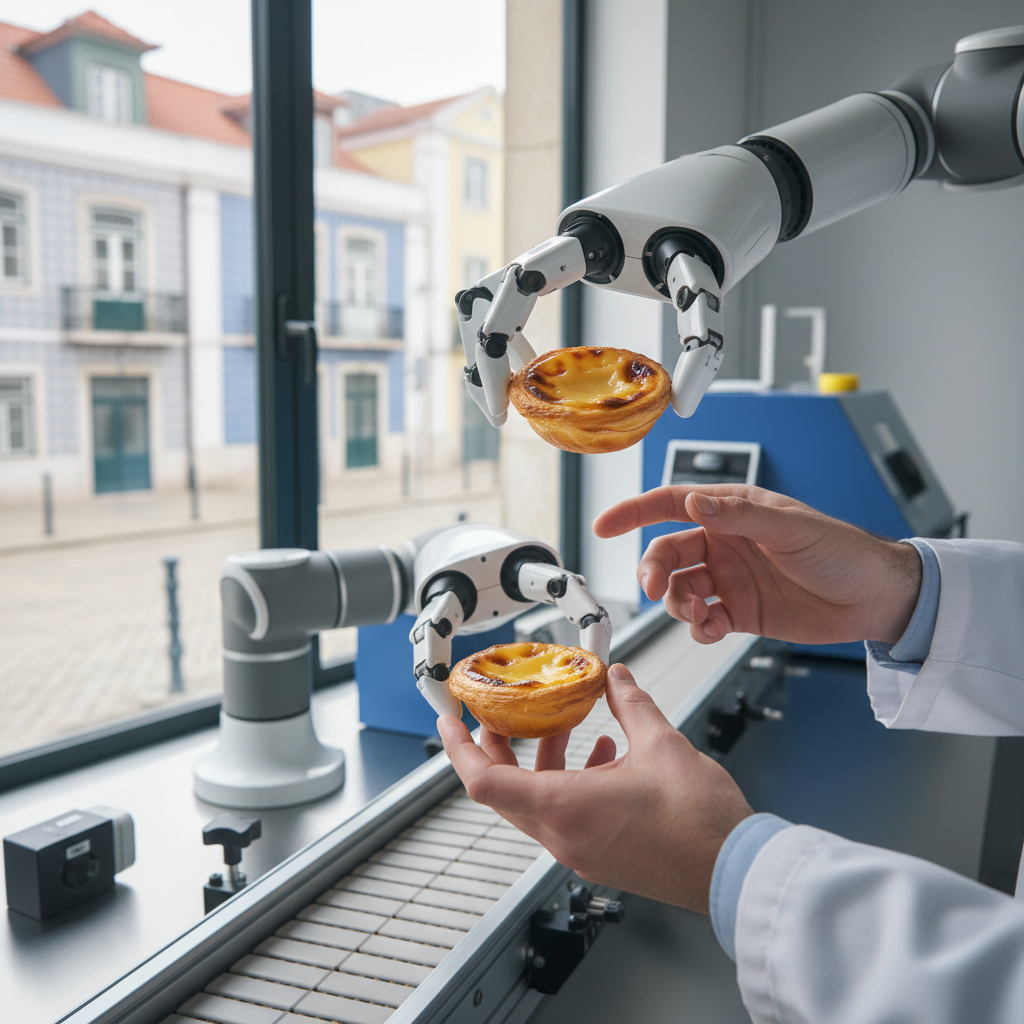

Ah, artificial intelligence. It is the talk of every café in Lisbon, from the bustling Cais do Sodré to the quiet corners of Alfama. Everyone marvels at ChatGPT's poetic prose or Google Gemini's uncanny ability to summarize a year's worth of emails. We see the polished, intelligent facade, the digital marvel that promises to revolutionize everything from healthcare to how we order our next bica. But like a perfectly crisp pastel de nata, whose golden crust hides hours of meticulous, often unseen, labor in the bakery, the dazzling capabilities of AI are built upon a foundation of very human effort. We are talking about the 'AI workers' rights' here, the humans behind the machine learning pipeline, and frankly, it is a story often overlooked.
What is the 'Pastel de Nata Problem' of AI?
Simply put, the 'Pastel de Nata Problem' of AI refers to the vast, often undervalued, and sometimes exploitative human labor that goes into making AI models function. When you interact with a large language model, or when an AI vision system identifies an object, it is not magic. It is the result of millions, sometimes billions, of data points that have been meticulously collected, labeled, categorized, and refined by human beings. These are the 'AI workers,' a global workforce performing tasks like transcribing audio, annotating images, moderating content, or even engaging in simulated conversations to teach AI how to respond. They are the unsung heroes, or perhaps the unacknowledged cogs, in the machine learning pipeline.
Why Should You Care? Because Your Future is Being Built on It.
Why should you, sipping your vinho verde by the Douro, care about someone labeling images halfway across the world? Because the quality, fairness, and ethical implications of the AI systems that are increasingly shaping our lives depend directly on this human labor. If the data is biased, the AI will be biased. If the workers are exploited, the ethical foundation of our digital future is shaky. As AI permeates every aspect of society, from job applications to medical diagnoses, understanding its human underpinnings becomes paramount. We are building a new world, and we must ensure it is built on fair principles, not on the backs of an invisible workforce.
How Did It Develop? From Academic Curiosity to Industrial Necessity.
The concept of needing human input for machine learning is not new. Early AI efforts, even back in the 1950s, relied on human-curated data. However, with the rise of deep learning and the insatiable appetite of neural networks for vast datasets in the 2010s, this need exploded. Companies like Google, Meta, and OpenAI realized that to train truly powerful models, they needed more data than any single team could ever process. This led to the proliferation of 'data labeling' or 'data annotation' companies, often outsourcing work to regions with lower labor costs. It became an industrial-scale operation, a global assembly line for data, much like the textile factories of old, but for digital goods.
“The sheer scale of data required for modern AI is mind-boggling,” explains Dr. Sofia Ribeiro, a computational linguist at the University of Porto. “To teach a model to understand Portuguese nuances, you do not just feed it text, you need humans to clarify ambiguities, identify sarcasm, and even correct grammatical errors. It is an iterative, labor-intensive process.”
How Does It Work in Simple Terms? The Digital Apanha da Azeitona.
Imagine the traditional apanha da azeitona, the olive harvest, here in Portugal. It is hard, manual work, often done by many hands to collect the olives that will eventually become our prized olive oil. The AI data pipeline is similar. Instead of olives, workers are 'harvesting' and 'processing' data. A company needs an AI to recognize cats in photos. Thousands of images are sent to human annotators who draw bounding boxes around every cat, labeling it as 'cat.' This labeled data is then fed to the AI, which learns to associate the visual patterns with the 'cat' label. The more accurately and consistently the humans label, the better the AI performs.
This work is often broken down into microtasks, distributed through platforms like Amazon Mechanical Turk or specialized data labeling firms. Workers might spend hours identifying traffic lights in images for self-driving cars, transcribing snippets of audio, or rating the relevance of search results. It is repetitive, requires focus, and often pays very little per task.
Real-World Examples: The Hidden Hands Everywhere.
- Self-Driving Cars: Every time a Tesla or Waymo car 'sees' a pedestrian, a stop sign, or a traffic cone, it is because thousands of human annotators have painstakingly labeled countless hours of video footage, teaching the AI what these objects look like in various conditions. This is a massive undertaking, and errors can have fatal consequences.
- Content Moderation: The pleasant online experience you have on Facebook or TikTok is partly due to AI filtering out harmful content. However, the AI is trained and constantly refined by human content moderators who review disturbing images, videos, and text, often suffering significant psychological distress in the process. These are the digital guardians, protecting our online spaces.
- Voice Assistants: When you ask Alexa or Siri a question, the AI's ability to understand your query and respond appropriately is built on millions of transcribed and annotated voice recordings. Humans listen to and label these recordings, teaching the AI to understand different accents, intonations, and linguistic variations.
- Medical Imaging: AI is increasingly used to detect anomalies in X-rays or MRIs. This AI is trained on vast datasets of medical images, each meticulously labeled by human radiologists or medical experts, identifying tumors, fractures, or other conditions. The accuracy here is literally a matter of life and death.
“The ethical implications are profound,” states Professor Ricardo Costa, an expert in labor law at the University of Coimbra. “We are creating a new class of digital laborers, often without the protections or benefits afforded to traditional employees. This is a global issue, and Portugal, with its growing tech sector, needs to be vigilant.”
Common Misconceptions: Not Just Robots All the Way Down.
One big misconception is that AI is entirely autonomous, a purely digital creation. The truth is, AI is deeply intertwined with human intelligence and labor. Another myth is that this work is temporary, a stepping stone to fully automated AI. While AI improves, the need for human oversight, refinement, and ethical calibration remains constant. AI evolves, and so does the need for human input to guide that evolution. It is not a temporary fix, but a fundamental component of the AI ecosystem.
“Lisbon's tech scene is like a good port wine, complex and improving with age, but even the finest vintages need careful tending,” remarks Maria Santos, CEO of a local AI startup focused on ethical data practices. “We cannot simply automate away the human element of ethical AI development. It is a continuous process of human-in-the-loop validation.”
What to Watch For Next: The Fight for Fair Digital Labor.
The conversation around AI workers' rights is gaining momentum. Regulators in Europe, particularly with the EU AI Act, are starting to consider the human element in AI development, pushing for transparency and accountability. We will see increased pressure on tech giants like OpenAI and Google to ensure fair wages, safe working conditions, and mental health support for their data labeling workforce. Unions are beginning to organize these digital laborers, demanding better terms. The goal is to move towards a model where these essential workers are recognized, protected, and fairly compensated, rather than treated as disposable cogs in a relentless machine.
Portugal punches above its weight in many areas, and it can certainly contribute to this global dialogue. We have a chance to advocate for a more humane and equitable digital future, one where the human hands that train our digital overlords are respected and valued. The sardine can of European tech is actually a treasure chest, and within it, we must ensure that the human element of AI is not forgotten, but celebrated and protected. The next time you marvel at an AI's capabilities, remember the many human hands that made it possible, much like the baker who kneads the dough for your pão every morning. The digital revolution, like all revolutions, has its silent laborers, and their rights are our collective responsibility. For more on the human side of AI, you can often find insightful pieces on Wired's AI section or TechCrunch's AI category. We must ensure that the AI future is not just smart, but also just.