
¡Hola, mis amigos! Marisolò Garcíà here, and let me tell you, the air in Spain is absolutely crackling with innovation, especially when it comes to how artificial intelligence is transforming the very fabric of life itself. Today, we're diving deep into a concept that sounds complex but is, in fact, one of the most exciting advancements of our time: AI protein folding. What is it, you ask? Why should you care? Let's unpack this marvel together, with a little Spanish flair, of course!
What Exactly is AI Protein Folding?
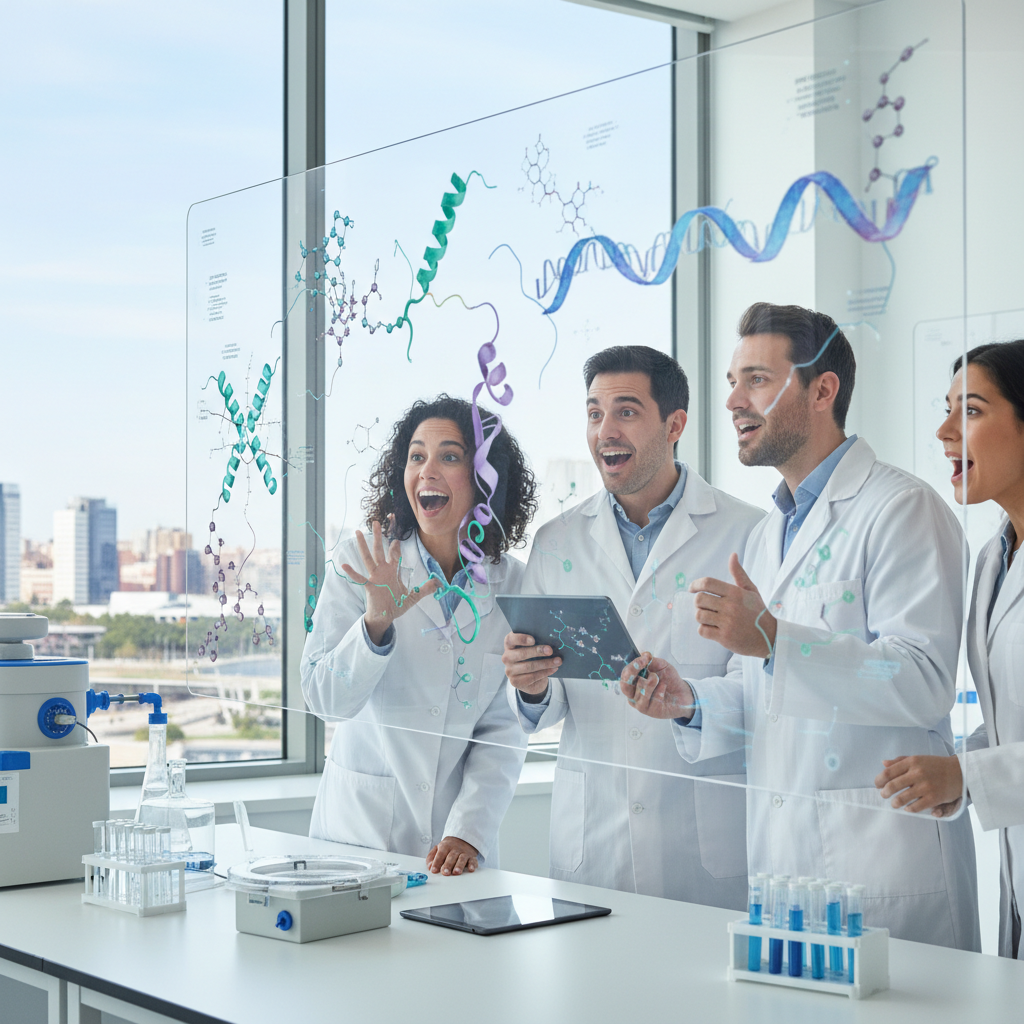
At its heart, AI protein folding is about predicting the three-dimensional shape of a protein from its amino acid sequence. Think of proteins as the tiny, intricate machines of life. They do everything: digest food, fight infections, carry oxygen, and even build our muscles. But for a protein to do its job, it must fold into a very specific, complex 3D shape. If it folds incorrectly, it can lead to diseases like Alzheimer's, Parkinson's, or even some cancers. For decades, predicting this shape was one of biology's grandest challenges, a puzzle so intricate it was called the 'protein folding problem.'
Enter artificial intelligence. AI protein folding is the use of sophisticated AI algorithms, particularly deep learning, to accurately and rapidly predict these 3D structures. It's like having a super-powered architect who can instantly visualize how a complex building will look just by looking at its blueprint, but on a molecular scale. The most famous example, of course, is Google DeepMind's AlphaFold, which has revolutionized the field.
Why Should You Care? The Future is Now!
Why should this matter to you, whether you're sipping a café con leche in Madrid or strolling through the Sagrada Familia in Barcelona? Because this is not just academic science; it's a direct pathway to a healthier, more sustainable future for all of us. This technology is accelerating drug discovery, creating new materials, and even helping us understand fundamental biological processes in ways we could only dream of before.
Imagine a new drug for a rare disease being developed in months instead of years, or a vaccine designed with unprecedented speed to combat the next pandemic. This is the promise. It means faster cures, more effective treatments, and even innovative solutions for climate change. Spain's AI moment has arrived, and it's powered by these very breakthroughs!
How Did This Marvel Develop?
The journey to AI protein folding has been a long and fascinating one, a true testament to human ingenuity. For over 50 years, scientists have grappled with the protein folding problem. Traditional methods, like X-ray crystallography and cryo-electron microscopy, are powerful but incredibly time-consuming and expensive. They're like trying to assemble a giant Lego castle by hand, piece by piece, without instructions.
The real turning point came with the advent of deep learning. In 2018, Google DeepMind unveiled AlphaFold, and then AlphaFold 2 in 2020, which achieved unprecedented accuracy in predicting protein structures. It was a jaw-dropping moment for the scientific community, akin to landing on the moon for molecular biology. Suddenly, the impossible seemed not just possible, but within reach. Companies like NVIDIA, with their powerful GPUs, have been instrumental in providing the computational muscle needed for these complex AI models to train and run, pushing the boundaries of what's achievable.
How Does It Work in Simple Terms? Analogies for Everyone!
Let's keep it simple, shall we? Imagine you have a long, beaded necklace. Each bead is an amino acid, and the order of the beads is the protein's sequence. This necklace can twist and turn into countless shapes. The AI's job is to figure out the one correct shape that allows the necklace to perform its function.
AlphaFold, for example, uses a deep neural network, a bit like a super-smart student who has studied millions of protein structures. It learns the