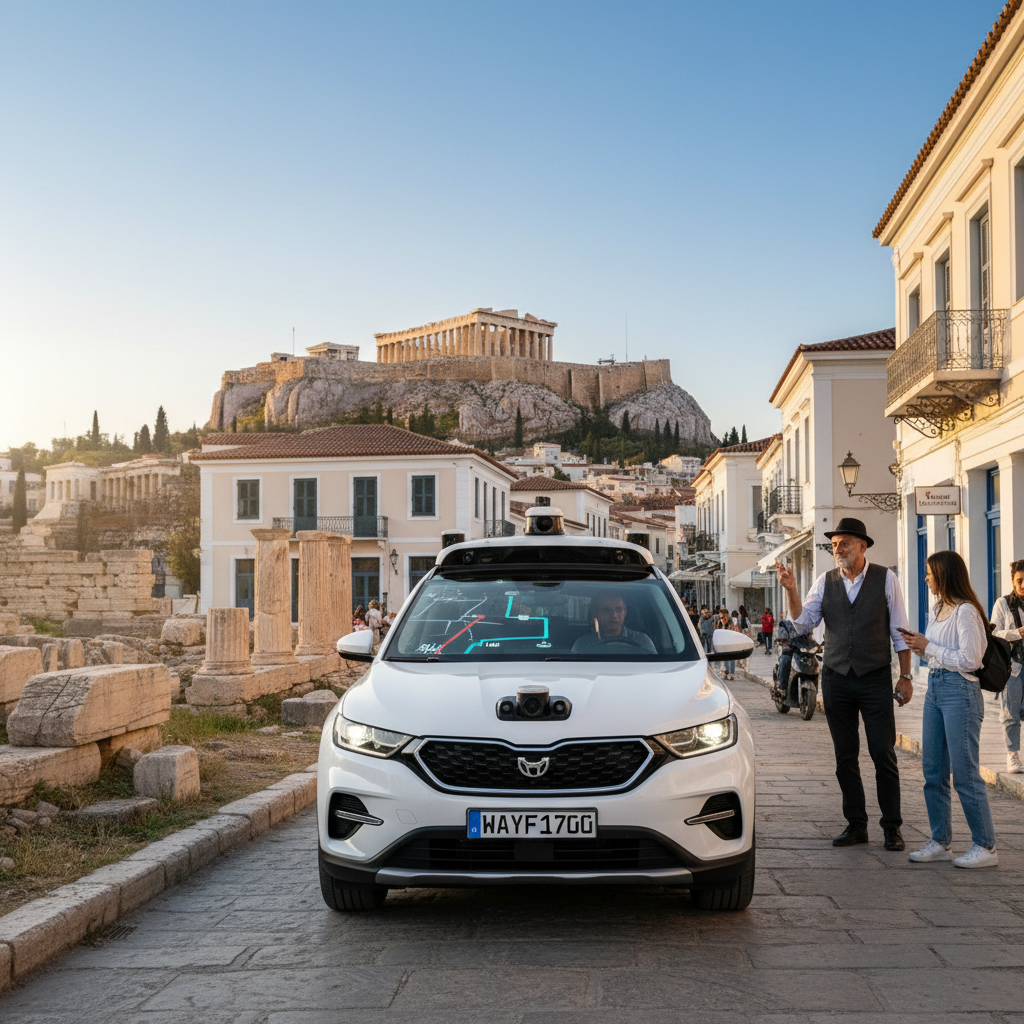
The news arrived with the predictable hum of a well-oiled machine, much like the autonomous vehicles themselves: Google's Waymo, the vanguard of self-driving technology, is accelerating its global rollout. After years of cautious, geographically constrained operations in places like Phoenix and San Francisco, the word from Mountain View is that Waymo is poised to expand its robotaxi services to a host of new cities across continents. This isn't just a ripple, my friends, it is a tidal wave, and it begs the question: what does this mean for the ancient heart of Europe, for cities like my beloved Athens?
I have watched this technological ballet unfold for years, from the nascent dreams of AI to the tangible reality of cars driving themselves. For too long, the narrative has been dominated by the Californian sun, by the relentless pursuit of efficiency and scale. But here, in Greece, we view the world through a different lens, one shaped by millennia of human interaction, by the chaotic beauty of shared public spaces, by the very philosophy that gave birth to the concepts of governance and community. The Mediterranean approach to AI is fundamentally different, I believe, and it's a perspective often overlooked in the rush to digitize everything.
Waymo's expansion is not merely about deploying more vehicles. It's about a fundamental shift in how we conceive of urban mobility, how we interact with our cities, and indeed, how we define convenience. "This isn't just an engineering feat, it's a societal transformation," declared Tekla Vasileiou, a leading urban planning expert at the National Technical University of Athens, during a recent symposium. "For Waymo to succeed in a city like Athens, it needs to understand more than traffic patterns. It needs to understand the rhythm of life, the impromptu stops, the human element that defies algorithms." Her words echo a sentiment I hear often: that while the technology is impressive, its integration must be thoughtful, not forceful.
Consider the numbers. Waymo has logged over 20 million fully autonomous miles on public roads, a staggering figure that speaks to the robustness of its AI and sensor suite. Their latest generation of vehicles, powered by a sophisticated blend of LiDAR, radar, and high-resolution cameras, can navigate complex urban environments with a reported safety record that, statistically, often surpasses human drivers. Reports from TechCrunch suggest that the company is eyeing European capitals, with whispers of initial pilot programs in cities like London, Paris, and potentially even Rome, before venturing further south. The economic incentives are clear: reduced labor costs, optimized routes, and the promise of a safer, more efficient transportation network.
But let us pause for a moment. Greece has something Silicon Valley doesn't: a profound respect for the human scale, for the nuanced interplay of tradition and modernity. Imagine a Waymo vehicle attempting to navigate the labyrinthine streets of Plaka, or the bustling morning markets of Varvakios Agora. These are not merely roads; they are living arteries of culture. How does an algorithm account for the elderly woman crossing the street with her shopping bag, oblivious to traffic lights, or the impromptu conversation between neighbors that momentarily blocks a narrow alley? These are not bugs in the system, they are features of our life.
"The challenge for Waymo, and indeed for any autonomous vehicle company, in a city like Athens, is not just technical, but profoundly cultural," states Dr. Andreas Kavouras, a prominent philosopher of technology at the University of Athens. "The very concept of 'driving' here is intertwined with social cues, with eye contact, with a shared, often unspoken, understanding of the road. Can an AI truly replicate that? Or will it impose a sterile, purely logical order onto a beautifully illogical reality?" He raises a critical point. Our cities are not just grids for efficient movement; they are stages for human drama, for spontaneous encounters, for the very essence of community.
There is also the question of governance. Athens was the birthplace of democracy, now it's reimagining AI governance. The European Union, with its landmark AI Act, is already setting a global precedent for regulating artificial intelligence, emphasizing transparency, safety, and human oversight. As Waymo seeks to expand into this highly regulated landscape, it will face scrutiny far beyond the technical specifications of its vehicles. Data privacy, algorithmic bias, liability in the event of an accident, and the ethical implications of autonomous decision-making will all be under the microscope. "We welcome innovation, but not at the expense of our citizens' rights or our societal values," affirmed Eleni Stavrou, a senior official at the Greek Ministry of Digital Governance, in a recent address. "Any technology operating on our streets must adhere to the strictest ethical and legal frameworks, and that includes a clear pathway for accountability."
My concern is not about the capability of the technology itself. I have no doubt that Waymo's engineers are among the best in the world. My concern is about the vision behind the deployment. Is it a vision that truly seeks to integrate with and enhance diverse urban cultures, or one that aims to homogenize them under the banner of efficiency? Will these autonomous vehicles become another layer of alienation, separating us further from our physical environment and from each other, or will they somehow contribute to a richer, more connected urban experience? I remain skeptical that a purely data-driven approach can grasp the intangible spirit of a place.
Consider the economic impact. While Waymo promises job creation in maintenance and operational oversight, there is an undeniable displacement of traditional taxi drivers. In a country like Greece, where tourism is paramount and personal service is deeply valued, how will this shift be managed? Will the new jobs truly compensate for the old ones, and will they offer the same level of human dignity and connection? These are not trivial questions; they are fundamental to the social contract.
As Waymo prepares its global chess moves, I urge a moment of reflection, not just from the engineers in California, but from the policymakers and citizens in Europe. We must demand more than just technological prowess. We must demand a technology that respects our history, understands our culture, and serves our communities in a way that enhances, rather than diminishes, our humanity. The future of our cities is too important to be left solely to algorithms. It is a conversation that must be had in the agora, not just in the server room. For more on the broader implications of AI in society, one might look to analyses from Wired. The path forward requires a dialogue, a true exchange, not a monologue from Silicon Valley. We have much to teach, even as we have much to learn. After all, the wisdom of the ancients still holds true: know thyself, and know the city in which you live, before you attempt to reshape it. This is not a technical problem; it is a philosophical one, cloaked in chrome and sensors. The future of mobility in Europe, especially in places like Greece, will depend on whether Waymo can learn to speak the language of the human heart, not just the language of code. If you are interested in how other Google AI projects are impacting global workforces, you might find this article on Google DeepMind's 'Nomad' Project [blocked] insightful.