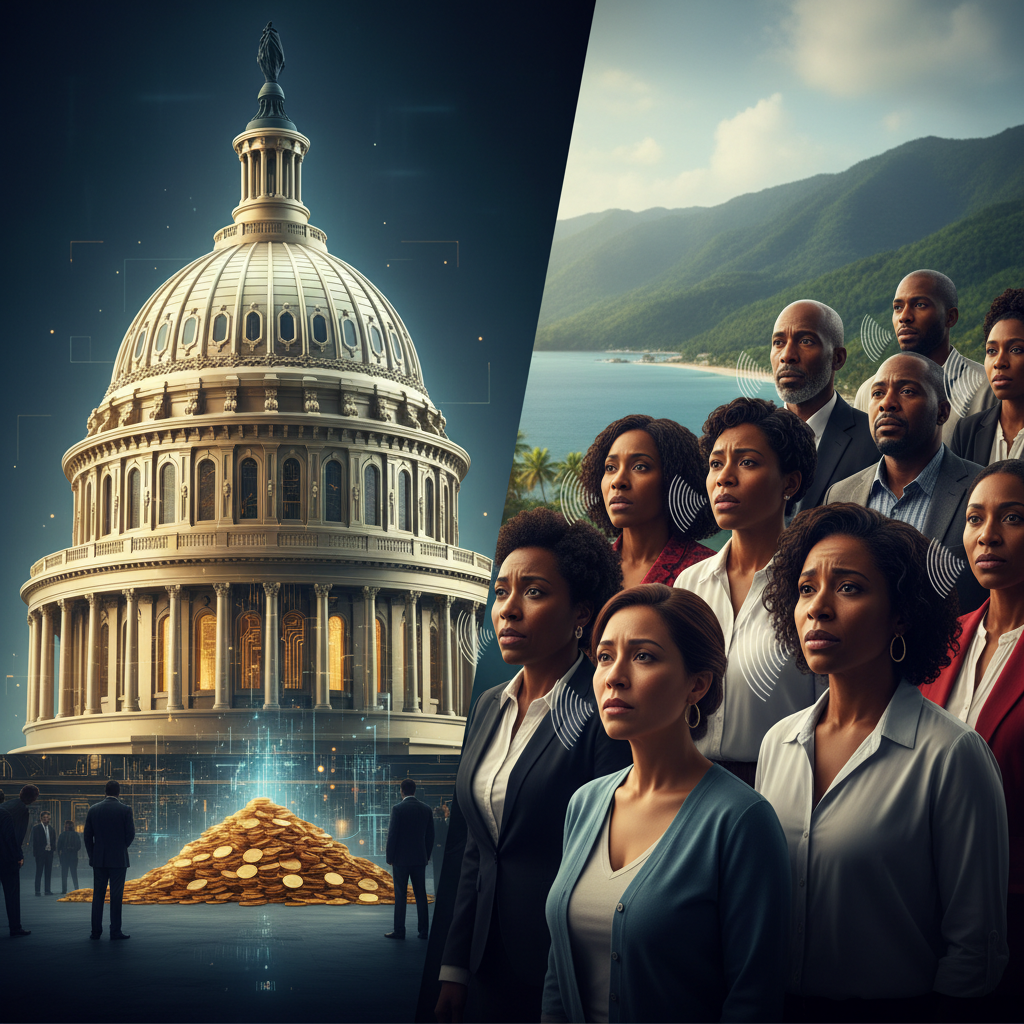
Alright, settle down, because we need to talk about what's brewing up in Washington, a place that often feels a million miles and a thousand worries away from our sunny shores. The US Congress, bless their hearts, is trying to figure out how to put some reins on artificial intelligence. And let me tell you, the lobbying happening around this is so intense, it makes our political campaigns look like a Sunday morning church picnic. Every tech titan, from OpenAI to Google, Microsoft to Meta, has their people on the ground, whispering sweet nothings and not-so-sweet warnings into the ears of lawmakers. It's a full-blown gold rush, only the gold is influence over the future of AI, and the prospectors are wearing expensive suits. But here's the kicker: while they're busy carving up the future, what does any of this mean for us, down here in Jamaica, where the biggest AI we usually think about is the one that helps predict hurricane season? More than you might think, my friend, more than you might think.
Why Most People Are Ignoring It (The Attention Gap)
Let's be real. When you hear 'US Congress debates comprehensive AI legislation,' your eyes probably glaze over faster than a plate of ackee and saltfish on a hot day. It sounds like bureaucratic mumbo jumbo, far removed from the rhythm of daily life. Most folks are worried about gas prices, school fees, or whether the internet will actually work today. They see AI as a fancy tool for Silicon Valley, a thing for nerds and billionaires, not something that impacts their ability to earn a living or keep their culture vibrant. The news cycle is already a dizzying kaleidoscope of local woes and global spectacles, so a complex, abstract debate about algorithms and ethics in a foreign parliament just doesn't make the cut. It's easy to dismiss it as 'them problem,' something that will sort itself out, or just another tech fad that will eventually fade. But that, my dears, is where we'd be making a big mistake.
How It Affects YOU (Personal Impact on Readers)
Now, let's bring it home. Imagine you're a small business owner in Kingston, maybe you run a tour company, or a craft shop in Ocho Rios. You're thinking about using AI to manage bookings, personalize customer experiences, or even translate your website into multiple languages. If the US sets the global standard for AI regulation, and trust me, they often do, then those rules will inevitably trickle down and impact the tools you can access, how you use them, and the data you can collect. If US legislation makes certain AI models too expensive, or too restrictive, or outright bans certain applications, that affects what's available on the global market, including right here. Your job, your privacy, even the content you consume online, could be shaped by these distant debates. Think about it: if AI systems become biased due to lax oversight, and those systems are used for things like loan applications or job screenings, who gets left behind? Often, it's those in developing nations, those whose data isn't as robustly represented in training sets, or those who don't fit the 'norm' defined by a few tech giants in California. This isn't just about Silicon Valley, it's about the very fabric of our digital existence, and the Caribbean has entered the chat, whether Washington notices or not.
The Bigger Picture (Societal, Economic, or Political Implications)
This isn't just about whether your next phone update has a better AI assistant. This is about power. The US, with its vast economic and technological might, is effectively setting the global playbook for AI. If they create a regulatory framework that favors large corporations and stifles smaller innovators, that has ripple effects. It could mean fewer opportunities for local tech startups, fewer diverse AI solutions, and a greater concentration of power in the hands of a few. Economically, if AI becomes a major driver of productivity and innovation, nations that can't access or adapt to these technologies due to prohibitive regulations or lack of infrastructure will fall further behind. Politically, who controls AI, controls information, surveillance, and even defense capabilities. We've seen how social media platforms, largely unregulated for years, have impacted elections and public discourse globally. AI could amplify those effects a thousandfold. The decisions made in Washington today could determine whether AI becomes a tool for global progress and equity, or another means of widening the gap between the haves and have-nots.
What Experts Are Saying (3-4 Expert Perspectives)