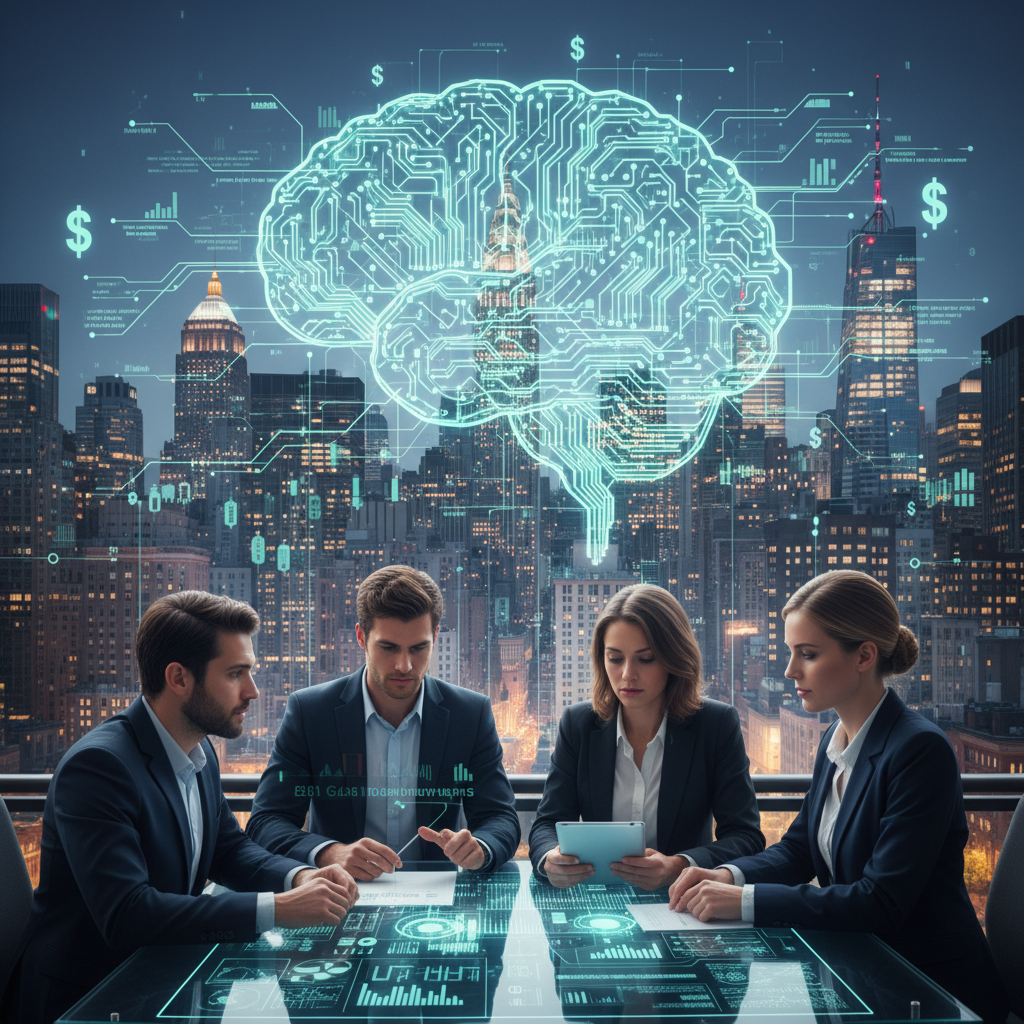

Remember those old movies, the ones with traders yelling into phones, paper flying everywhere, that chaotic energy on the New York Stock Exchange floor? Well, hold onto your hats, folks, because the financial world, particularly here in the good ol' USA, is getting a massive, mind-blowing upgrade, and it's all thanks to artificial intelligence. We're not just talking about fancy spreadsheets anymore, we're talking about systems that learn, adapt, and predict with a speed and accuracy that would make even the savviest human analyst blush.
From the bustling canyons of Manhattan to the tech hubs of Silicon Valley, AI is no longer a futuristic concept, it's the engine driving a revolution in how money moves, how risks are calculated, and how fortunes are made. This isn't some quiet, behind-the-scenes tweak either, this is a full-blown, lights-out, rock concert of innovation, and you need to pay attention to this.
Think about it: the financial markets are a beast of data. Every tick, every trade, every news headline, every tweet, it's all information. For decades, humans have tried to make sense of this tsunami of data, looking for patterns, predicting the next big wave. But now, AI models, powered by incredible computational muscle from companies like NVIDIA, are sifting through petabytes of information in milliseconds. They're not just finding patterns, they're discovering correlations we never even knew existed, predicting market shifts before the first ripple appears.
I recently spoke with Dr. Lena Petrova, Head of Quantitative Strategies at Citadel Securities in Chicago. She told me, "The sheer volume and velocity of data in modern financial markets make human-only analysis virtually impossible for optimal performance. Our AI systems can process global news feeds, economic indicators, and historical trading data simultaneously, identifying micro-trends that would be invisible to the naked eye. This allows us to execute trades with unprecedented precision and speed, often anticipating market movements by fractions of a second." Fractions of a second, people! That's the difference between a profit and a missed opportunity in this hyper-speed world.
It's not just about speed, though. It's about intelligence. These AI models are getting smarter, more nuanced. They're moving beyond simple algorithmic trading, which has been around for a while, into sophisticated predictive analytics and even generative AI for market insights. Imagine an AI that doesn't just tell you what happened, but can simulate future market scenarios based on a thousand different variables. That's the kind of power we're talking about.
Take risk management, for example. Historically, banks and investment firms have relied on complex statistical models, often based on historical data. But what happens when the market throws a curveball, something completely new? AI, particularly machine learning algorithms, can adapt. They can learn from new, unforeseen events, adjusting risk profiles in real-time. "Our AI-driven risk models have reduced our exposure to unexpected market volatility by an estimated 15% in the last year alone," shared Marcus Thorne, Chief Risk Officer at JPMorgan Chase, during a recent fintech summit in New York. "It's like having a super-intelligent guard dog that not only barks at danger but can also predict where the next threat will come from." That's a game-changer for stability and investor confidence.
And let's not forget the retail investor, the everyday folks like you and me. While the big players are using custom-built super-AIs, consumer-facing AI tools are democratizing access to sophisticated financial insights. Robo-advisors, powered by AI, are offering personalized investment strategies at a fraction of the cost of traditional financial advisors. Apps are analyzing spending habits, predicting future expenses, and even suggesting optimal savings plans. It's like having a personal financial guru in your pocket, always learning, always optimizing. This is going to change everything for how Americans manage their money, from their first paycheck to their retirement nest egg.
However, it's not all sunshine and rainbows. The rapid adoption of AI in finance also brings challenges. Cybersecurity is paramount, as these systems become prime targets for sophisticated attacks. And then there's the question of bias. If an AI is trained on biased historical data, it could perpetuate or even amplify those biases, leading to unfair outcomes, especially in areas like loan applications or credit scoring. We've got to be vigilant, ensuring these powerful tools are built and deployed responsibly.
Regulators are scrambling to keep up, too. The Securities and Exchange Commission (SEC) and the Commodity Futures Trading Commission (cftc) are actively exploring frameworks to ensure fairness, transparency, and stability in an AI-dominated market. "We are in constant dialogue with industry leaders and AI researchers," stated Commissioner Sarah Chen of the SEC, at a recent Washington D.C. hearing. "Our goal isn't to stifle innovation, but to ensure investor protection and market integrity remain paramount as AI reshapes the financial landscape." It's a delicate balance, for sure.
What truly excites me, though, is the potential for financial inclusion. Imagine AI models that can assess creditworthiness in underserved communities, not just based on traditional metrics, but on alternative data points, opening up access to capital for millions who were previously locked out. Or AI-powered micro-lending platforms that can empower small businesses in rural America. The possibilities are endless, and they point towards a more equitable financial future.
Companies like OpenAI and Google's DeepMind are pushing the boundaries of what's possible with large language models and reinforcement learning, and their advancements are quickly finding applications in finance, from natural language processing for earnings call analysis to complex market simulations. You can keep up with the latest industry news and breakthroughs on platforms like TechCrunch which often covers these developments.
The integration of AI in finance is more than just a technological upgrade; it's a fundamental shift in how value is created, managed, and distributed. It's a testament to human ingenuity, pushing the boundaries of what machines can do to augment our own capabilities. As we move forward, the collaboration between human expertise and artificial intelligence will define the next era of financial markets. It's a wild ride, and I for one, am strapped in and ready for the future. For more insights into how AI is impacting various global sectors, you might find this article on AI in Mongolia's financial script [blocked] interesting, showing the global reach of this transformation. We're on the cusp of something truly extraordinary, and the financial world, particularly here in the USA, is leading the charge.