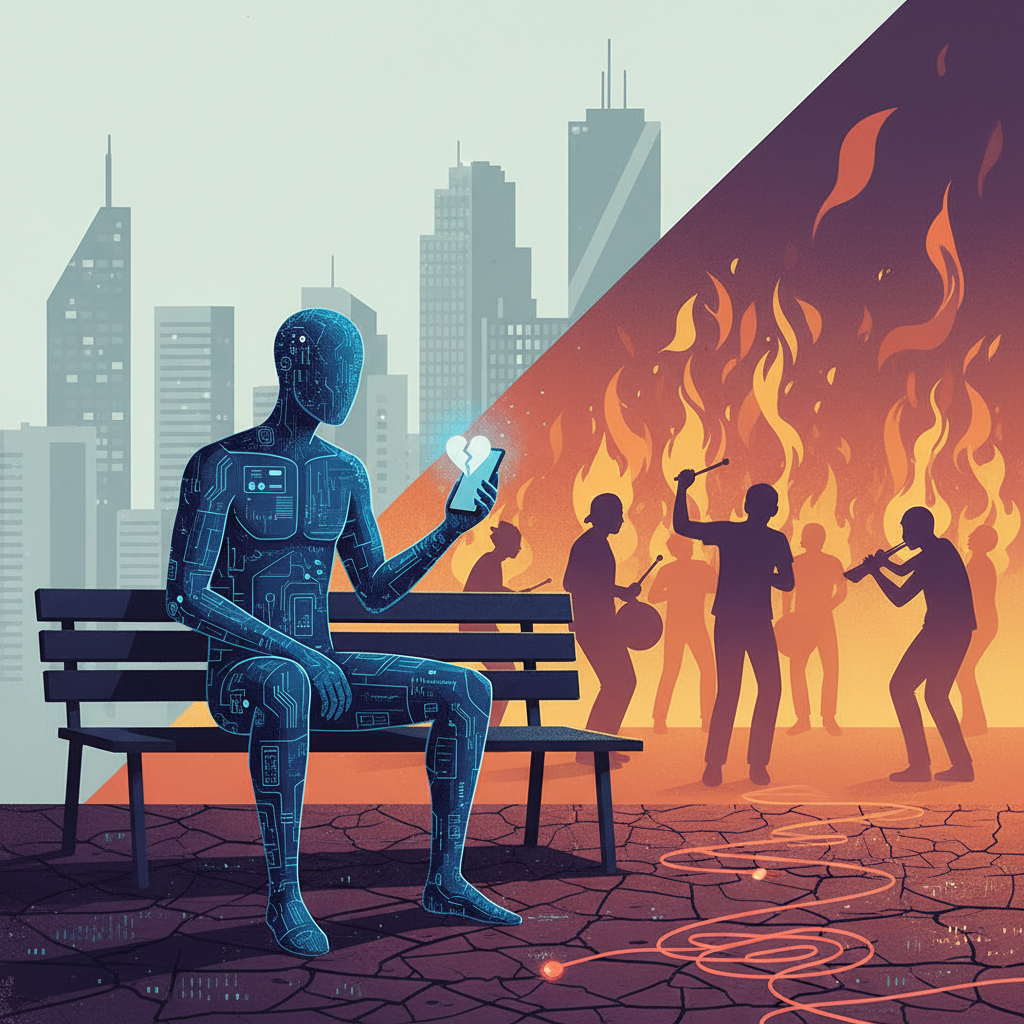

Let me tell you, my friends, there's a samba of solitude playing out across the digital landscape, and AI is conducting the orchestra. We are in April 2026, and the promise of algorithmic matchmaking, once heralded as the ultimate solution to finding love, is starting to feel less like a warm embrace and more like a cold, calculated transaction. From my vantage point here in Brazil, a nation that understands human connection perhaps better than any other, I see a future where the very tools designed to bring us together are pushing us further apart.
Think about it. Dating apps like Tinder, Bumble, and Happn, already deeply embedded in our social fabric, are now supercharging their algorithms with advanced AI models. We are talking about the kind of sophisticated machine learning that Meta's Llama and Google's Gemini are capable of, analyzing not just our stated preferences, but our swiping patterns, our chat histories, even our facial expressions in photos. They promise to find us the 'perfect match,' the one person who ticks all the boxes, the statistical anomaly that guarantees happiness. But what if this pursuit of algorithmic perfection is precisely what's making us so profoundly lonely?
I've seen it firsthand. My cousin, a brilliant software engineer right here in São Paulo, spent months meticulously refining his dating app profile. He used AI tools to optimize his photos, crafted witty bios with generative AI, and even employed sentiment analysis to tailor his opening lines. He got more matches, yes, a flood of them. But after countless dates, he felt emptier than ever. 'Rodrigoò,' he told me over a caipirinha, 'it's like I'm dating a ghost. The algorithm connects me to people who look good on paper, but there's no spark, no unpredictability, no magic. It's all too… efficient.'
This efficiency, this relentless optimization, is the heart of the problem. AI models are designed to minimize friction, to maximize engagement, and to deliver what they perceive as 'success' based on predefined metrics. But human connection is messy, unpredictable, and often illogical. It thrives on serendipity, on shared vulnerabilities, on the beautiful imperfections that an algorithm might filter out. When every interaction is curated, every potential partner pre-vetted by an unseen hand, we lose the very essence of discovery. We become passive recipients of algorithmic suggestions, rather than active participants in the unpredictable dance of human courtship.
Dr. Sofia Mendes, a leading sociologist at the Federal University of Rio de Janeiro, echoed this sentiment in a recent interview. 'The algorithms are creating echo chambers of desirability,' she explained. 'They show us more of what we've already liked, reinforcing narrow preferences and reducing exposure to diverse personalities. This homogeneity, paradoxically, makes it harder to form deep, meaningful connections. People feel seen by the algorithm, but not necessarily by another human being.' She estimates that while dating app usage has soared by 40% in Brazil over the last three years, reported feelings of loneliness among young adults have increased by 25% in the same period, according to preliminary data from her ongoing research.
Now, I hear the counterarguments already. The tech evangelists, the venture capitalists pouring billions into these platforms, they will tell you that AI is simply a tool, a powerful enhancer. They will argue that it helps people who are shy, or busy, or living in remote areas, to find partners they might never encounter otherwise. 'AI removes the guesswork,' says Lucas Pereira, CEO of a São Paulo based AI startup specializing in relationship analytics. 'It learns from millions of data points to identify true compatibility factors that humans often miss. Our goal is to create more successful, lasting relationships, not fewer.' He cites internal data suggesting a 15% increase in long-term relationship formation among users of his company's AI-enhanced matchmaking service.
And yes, there's some truth to that. For some, AI can indeed be a bridge. For someone with very specific needs or preferences, or someone in a niche community, these algorithms can be a godsend. But we must ask ourselves, at what cost? Are we trading genuine human intuition for algorithmic inference? Are we outsourcing the most fundamental aspect of our emotional lives to machines that, for all their intelligence, lack consciousness, empathy, and the capacity for true love?
This is not a uniquely Brazilian problem, of course. It's a global phenomenon. But here, where community, family, and direct interaction are so deeply ingrained in our culture, the shift feels particularly jarring. We are a people who thrive on connection, on the warmth of human touch, on the spontaneity of a shared laugh over a coxinha. The idea of a machine dictating our romantic destiny feels, frankly, a little cold.
What truly concerns me is the long-term impact. If we become accustomed to algorithmic curation in our most intimate relationships, what happens to our ability to navigate the complexities of real human interaction? Do we lose the resilience, the patience, the willingness to compromise that true relationships demand? Do we become so reliant on the 'perfect match' that we discard anyone who doesn't fit the algorithmic mold?
This is Brazil's decade, not just for economic growth and cultural influence, but for shaping the ethical landscape of emerging technologies. We cannot afford to simply import Silicon Valley's solutions without critical examination. We need to foster innovation that prioritizes human well-being, not just engagement metrics. We need our own technologists, our own thinkers, to ask the hard questions about what kind of future we are building.
Perhaps the answer isn't to abandon AI in dating altogether, but to redefine its role. Instead of a matchmaker, maybe AI should be a facilitator, a tool that helps us understand ourselves better, or suggests diverse experiences where we might naturally encounter new people. It should augment our human capacity for connection, not replace it. We need to remember that the most profound connections often arise from unexpected places, from shared vulnerabilities, from the beautiful, messy, inefficient process of simply being human together.
We must demand transparency from these platforms. We need to understand how these algorithms work, what data they are collecting, and what biases they might be perpetuating. Regulators, like those at Brazil's National Data Protection Authority, need to step up and ensure that our digital hearts are protected just as much as our digital wallets. The conversation around AI ethics, often focused on job displacement or autonomous weapons, must expand to include the very fabric of our social and emotional lives. For more on the broader implications of AI in society, I often consult publications like Wired and MIT Technology Review.
The loneliness epidemic is real, and it's growing. If AI in dating apps continues on its current trajectory, optimizing for superficial compatibility rather than fostering genuine connection, we risk creating a generation of perfectly matched, yet profoundly isolated, individuals. It's time for us to reclaim the narrative, to insist that technology serves humanity, not the other way around. Otherwise, the samba of solitude will only grow louder, and the warmth of human connection will fade into the cold glow of our screens.