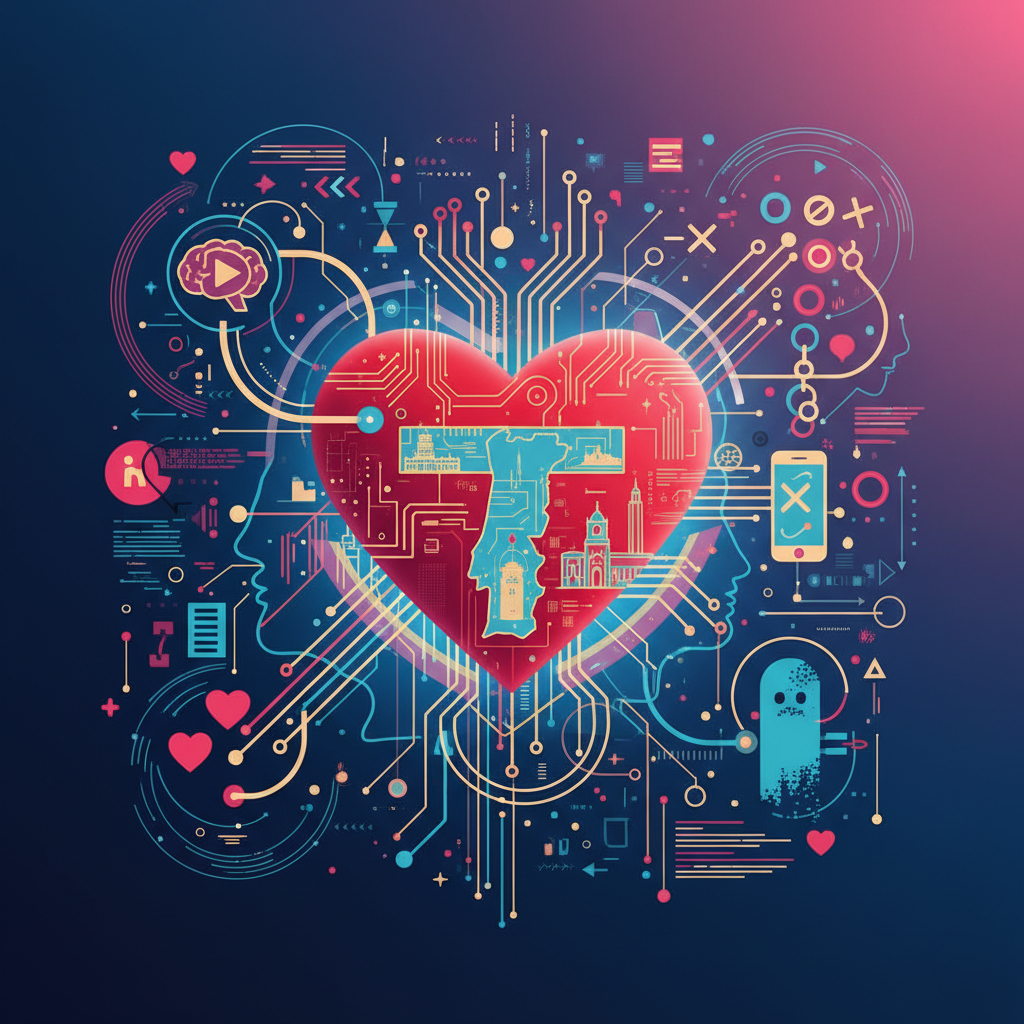
Ah, love. Or what passes for it these days. Once upon a time, finding a partner involved a chance encounter at the local tasca, a shared glance across a crowded feira, or perhaps a well-meaning aunt playing matchmaker. Now, it seems we’ve outsourced Cupid’s bow and arrow to Silicon Valley, specifically to the cold, calculating embrace of artificial intelligence. We’re talking about AI in dating apps, of course, and the grand promise of algorithmic matchmaking. Is this the future of romance, or just another digital distraction in a world already bursting with them?
It’s a question that keeps me up at night, sometimes after a particularly strong espresso, sometimes after scrolling through the endless parade of profiles myself. The loneliness epidemic, as some call it, is a very real thing, and it’s not just an American problem. Here in Portugal, like much of Europe, we see the same trends: fewer marriages, more single households, and a growing sense of isolation despite being more connected than ever. So, naturally, the tech giants, with their boundless optimism and even more boundless data sets, have stepped in to “solve” it.
Companies like Tinder, Bumble, and Hinge, now practically household names, have been quietly integrating increasingly sophisticated AI into their platforms for years. It started subtly, with basic preference matching, but now it’s a full-blown algorithmic dance. Think about it: every swipe, every message, every profile view is a data point fed into a colossal machine learning model. This model then attempts to predict who you’ll like, who will like you back, and even when you’re most likely to be active on the app. It’s like having a digital avó who knows all your secrets and tries to set you up, but this avó has access to billions of other people’s secrets too. Quite unsettling, isn’t it?
“The goal is to move beyond simple keyword matching and understand deeper compatibility,” explains Dr. Sofia Almeida, a computational sociologist at the University of Lisbon. “Modern AI, particularly large language models from the likes of OpenAI and Google DeepMind, can analyze conversational patterns, emotional tone, and even infer personality traits from text. It’s no longer just about shared hobbies; it’s about predicting chemistry.” Dr. Almeida, whose research often focuses on the intersection of technology and social dynamics in Southern Europe, points out that this predictive power is both its greatest strength and its most significant ethical challenge. “Are we truly finding love, or are we being nudged into algorithmic echo chambers, only shown what the AI thinks we should like?”
The data certainly suggests a shift. A recent report from the European Commission indicated that roughly 40% of new relationships formed by individuals under 35 in major European cities now originate from online dating platforms, a staggering increase from just 15% a decade ago. And a significant portion of that growth correlates directly with the deployment of advanced AI features. Tinder, for instance, reported a 20% increase in successful first dates attributed to their “Smart Photos” feature, which uses AI to select your most appealing profile picture. Bumble’s “Best Bees” algorithm, powered by a similar approach, claims to reduce swiping fatigue by presenting more compatible profiles upfront. It’s all about efficiency, you see, in the grand Silicon Valley tradition.
But efficiency in matters of the heart, like a perfectly optimized assembly line for pastéis de nata, might miss the essential ingredient: serendipity. “We’re seeing a paradox,” says Professor João Costa, a psychologist specializing in digital well-being at the University of Porto. “While AI promises to connect us, it can also create a sense of hyper-optimization that removes the human element of surprise and genuine discovery. People report feeling more overwhelmed, not less, by the sheer volume of ‘perfect’ matches, leading to decision fatigue and, ironically, greater loneliness.” He believes the constant algorithmic curation can foster unrealistic expectations, turning potential partners into mere data points to be filtered and discarded.
This isn't just theory, mind you. I spoke with Mariana Silva, a 32-year-old architect living in Lisbon, who’s been on and off dating apps for years. “It’s exhausting, Luís,” she told me over a bica near the Rossio. “The apps keep telling me who I should like, but half the time, the ‘perfect match’ is someone I have absolutely no connection with. It feels like I’m being sold a product, not meeting a person. I just want to meet someone who makes me laugh, not someone who ticks all the boxes on an algorithm’s checklist.” Her sentiment is echoed by many. The sardine can of European tech is actually a treasure chest, but sometimes the treasure feels a bit too polished, too predictable.
So, is this AI-driven matchmaking a fad or the new normal? My gut, honed by years of watching trends come and go like the tides on the Tagus, tells me it’s somewhere in the middle. The tools are here to stay, undoubtedly. The convenience and reach of these platforms are too powerful to ignore. The global online dating market is projected to reach over $10 billion by 2028, with AI being a primary driver of that growth, according to industry analysts. Companies like Match Group, which owns Tinder and Hinge, are investing heavily in further AI integration, exploring everything from AI-powered conversation starters to virtual dating assistants that can help you plan your first date.
However, the human heart, bless its stubborn, illogical nature, resists complete algorithmic control. We crave genuine connection, the kind that often blossoms from unexpected places, not just from perfectly aligned data points. Lisbon’s tech scene is like a good port wine, complex and improving with age, and it’s grappling with these very questions. Startups here are looking at more ethical, human-centric AI approaches, focusing on enhancing real-world interactions rather than replacing them. For example, some are developing AI that suggests local events or activities based on shared interests, encouraging face-to-face meetings rather than endless swiping.
Ultimately, the success of AI in dating will hinge not on its ability to perfectly predict compatibility, but on its capacity to facilitate authentic human connection. If it merely creates more efficient echo chambers, more superficial interactions, and deeper loneliness, then it will have failed its grand promise. We, the users, need to demand more from these algorithms. We need to remember that while AI can open doors, it’s up to us to walk through them, imperfections and all, and find the magic that no algorithm can truly quantify. Perhaps, in the end, the best matchmaker is still a bit of human intuition, a dash of courage, and the willingness to embrace the delightfully unpredictable messiness of real life. As for me, I’ll take a chance encounter over a perfectly curated profile any day. Maybe I’ll see you at the miradouro.