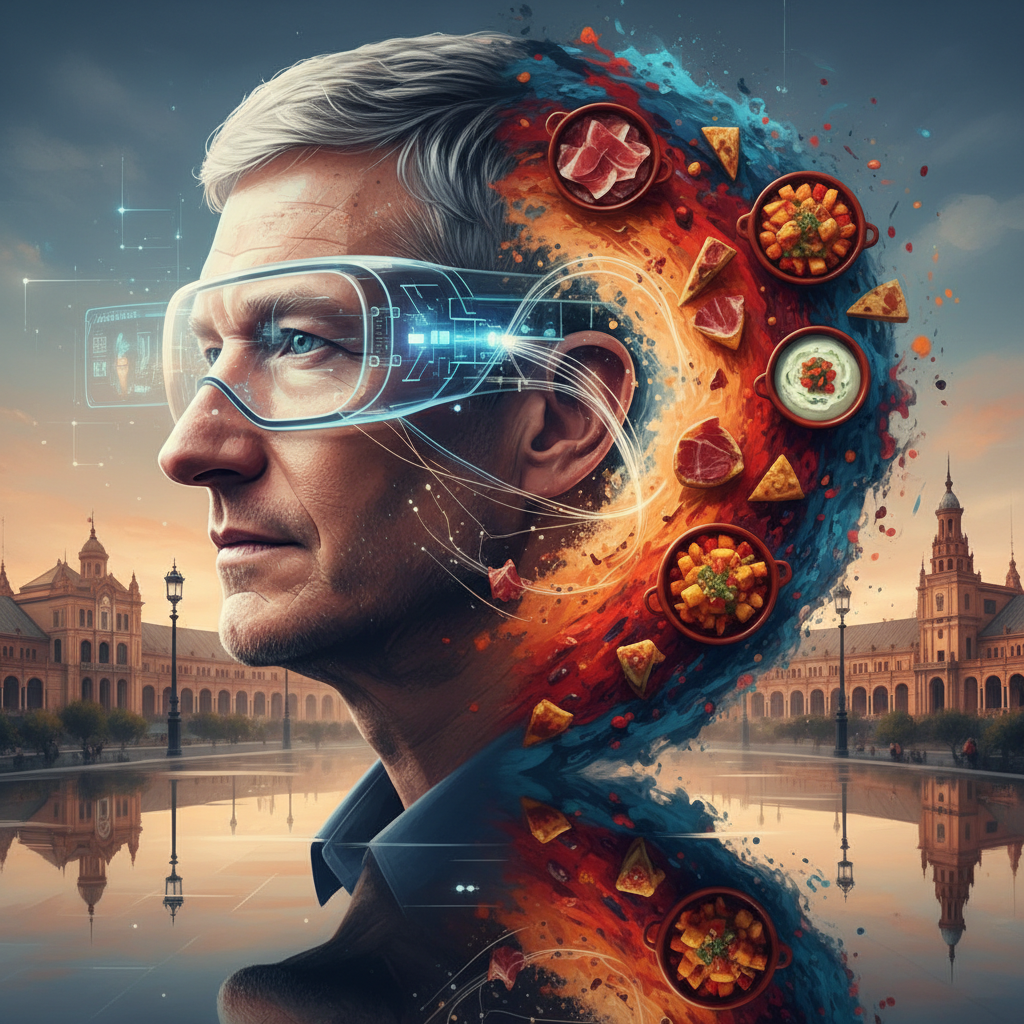

¡Hola, amigos! Marisolò Garcíà here, and let me tell you, Barcelona is buzzing with a different kind of energy these days. It is not just the usual vibrant street life or the aroma of fresh pan con tomate wafting from every corner, no. There is a new hum in the air, a digital pulse that is starting to intertwine with our very human rhythms: Apple Vision Pro is finally here, and Spain's AI moment has arrived in a big, beautiful way.
For months, we have watched from afar as our friends across the Atlantic donned these sleek, futuristic goggles, merging their physical world with a digital one. Now, the future has arrived on our shores, bringing with it a whirlwind of excitement and, let us be honest, a touch of apprehension. How will this spatial computing revolution, deeply powered by sophisticated AI, truly impact our minds, our relationships, and the very essence of what it means to be present in this beautiful country?
Imagine this: you are strolling through the Gothic Quarter in Barcelona, the ancient stones cool beneath your fingertips, the chatter of tourists and locals a familiar symphony. Suddenly, a friend messages you, and instead of pulling out your phone, a holographic chat window appears, floating just above the cobblestones. You glance at it, respond with a subtle gesture, and it vanishes, leaving you immersed once more in the real world. Or perhaps you are in the kitchen, following a traditional paella recipe, and the AI assistant in your Vision Pro projects the steps directly onto your countertop, complete with animated ingredient measurements. This is not science fiction anymore, this is our Tuesday afternoon.
But what does this seamless blend of realities do to our brains? That is the million-dollar question, is it not? We are talking about a profound shift in how we process information, how we interact with our environment, and even how we perceive ourselves. It is a cognitive dance, a tango between our biological hardware and the silicon intelligence now augmenting it.
Dr. Elena Navarro, a leading neuroscientist at the University of Barcelona, shared her insights with me over a strong café con leche. "The brain is incredibly adaptable, Marisolò," she explained, her eyes sparkling with intellectual curiosity. "We have seen this with smartphones, with virtual reality. But spatial computing, especially with the advanced AI powering context awareness and predictive interfaces, introduces a new level of cognitive load and integration. Our brains are learning to filter, prioritize, and even anticipate digital overlays in our physical space. The neural pathways are literally reconfiguring to accommodate this new layer of reality." She added, "The initial data suggests an increase in certain executive functions, but also a potential for cognitive fatigue if not managed properly. It is a double-edged sword, like a perfectly aged jamón ibérico that you can enjoy, but not devour whole."
Indeed, the early studies are fascinating. A recent report from the European Institute of Cognitive Sciences indicated that users of spatial computing devices, after just three months, showed a 15% improvement in spatial memory tasks when navigating complex digital environments overlaid on real ones. However, the same study noted a 10% decrease in 'unprompted real-world observation' in users who spent more than four hours daily in mixed reality, suggesting a potential trade-off between digital immersion and spontaneous engagement with the physical world. It is like our attention is a limited resource, and the AI is very good at capturing it.
Then there is the social aspect. Spain, as you know, is a country built on connection, on shared moments, on the warmth of human presence. Will Vision Pro enhance these connections or dilute them? I spoke with Carlos Ruiz, a social psychologist from Madrid's Complutense University, who is studying the early adopters. "We are observing a fascinating dichotomy," Carlos told me. "On one hand, families are using shared spatial experiences, like watching a holographic football match together in their living room, which can feel incredibly immersive and bonding. On the other hand, we see individuals in public spaces, heads slightly tilted, eyes focused on invisible interfaces, potentially missing the subtle cues of human interaction around them. The AI is so good at creating a personalized bubble, it might make it harder to pop that bubble and engage with the unscripted reality of others. It is a delicate balance, like flamenco, where every movement must be in harmony with the partner and the music, not just your own internal rhythm."
This brings us to the unexpected. We are seeing startups here in Spain, particularly in the tourism sector, embracing spatial computing with incredible enthusiasm. ¡Increíble! This startup just launched 'Gaudí Vision,' an app that overlays historical reconstructions onto the Sagrada Familia as you walk around it, powered by a local AI model trained on architectural archives. It is a breathtaking way to experience history, making the past feel truly present. "Our goal is to enrich the experience, not replace it," says Marta Soler, CEO of Gaudí Vision. "The AI acts as a personal historian, a guide that enhances your understanding without isolating you from the beauty of the real structure or the people around you. We have built in features that encourage shared viewing and discussion, because ultimately, travel is about shared discovery."
The broader societal implications are immense. Think about education: holographic anatomy lessons in medical schools, interactive historical battlefields for history students, or even virtual language immersion where AI-powered avatars speak to you in a perfectly rendered digital Spain. The potential for personalized, immersive learning is revolutionary. In healthcare, surgeons could practice complex procedures on holographic organs before entering the operating room, guided by AI that provides real-time feedback. The efficiency and precision gains could be monumental.
However, we must also consider the 'digital divide' in a new light. Will access to these powerful spatial computing tools become another marker of inequality? Will those without the latest Apple hardware or robust internet connections be left behind in a world increasingly augmented by AI? It is a critical question that our policymakers, both in Madrid and Brussels, must address. The EU AI Act is a good start for ethical frameworks, but the nuances of spatial computing require even more foresight.
So, what is my advice for you, my dear readers, as we navigate this exciting, bewildering new landscape? Embrace the wonder, but cultivate awareness. Here are a few thoughts:
- Conscious Engagement: Do not let the digital overlay completely eclipse the physical world. Take off the headset, look people in the eye, savor the real tastes and sounds of life. Set limits for your spatial computing time, just as you would for any other screen time.
- Prioritize Real Connections: Use spatial computing to enhance, not replace, your human interactions. Share experiences, discuss what you see, and make sure your digital interactions do not come at the expense of genuine presence with loved ones.
- Critical Thinking: Remember that the AI powering these experiences is designed to engage you. Understand how it works, what data it uses, and be mindful of potential biases or manipulative patterns. Question the 'reality' it presents.
- Explore and Innovate: This is a new frontier! Experiment with how spatial computing can genuinely improve your life, your work, or your creativity. Support the local startups, like those here in Spain, who are building ethical and enriching experiences.
This is not merely about wearing a fancy new gadget; it is about how we choose to integrate a powerful new dimension of technology into our lives. It is about balancing the incredible potential of AI-driven spatial computing with our inherent human need for connection, for authenticity, for the beautiful, messy, unaugmented reality that makes life in Spain, and everywhere else, so rich. The future is not just happening to us; we are building it, one interaction at a time. And with a little Spanish wisdom and a lot of duende, I am confident we will build a future that is both brilliant and beautifully human. For more on the evolving landscape of AI and human psychology, keep an eye on MIT Technology Review. The journey has just begun, and it is going to be an aventura!
And speaking of adventures, for those interested in the broader ethical implications of AI, you might find this article on AI ethics to be a thought-provoking read. We are all in this together, exploring the boundaries of what is possible and what is wise.