
For too long, the conversation about artificial intelligence has been dominated by distant voices, by the tech giants of Silicon Valley and their cloud-centric visions. But here in Mexico, where our digital landscape is rapidly evolving, we know that the future of AI is not just about algorithms and processing power, it is about people, about privacy, and about power. That is why Apple's recent unveiling of 'Apple Intelligence,' a suite of on-device AI features, has ignited a crucial debate, one that resonates deeply with our efforts to establish meaningful data governance.
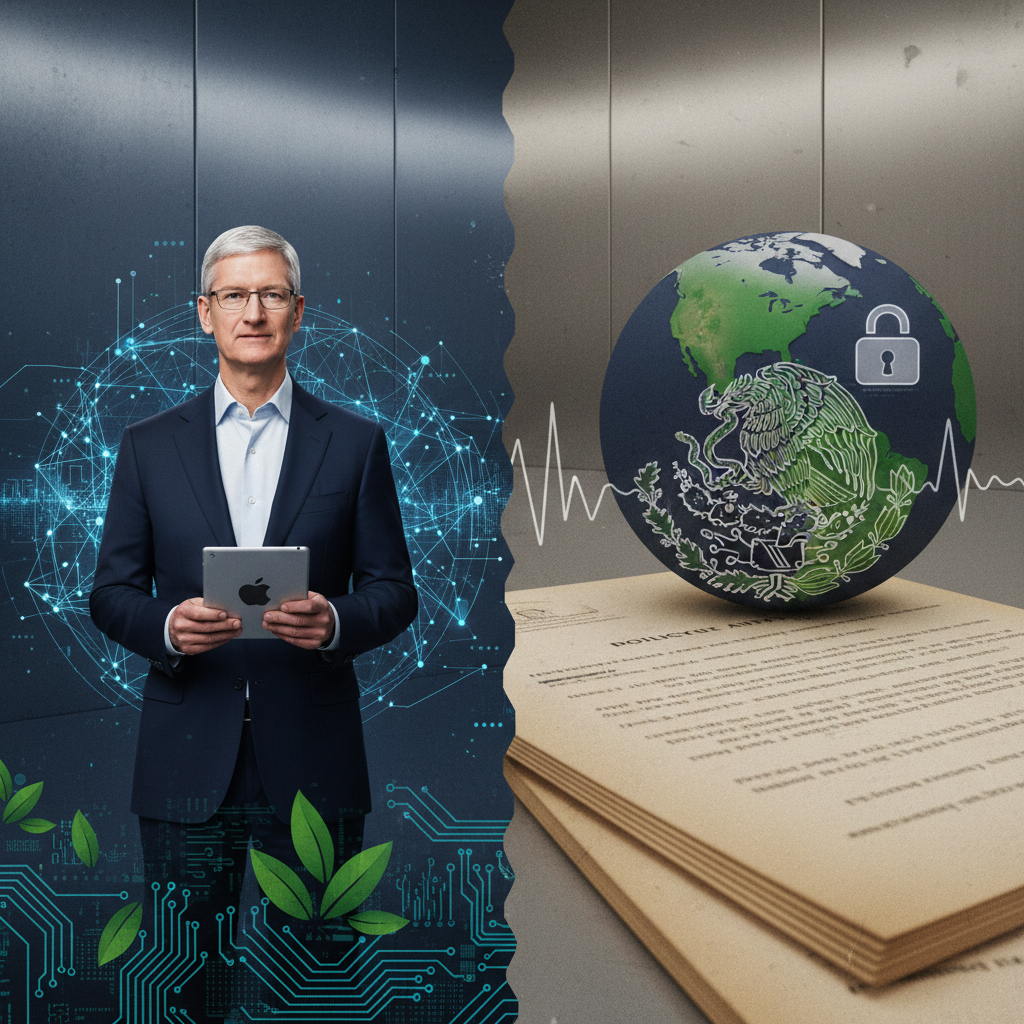
The policy move itself, while not a direct regulation, is a strategic shift by one of the world's most influential companies. Apple is betting big on processing AI tasks directly on your iPhone, iPad, and Mac, rather than sending all your data to massive cloud servers. This is a stark contrast to the dominant models championed by Google with Gemini, Microsoft with Copilot, and OpenAI's various offerings, which rely heavily on vast data centers. Apple's pitch is simple and powerful: enhanced privacy and security, as your personal data stays on your device. They argue that sensitive information, from your calendar entries to your photos, will not be uploaded to the cloud for AI analysis unless explicitly necessary and with robust safeguards.
Who is behind this, and why? This strategy is a direct response to growing public concern over data privacy, a concern I share wholeheartedly. Tim Cook, Apple's CEO, has long positioned the company as a champion of user privacy, a stance that has often set them apart from their peers. This on-device AI approach is an extension of that philosophy. Their motivation is not purely altruistic, of course. It is a shrewd business move, differentiating them in an increasingly crowded AI market. By offering a privacy-first AI, they aim to solidify their premium brand image and appeal to users who are wary of handing over their digital lives to distant servers. For many, the idea of a personal AI assistant that truly understands you, without constantly sending your most intimate details across the internet, is incredibly appealing. It is about trust, and trust is a valuable commodity in our digital age.
What does this mean in practice, especially for us in Mexico? On the surface, it sounds promising. Imagine your phone summarizing your WhatsApp conversations in Spanish, organizing your photos by local landmarks, or suggesting replies in a way that truly understands our unique cultural nuances, all without your data leaving your device. This could be a game-changer for digital inclusion and data sovereignty. Our government, through institutions like the Instituto Nacional de Transparencia, Acceso a la Información y Protección de Datos Personales (inai), has been working tirelessly to strengthen data protection laws. Apple's approach could, in theory, complement these efforts by reducing the attack surface for data breaches and minimizing the need for cross-border data transfers, a complex issue in international law. However, there is a catch. While data stays on the device, the models themselves are still developed by Apple, and the underlying biases and design choices are embedded within them. We must ask: whose values are being coded into these on-device intelligences? Will they truly understand the rich tapestry of Mexican life, or will they still reflect a predominantly Anglo-American worldview?
Industry reaction has been mixed, as you might expect. Cloud-first competitors like Google and Microsoft are quick to point out the limitations of on-device processing. They argue that the most powerful, cutting-edge AI models require the immense computational resources of the cloud, and that on-device AI will always be a step behind in terms of capability and flexibility. "While Apple's privacy focus is commendable, the true power of AI, especially for enterprise and complex research, lies in scalable cloud infrastructure," stated Dr. Elena Vargas, Chief AI Architect at a leading Mexican tech firm, InnovaTech Solutions. "Trying to cram that into a phone means compromises on intelligence and adaptability. It is a trade-off, and for many applications, the cloud still wins." Yet, some smaller startups, particularly those focused on specialized, privacy-sensitive applications in areas like healthcare or finance, see an opportunity. They believe Apple's stance validates a market for secure, localized AI solutions. "This creates a new paradigm," says Ricardo Morales, CEO of DataSegura, a Mexican startup specializing in secure data processing. "It empowers developers to build truly private AI experiences, which is something our clients in sensitive sectors desperately need. TechCrunch has been covering this shift, highlighting the potential for new business models around privacy-preserving AI."
From a civil society perspective, the debate is equally complex. On one hand, the promise of enhanced privacy is a significant victory for digital rights advocates. "For years, we have been calling for greater control over our personal data," explains Sofia Flores, a digital rights activist with Red por la Defensa Digital. "Apple's on-device AI could be a powerful tool in that fight, reducing the footprint of data surveillance and mass collection. It is a step towards true data self-determination." However, concerns remain. The 'black box' nature of proprietary AI models, even on-device ones, still poses transparency challenges. How can we audit these systems for bias if we cannot see how they work? Furthermore, the high cost of Apple devices means that this 'privacy premium' is not accessible to everyone. "La tecnología es para todos," I always say, but if the most secure and private AI is locked behind expensive hardware, then it exacerbates the digital divide, leaving many vulnerable. This affects every family in Latin America, where access to cutting-edge technology is often a privilege, not a right.
Will it work? That is the million-dollar question, and the answer is not simple. For Apple, it is likely to reinforce their brand and appeal to their existing user base, potentially attracting new customers who prioritize privacy. For consumers, it offers a tangible benefit in terms of data security, a welcome change from the constant barrage of privacy breaches. However, for the broader goal of equitable and responsible AI governance, Apple's strategy is only one piece of a much larger puzzle. It does not replace the need for robust, internationally coordinated regulatory frameworks that address issues like algorithmic bias, accountability, and transparency, regardless of where the processing happens. The European Union's AI Act, for example, aims to create such a framework, and we in Mexico are watching closely, learning from these global efforts.
Ultimately, while Apple's on-device AI strategy offers a compelling vision for privacy, it also highlights the urgent need for us to define our own digital future. Mexico's AI story is not being told by Silicon Valley alone, until now. We must ensure that the benefits of AI, whether on-device or in the cloud, are shared equitably and that our values of fairness, transparency, and access are embedded in the very fabric of these powerful technologies. The conversation around AI governance must continue to amplify the voices of civil society, local experts, and everyday citizens, ensuring that technology serves humanity, not the other way around. The future of our data, our privacy, and our digital sovereignty depends on it. For more insights into how different regions are tackling AI governance, you can explore articles on MIT Technology Review. The path ahead is complex, but it is one we must walk with our eyes wide open, demanding accountability and striving for a truly inclusive digital world.