
The air crackles with innovation, doesn't it? Every day, it seems, another AI breakthrough from OpenAI or Google DeepMind promises to revolutionize our lives, our industries, our very understanding of what is possible. From Warsaw to Wrocław, our brilliant Polish engineers are not just watching this revolution unfold, they are building it, shaping it, making it uniquely ours. Yet, amidst this exhilarating march forward, a growing chorus of concern echoes from factory floors and office cubicles alike, a human voice asking: What about us? What about the workers?
This is not a new question, of course. Automation has been a constant companion to industrial progress for centuries. But the speed, scale, and cognitive reach of today's artificial intelligence, powered by giants like NVIDIA and its incredible chips, feel different. It feels like a tectonic shift, and it is stirring something profound within labor movements globally. Here in Poland, a nation forged in the crucible of worker solidarity, this pushback against AI-driven automation carries a particular resonance, a historical echo that Silicon Valley might underestimate at its peril.
My argument is clear: The current trajectory of AI development, if left unchecked by robust worker protections and proactive social dialogue, risks creating a deeply fractured society. We cannot allow technology, no matter how brilliant, to become a tool that erodes human dignity and economic stability for the many, while enriching only a select few. This isn't about stopping progress, it is about steering it towards a more equitable and humane destination. We have seen this fight before, and we know how to win it.
Consider the recent rumblings from Germany's powerful IG Metall union, which represents millions of industrial workers. They are not simply resisting AI, they are demanding a seat at the table, advocating for co-determination in how AI is implemented, and pushing for retraining programs funded by the very companies that benefit from automation. Their approach is pragmatic, not Luddite. They understand AI is coming, but they insist it must serve humanity, not subjugate it. This proactive stance, rooted in a long tradition of worker empowerment, offers a blueprint for how unions can engage constructively, yet firmly, with the AI revolution.
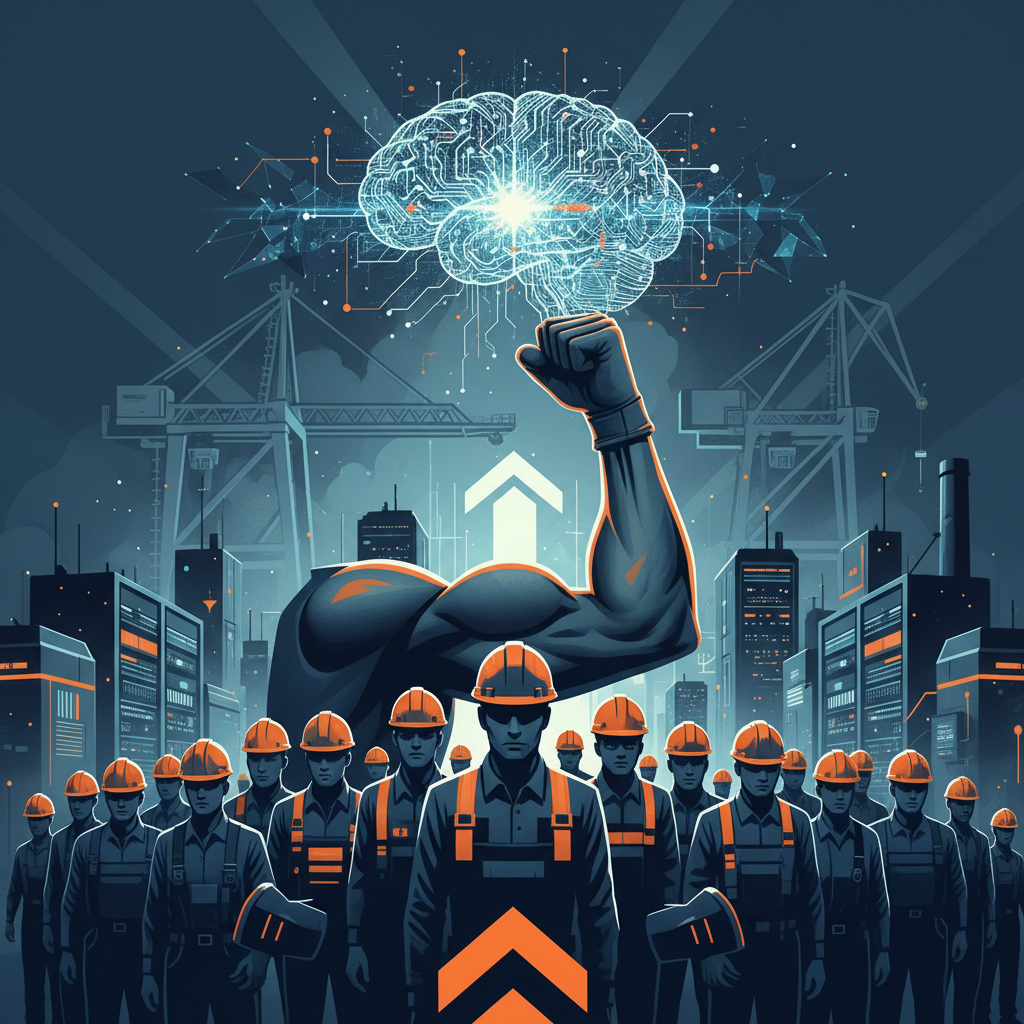
Here in Poland, our history provides an even more potent example. The Solidarity movement, Solidarność, born in the shipyards of Gdańsk, showed the world the power of collective action, the unbreakable spirit of workers uniting for their rights, their dignity, and a better future. That spirit, I believe, is not confined to history books. It lives on in the hearts of Polish workers, in the resilience and ingenuity that has fueled our economic transformation. Poland's tech talent is Europe's best-kept secret, and our workers are not afraid to innovate, but they also demand fairness.
Now, I can already hear the counterarguments. The tech optimists, often from the sun-drenched campuses of California, will tell us that AI creates more jobs than it destroys. They will point to new roles in AI development, data labeling, and maintenance, arguing that displaced workers can simply be retrained. They will cite the efficiency gains, the increased productivity, and the potential for economic growth that AI promises. They might even suggest that resisting AI is akin to resisting the printing press or the steam engine, a futile attempt to hold back the tide of progress. They will say that unions are simply afraid of change, clinging to outdated models of employment.
But this perspective, while perhaps well-intentioned, often overlooks the human cost and the systemic challenges. Retraining is not a magic wand. It requires significant investment, accessible programs, and a fundamental shift in educational paradigms. Furthermore, the new jobs created by AI are often highly specialized, requiring skills that are vastly different from those being automated away. A factory worker with decades of experience on an assembly line cannot simply become a prompt engineer overnight. The social safety nets in many countries, including some in Europe, are simply not robust enough to handle mass displacement without creating immense hardship.
Moreover, the argument that AI creates more jobs often ignores the quality of those jobs. Are they well-paying? Do they offer benefits? Do they provide a sense of purpose and dignity? Or are we creating a future where a small elite thrives while a vast precariat struggles in low-wage, precarious roles, constantly battling algorithms for their next gig? This is not the future we want, not in Poland, and not anywhere.
We must also consider the ethical implications. When algorithms decide who gets hired, who gets fired, or even who gets a loan, without human oversight or accountability, we risk embedding existing biases and creating new forms of discrimination. The European Union, with its pioneering AI Act, is attempting to grapple with these complexities, but legislation alone is not enough. We need active participation from civil society, from workers, and from unions to ensure that AI serves all of us, not just a privileged few.
What is the path forward then? It is not about rejecting AI. That would be as foolish as trying to stop the wind. Instead, it is about demanding a seat at the table, about proactive engagement, and about shaping the future of work with human values at its core. It means advocating for policies that prioritize human well-being alongside technological advancement. This includes universal basic income discussions, robust social safety nets, lifelong learning initiatives, and, crucially, strengthening the power of collective bargaining.
We need to foster a culture where companies like Microsoft and Amazon, who are investing heavily in AI, see workers not as obstacles to automation, but as partners in its responsible deployment. We need to encourage a dialogue where the concerns of a truck driver in Opole or a customer service representative in Kraków are heard just as clearly as the pronouncements from a CEO in Seattle. This Polish startup just launched an incredible AI solution for logistics optimization, but they are also actively engaging with their employees about its impact, a vital step often missed by their larger counterparts.
As Professor Joanna Mazur, a leading expert in labor economics at the Warsaw School of Economics, recently stated, "The narrative cannot simply be 'AI will take your job.' It must be 'How can AI augment human potential, and how do we ensure the benefits are shared equitably?' This requires a fundamental shift in corporate responsibility and government policy, driven by the collective voice of workers." Her words resonate deeply with our history and our aspirations.
The future of work is not predetermined by algorithms. It is shaped by choices we make today. We have the opportunity, and indeed the responsibility, to ensure that the AI revolution is a revolution for all, one that uplifts humanity, rather than diminishing it. The spirit of Solidarity, the belief in the power of ordinary people to effect extraordinary change, is precisely what we need to navigate this complex new world. Let us not forget that lesson, for it holds the key to a future where technology truly serves humankind. The fight for a humane AI is just beginning, and it is a fight we can, and must, win. We must ensure that the digital revolution respects the dignity of labor, a principle that has always been central to our Polish identity. You can learn more about these global labor movements and their strategies on Reuters Technology News or dive deeper into the ethical considerations of AI on MIT Technology Review. For a broader perspective on AI's societal impact, Wired's AI section offers insightful analysis. We cannot afford to be passive observers. We must be active participants. This is our moment to define what progress truly means. ```