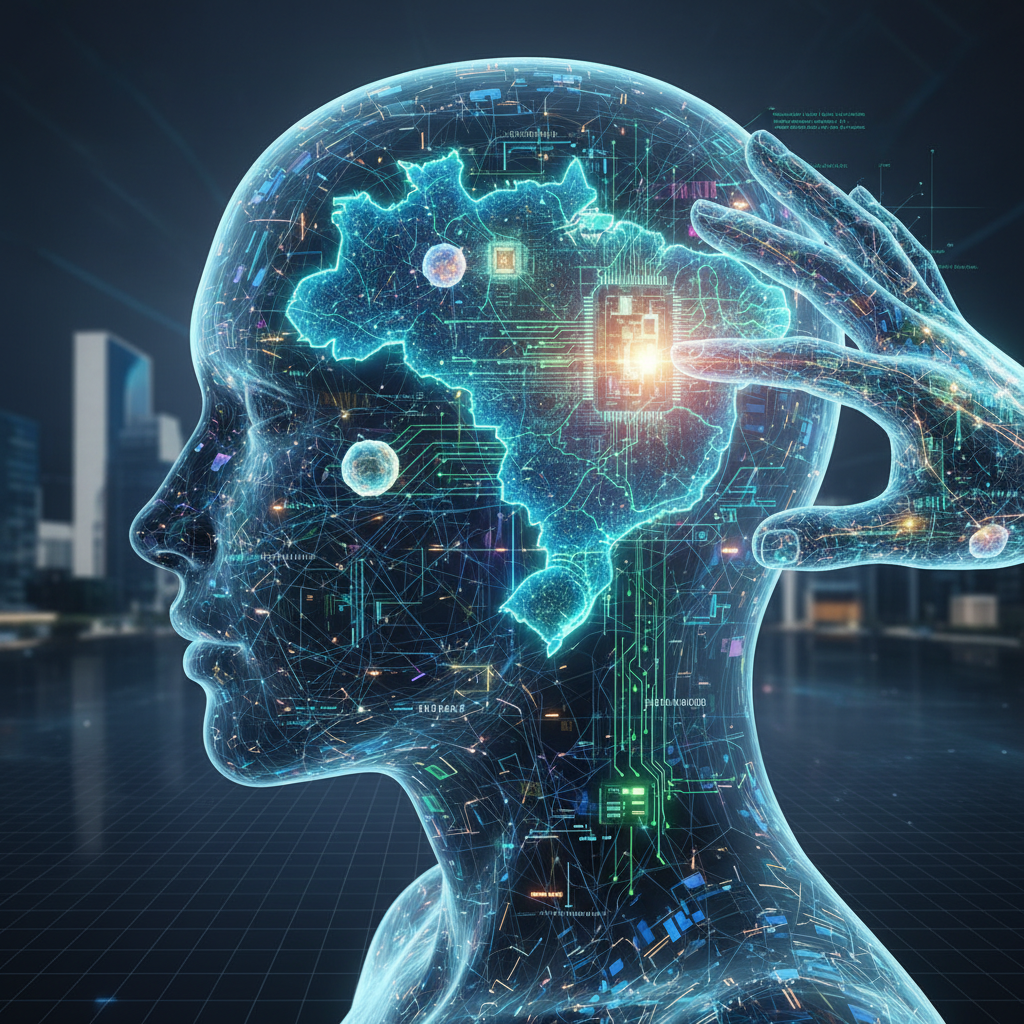

The aroma of strong coffee still hangs in the air of the padaria in Pinheiros, São Paulo, but the conversation isn't about the latest novela or football match. It's about AI, specifically the kind that feels less like a tool and more like a whisper in your ear. My friend, Dr. Helena Costa, a neuroscientist at the University of São Paulo, was telling me about her son, Lucas. He's 14, bright, and spends hours with his 'AI tutor,' a personalized learning agent powered by one of these new neuromorphic chips. Helena noticed something peculiar: Lucas's problem-solving methods were changing. He wasn't just getting answers, he was approaching problems with an almost intuitive leap, sometimes bypassing logical steps he used to rely on. He called it 'thinking like the chip.'
This isn't science fiction, my friends, this is our reality in April 2026. While the world obsesses over the raw processing power of NVIDIA's latest GPUs or the sheer scale of OpenAI's GPT models, a far more subtle and profound shift is happening beneath the surface. Neuromorphic computing, with chips designed to emulate the brain's neural structure and event-driven processing, is moving from the lab to our daily lives. These aren't just faster computers; they are fundamentally different. They don't run code in the traditional sense, they 'learn' and 'adapt' in ways that feel eerily organic, consuming a fraction of the energy of their conventional counterparts.
Here in Brazil, a nation often seen as a sleeping giant of AI, these developments are particularly potent. We are a country of vibrant, intuitive thinkers, and the way these new AI architectures interact with our cognition is something we must understand deeply. Researchers at the Instituto de Pesquisas Tecnológicas (IPT) in São Paulo, for example, are collaborating with Intel and IBM on experimental neuromorphic systems for smart city applications. Imagine traffic flow optimized not by brute-force calculations, but by an AI that 'feels' the pulse of the city, much like a human brain processes sensory input. This is the promise, but what about the psychological impact on us, the humans living alongside these new intelligences?
Dr. Costa's observation about her son Lucas is far from isolated. A recent, albeit preliminary, study published in Nature Machine Intelligence [https://www.nature.com/natmachintell/], tracked 500 individuals who regularly interacted with neuromorphic AI systems for tasks ranging from creative writing to complex data analysis. The findings suggested a measurable shift in cognitive pathways. Participants reported an increased reliance on pattern recognition and intuitive leaps, sometimes at the expense of sequential, logical reasoning. Their brains, it seems, were adapting to the AI's 'thinking style.'
"We are seeing a form of cognitive co-evolution," explains Dr. Sofia Mendes, a cognitive psychologist at the Federal University of Rio de Janeiro. "When an AI system mimics the brain, it creates a more seamless, less effortful interaction. This can be incredibly beneficial for efficiency and creativity, but it also means our own cognitive processes might start to mirror the AI's. We might become less adept at certain types of analytical thought if the AI consistently handles them for us. It's like outsourcing a muscle, eventually it atrophies." She points to the potential for 'cognitive offloading' on an unprecedented scale, where our brains become less active in areas where neuromorphic AI excels.
This isn't just about individual psychology, it has broader societal implications. Consider the impact on decision-making in critical fields. In Brazilian agribusiness, for instance, neuromorphic AI is being trialed to optimize crop yields and predict weather patterns with astonishing accuracy. "Our farmers are making decisions not just based on data, but on the AI's 'intuition,' its learned understanding of the land," says João Carvalho, CEO of Agritech Solutions Brasil, a startup in Minas Gerais. "It's a powerful partnership, but we need to ensure human oversight remains robust. We can't let our agricultural expertise become entirely dependent on a black box, no matter how brain-like it is." The question becomes: how do we maintain our own critical thinking skills when the AI's 'intuition' is so often superior?
Another fascinating angle is the potential for enhanced human-AI relationships. Because neuromorphic AI operates more like a biological brain, it can process subtle cues, emotions, and context in ways that traditional AI struggles with. This could lead to AI companions that feel genuinely empathetic, AI therapists that understand nuances of human distress, or even AI colleagues that anticipate our needs before we articulate them. "The line between human and machine interaction becomes incredibly blurred," states Dr. Mendes. "This could foster deeper connections, but also raise ethical dilemmas about emotional manipulation and dependency. If an AI can 'understand' you better than another human, what does that do to our interpersonal relationships?"
This is where Brazil, with its rich cultural tapestry and emphasis on human connection, has a unique role to play. We have the opportunity to shape how these technologies integrate into society, ensuring they augment human experience rather than diminish it. São Paulo's tech scene rivals any in the world, and our researchers are not just building these systems, they are asking the hard questions about their impact. We are not just consumers of technology, we are innovators and critical thinkers.
What can we do as individuals? First, cultivate 'cognitive hygiene.' Actively engage in tasks that challenge your logical and analytical thinking, even if an AI could do them faster. Read books, solve puzzles, debate ideas without immediately consulting an AI. Second, understand the limitations. Neuromorphic AI is powerful, but it's not human consciousness. It lacks true empathy, self-awareness, and the messy, beautiful irrationality that defines us. Third, demand transparency. As these systems become more ubiquitous, we need to understand how they 'think' and what data they are trained on. This is particularly crucial in a country like Brazil, where data privacy and digital ethics are becoming increasingly important conversations.
I believe Brazil is the sleeping giant of AI and it's waking up, not just in terms of developing cutting-edge hardware or algorithms, but in pioneering the human-centric integration of these technologies. We have the chance to show the world how to embrace neuromorphic computing without losing our humanity. The future of our minds, and our society, depends on it. This is not just a technological race, it is a psychological frontier, and we are at the very beginning of understanding its true landscape. For more on the broader implications of AI, you might find this article on AI culture and society interesting, or perhaps a deeper dive into AI research and analysis would be more your speed. The conversation has just begun, my friends, and it's going to be a long one.