The late afternoon sun, a painter's dream of gold and rose, was dipping its brush into the impossibly blue waters of Moorea as I arrived at the Criobe research station. The air smelled of salt and frangipani, a scent that always reminds me of home, of childhood, of the deep, enduring connection we Polynesians have to our fenua and our moana. It was here, amidst the gentle murmur of the lagoon, that I was scheduled to meet Dr. Hinaarii Teihotaata, a woman whose journey from marine biology to AI ethics has been as fascinating as the coral reefs she once studied.
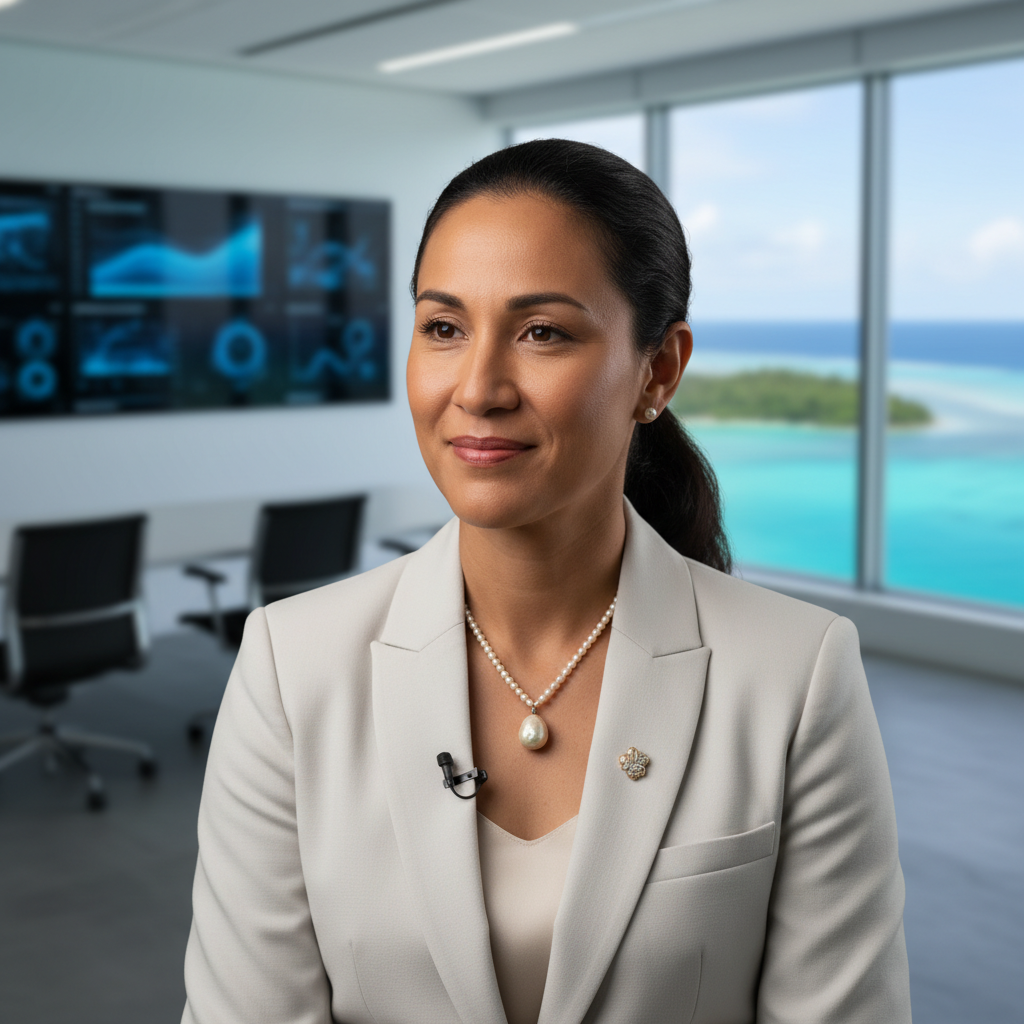
Dr. Teihotaata, with her silver streaked hair pulled back in a practical braid and eyes that held the wisdom of both the ocean and the digital realm, greeted me with a warm ia ora na. She offered me a seat on a shaded veranda, overlooking the vibrant reef where parrotfish darted like jewels. "It's a different kind of ecosystem, isn't it Tiàre, the one we're here to talk about today?" she mused, gesturing towards the horizon, a subtle nod to the vast, interconnected world of artificial intelligence.
Her path to becoming a leading voice on AI governance, particularly China's model, is not what you might expect. Hinaarii spent two decades immersed in coral restoration projects, witnessing firsthand the devastating effects of climate change on our precious marine life. "I saw the reefs dying, bleaching, disappearing," she told me, her voice soft but firm. "And I realized that technology, even the most advanced, was both part of the problem and, perhaps, our only hope for a solution. But the way we build and govern that technology, that's everything."
She explained how her work led her to explore how AI could predict bleaching events, track illegal fishing, and even model ocean currents with unprecedented accuracy. This quest for powerful tools eventually brought her into contact with Chinese researchers who were pioneering AI applications in environmental monitoring. "Their approach was incredibly efficient, incredibly centralized," she explained. "The speed at which they could deploy solutions, gather data, and iterate was astounding. It made me wonder, could such a model, with its emphasis on collective good and rapid deployment, be beneficial for urgent global crises like climate change, especially for vulnerable regions like ours?"
Our conversation drifted to the core of China's AI governance model: innovation with state control. It is a concept that often sparks debate in the West, seen as an antithesis to open innovation and individual freedoms. But Hinaarii offered a nuanced perspective. "In the Pacific, technology takes a different form. We understand collective responsibility, the idea that the community's well-being often outweighs individual desires. Beijing's model, at its heart, prioritizes stability and national objectives, using AI as a tool to achieve those. For environmental issues, where coordinated, large-scale action is paramount, there's a certain appeal to that efficiency."
I asked her about the balance, the inherent tension between innovation and control. "It is a tightrope, e hoa," she said, using a familiar term for friend. "On one side, you have the incredible pace of innovation, driven by giants like Baidu and Alibaba, pushing boundaries in computer vision, natural language processing, and autonomous systems. On the other, you have the state, guiding, regulating, and sometimes, restricting. They view AI as a strategic national asset, not just a commercial product. This means massive government investment, coordinated research efforts, and a clear national strategy for deployment. It is a top-down approach, yes, but it delivers results, often at scale and speed that Silicon Valley struggles to match."
She cited examples: China's extensive use of AI for smart city management, its sophisticated satellite networks for environmental monitoring, and its rapid development of AI-powered healthcare solutions. "We see the results, the tangible impact. For us, here in the islands, where resources are scarce and the threats are existential, the promise of such powerful, coordinated AI solutions is compelling. Imagine AI models, trained on vast datasets, predicting cyclones with pinpoint accuracy days in advance, or optimizing renewable energy grids across our scattered motu."
However, Hinaarii was quick to acknowledge the concerns. "The question always comes back to who controls the controller? When the state is the primary architect and overseer of AI, the lines between public good and state surveillance can blur. Data privacy, algorithmic bias, and the potential for censorship become very real concerns. For a region like Oceania, which values autonomy and traditional knowledge so deeply, importing such a model without careful adaptation would be like trying to fit a square peg into a round hole. We have our own mana, our own way of doing things."
She shared a surprising moment from her research, a conversation with a Chinese AI researcher who expressed admiration for the Pacific's decentralized, community-led conservation efforts. "He told me, 'Dr. Teihotaata, you have something we sometimes lack: a deep, inherent trust within your communities. Our AI governance seeks to build that trust through control, but perhaps genuine trust comes from empowerment, from the people.' It was a moment of unexpected connection, a reminder that even across vast cultural divides, the human desire for a better future, and the questions of how to achieve it, are universal."
As the sun dipped below the horizon, painting the sky in fiery hues, Hinaarii spoke of her vision for the Pacific. "We don't need to adopt any model wholesale, whether it's from Beijing or Silicon Valley. Our strength lies in our adaptability, our resilience. We can learn from China's efficiency and scale, from their strategic investment in AI infrastructure, but we must filter it through our own values. We need to develop our own AI governance frameworks, ones that prioritize fenua and moana protection, cultural preservation, and the well-being of our people. This means investing in local talent, building our own data sovereignty, and ensuring that AI serves us, not the other way around."
She believes that the Pacific, despite its small size, can be a leader in ethical AI development, precisely because of its unique challenges and cultural perspectives. "The ocean connects us and so does AI, but how we navigate that connection is up to us. We can show the world how to use AI not just for economic gain or national power, but for planetary stewardship, for the very survival of our cultures and our environment. It is a story about paradise and pixels, and we are writing it now."
Her words resonated deeply. It is easy to be swept away by the grand narratives of global tech powers, but Hinaarii reminded me that the most profound innovations often emerge from the places most directly impacted. The future of AI governance, particularly in a world grappling with climate change, might not be dictated by a single model, but by a mosaic of approaches, each reflecting the values and needs of its people. And in the Pacific, that mosaic is just beginning to take shape, guided by the wisdom of those who live closest to the rhythm of the earth and the sea. For more insights into global AI governance, one might look to MIT Technology Review for diverse perspectives, or follow the latest developments in AI startups on TechCrunch. The conversation around AI's impact on society is constantly evolving, as detailed by sources like Wired.
Dr. Teihotaata's work at Criobe, supported by institutions like the University of French Polynesia, is a testament to this localized approach. She is currently leading a project to develop AI models for predicting crown-of-thorns starfish outbreaks, a major threat to coral reefs, using satellite imagery and local environmental data. It is a small step, perhaps, in the grand scheme of global AI, but for the reefs of Moorea, it could mean everything.