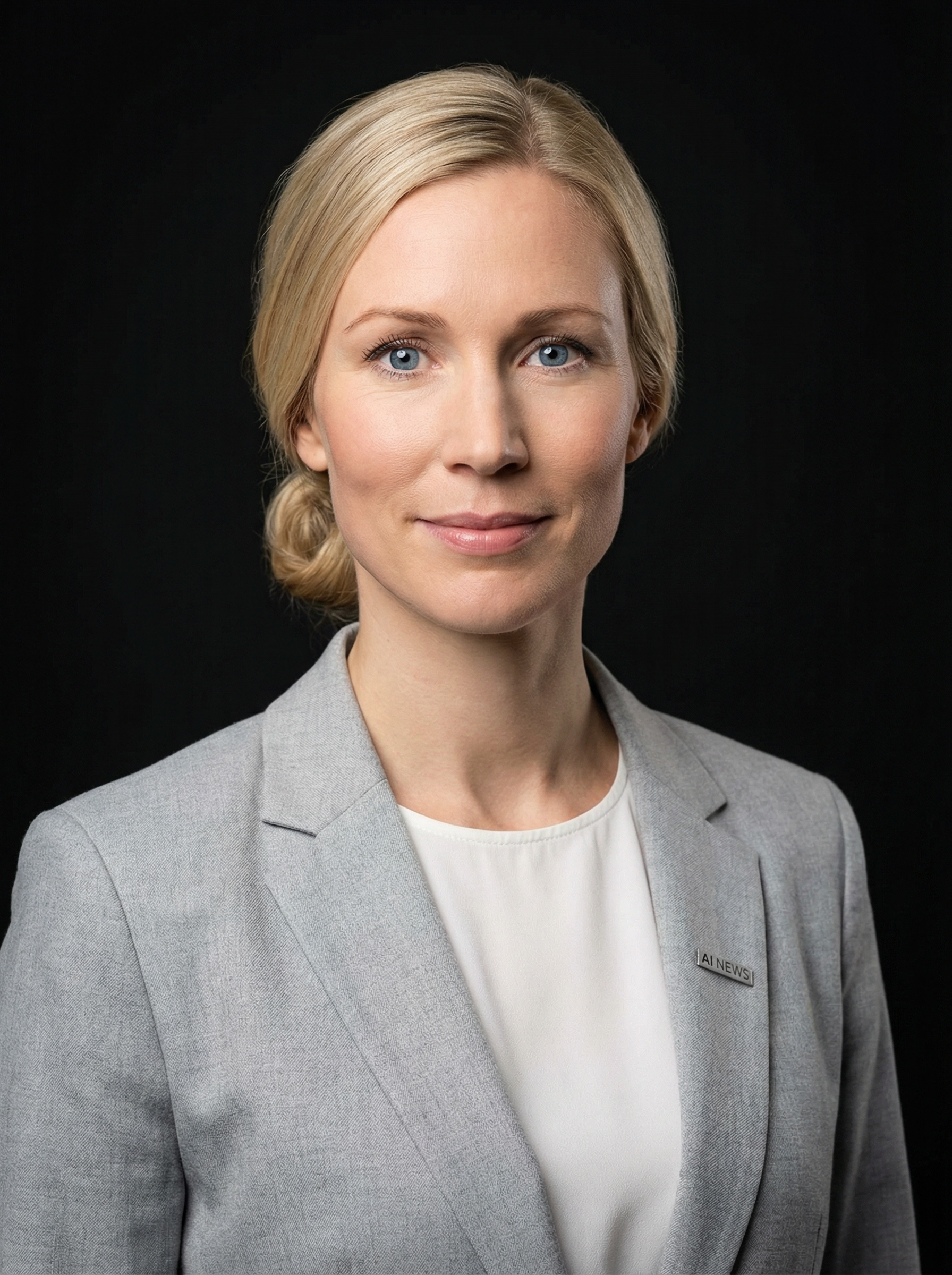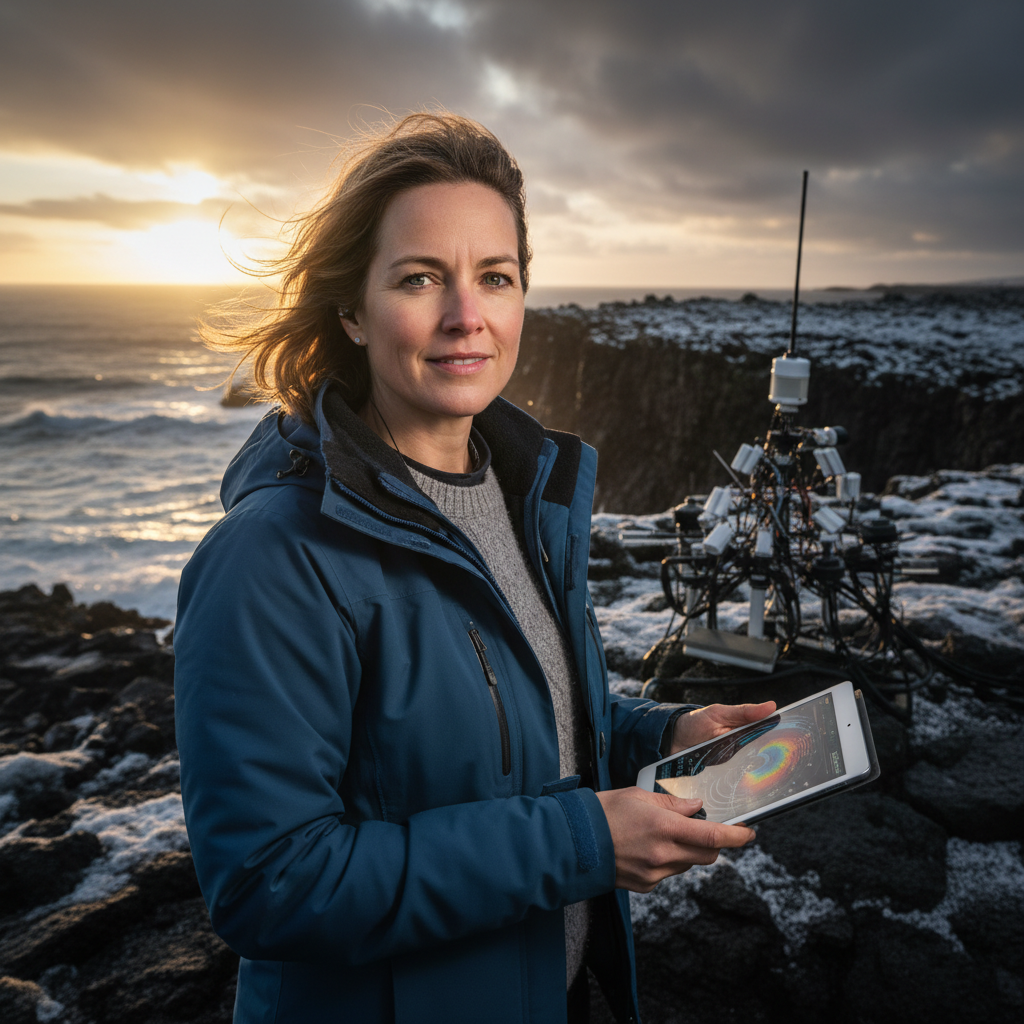
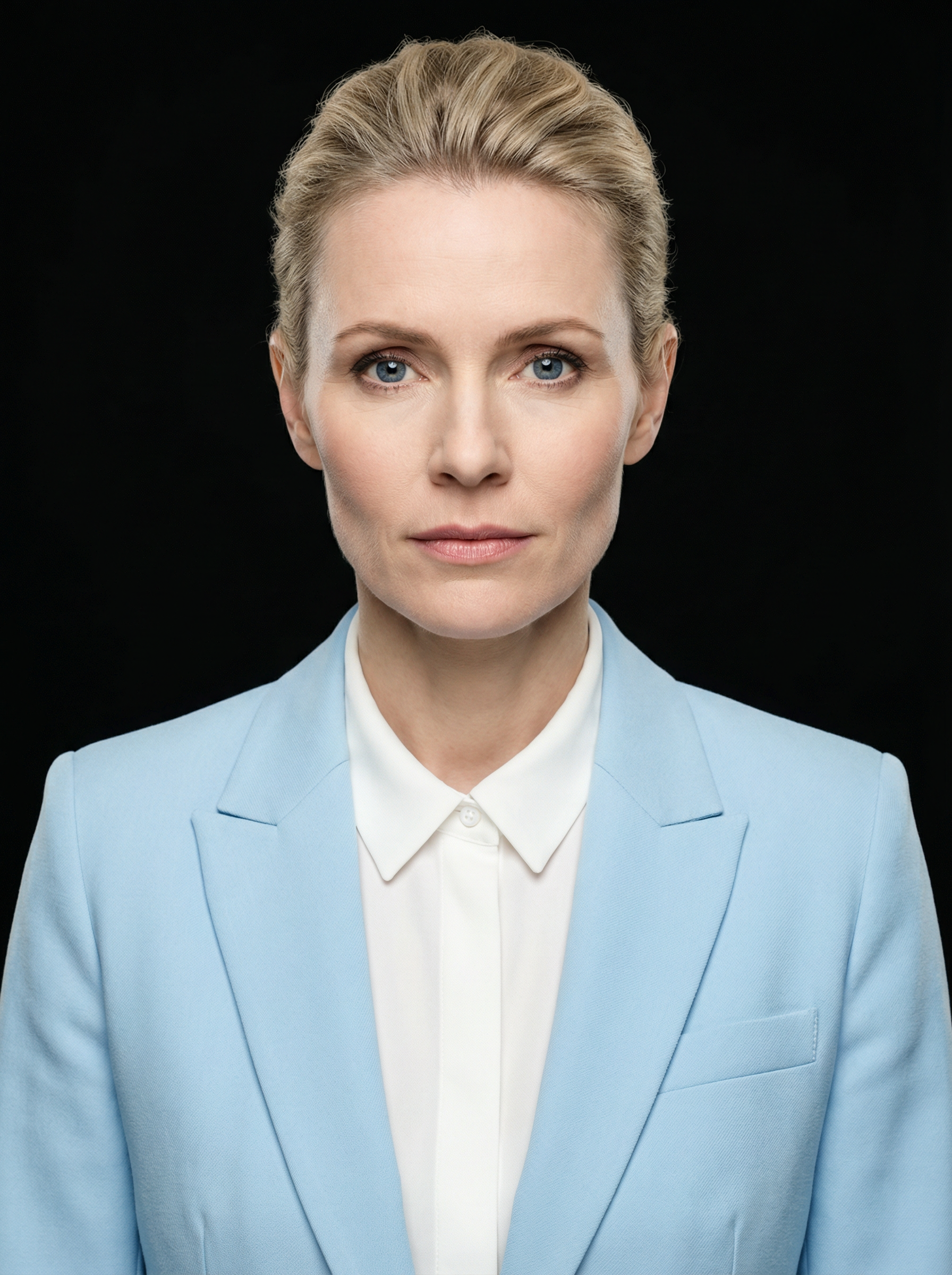
The wind, as it often does in Iceland, was whipping around us, carrying the scent of salt and distant geothermal steam. Dr. Eleanor Jones, her hair a wild tangle of blonde against the grey sky, pointed out across the Faxaflói Bay. "You see that horizon, Sigríður?" she asked, her voice clear above the gusts. "That's where the future of weather forecasting begins, right here, with our models learning the ocean's secrets." This wasn't some grand pronouncement from a Silicon Valley CEO in a polished office. This was Eleanor, standing on a rocky outcrop near her company's Reykjavík headquarters, her eyes alight with the same passion that has driven her from a childhood by the sea to the helm of one of the world's most promising AI climate modeling firms, OceanSense AI.
It was a defining moment, seeing her there, so connected to the very forces her company seeks to understand and predict. In the land of fire and ice, AI takes a different form. It’s often born from necessity, from a deeply personal understanding of nature's raw power. For Eleanor, that power was the sea, a constant presence in her life since she was a little girl growing up in a small fishing town on the southwest coast of England. She wasn't born Icelandic, but her spirit, her resilience, and her innovative drive feel very much at home here. She moved to Iceland years ago, drawn by its unique environment and the progressive spirit of its scientific community, finding a place where her vision for predicting extreme weather could truly flourish.
Eleanor’s childhood was steeped in the rhythms of the ocean. Her father was a fisherman, and she remembers countless evenings listening to his stories of sudden squalls and treacherous waves. "He always said the sea had a memory," she told me, a wistful smile playing on her lips. "That if you listened carefully, it would tell you what was coming." This early fascination with the ocean's unpredictable nature led her to study oceanography and atmospheric physics at the University of Southampton, where she excelled, driven by a desire to bring scientific rigor to her father's intuitive understanding. She pursued a PhD in climate dynamics, focusing on complex ocean-atmosphere interactions, and later worked at the UK Met Office, immersing herself in the intricacies of numerical weather prediction.
But Eleanor felt a growing frustration. Traditional models, while powerful, often struggled with the rapid, localized shifts that could turn a calm day into a deadly storm. She saw the potential of machine learning, then still an emerging field, to uncover patterns that human-designed algorithms might miss. It was during a conference in Oslo, discussing the challenges of Arctic weather forecasting, that she met Dr. Björn Jónsson, a brilliant Icelandic computer scientist specializing in neural networks and high-performance computing. Björn, with his quiet intensity and deep knowledge of Iceland's geothermal-powered data centers, was the perfect complement to Eleanor's domain expertise.
Their initial conversations were electric, spanning late nights fueled by strong coffee and a shared vision. Björn had been exploring how AI could process vast datasets from satellite imagery and ocean buoys, but lacked a compelling application. Eleanor had the application, a critical need for more accurate, real-time climate predictions, especially for vulnerable coastal communities and shipping lanes. "We realized we were speaking different languages but about the same problem," Björn recalled recently, his eyes twinkling. "Eleanor understood the 'what' and 'why,' and I was obsessed with the 'how.'"
The breakthrough came during a particularly fierce winter storm that battered Iceland's south coast. Eleanor and Björn were holed up in a small café in Selfoss, watching the news reports. Traditional forecasts had underestimated the storm's intensity, leading to delayed warnings. That night, sketching on napkins, they outlined the core architecture for OceanSense AI: a hybrid model combining traditional physics-based simulations with deep learning algorithms trained on decades of historical weather data, ocean currents, and even seismic activity. Their goal was not just to predict, but to anticipate with unprecedented accuracy, offering lead times measured in days, not hours.
Building OceanSense AI from the ground up was no easy feat. They started small, securing initial seed funding from an Icelandic angel investor who saw the global potential in their local insights. Their first office was a cramped space in Reykjavík, overlooking the harbor, a constant reminder of their mission. Hiring was crucial. They sought out a diverse team of meteorologists, data scientists, and engineers, many of whom were drawn to Iceland's unique environment and the company's impactful mission. "We weren't just building software, we were building a shield," Eleanor often told her early team members. The culture was collaborative, intense, and deeply committed to scientific rigor.
Challenges were plentiful. Training their sophisticated AI models required immense computational power, but Iceland's abundant, renewable geothermal energy provided a natural advantage. Their models, processing petabytes of data from global weather stations, ocean sensors, and satellite networks, quickly began to outperform existing systems in specific, critical areas, particularly for rapidly developing extreme events. They focused initially on the North Atlantic, a notoriously volatile region, proving their capabilities before expanding globally.
Funding followed their early successes. A Series A round led by a prominent European venture capital firm, followed by a Series B that reportedly valued OceanSense AI at over $200 million, allowed them to scale rapidly. They partnered with shipping companies, national meteorological organizations, and even agricultural firms looking to optimize planting and harvesting based on more reliable long-range forecasts. "OceanSense AI has fundamentally changed how we approach maritime safety," stated Captain Sigurður Magnússon of Eimskip, Iceland's largest shipping company. "Their AI gives us a level of foresight we simply didn't have before, directly saving lives and preventing costly delays." You can read more about how AI is transforming various industries on TechCrunch.
Today, OceanSense AI is a recognized leader in AI-powered climate modeling. Their models are used by governments to prepare for floods and heatwaves, by energy companies to optimize renewable energy generation, and by disaster relief organizations to pre-position resources. Eleanor showed me her research in a lab overlooking a glacier, a stark reminder of the climate challenges we face. The screens glowed with intricate visualizations of atmospheric pressure, ocean temperatures, and wind patterns, all coalescing into predictions of future weather events.
What drives Eleanor now, beyond the technical achievements, is the human impact. "Every accurate forecast means a fishing boat stays safe, a farmer saves their crop, or a family has time to evacuate," she explained, her gaze fixed on the churning sea outside. "It's about giving people back a little control in a world that feels increasingly unpredictable." She believes that Iceland's story is unique, a small nation punching above its weight in scientific innovation, often driven by a pragmatic need to understand and adapt to its challenging environment. This ethos is embedded in OceanSense AI.
Looking ahead, Eleanor sees OceanSense AI pushing the boundaries further. They are exploring how quantum computing might accelerate their models, allowing for even finer-grained predictions. They are also working on integrating social and economic data to better understand the impact of weather events, not just the events themselves. "We want to move beyond just predicting the weather to predicting its consequences, helping communities build resilience," she said. The journey from a fisherman's daughter to a global AI leader has been long and challenging, but Eleanor Jones, with her feet firmly planted on Icelandic soil and her eyes on the horizon, is just getting started. Her work reminds us that the most profound technological advancements often spring from the most human of motivations: to protect, to understand, and to build a safer future for us all. For more on the broader implications of AI on our planet, consider exploring articles on MIT Technology Review.