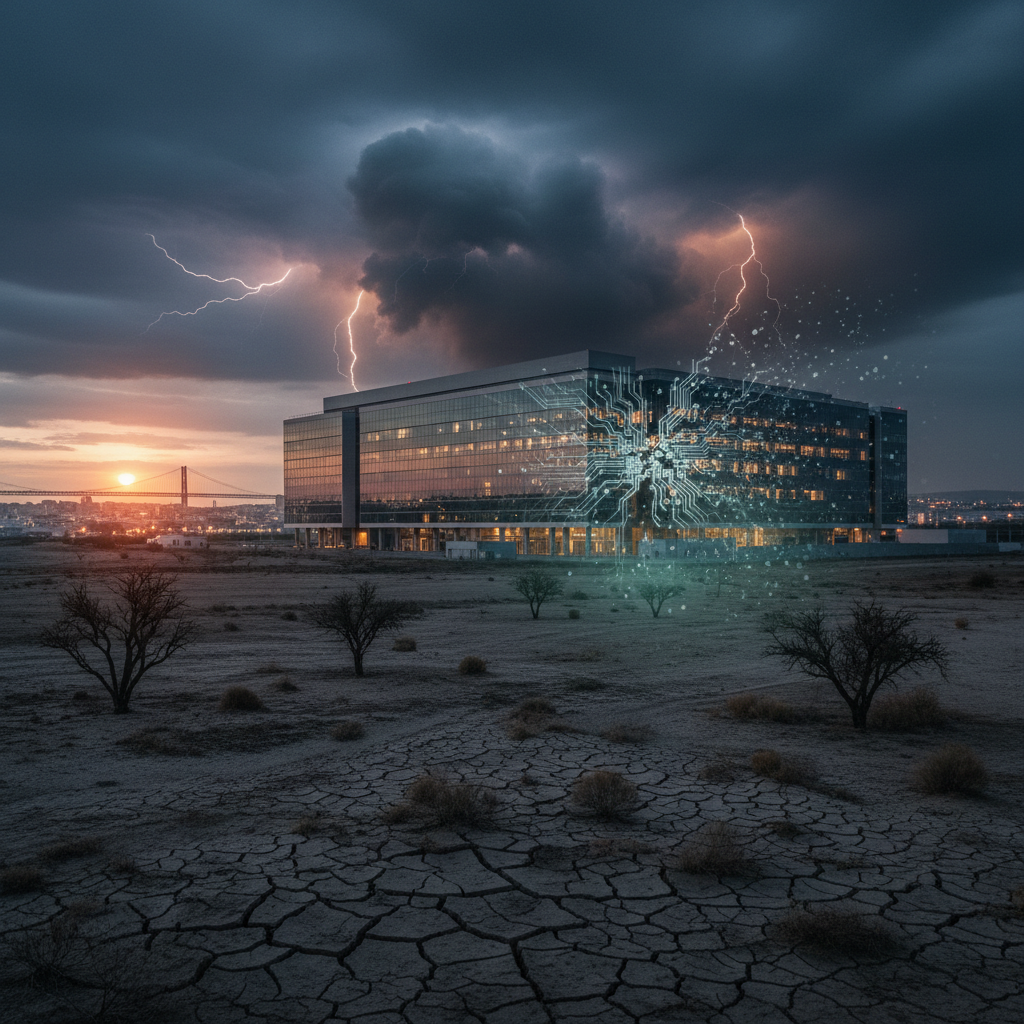

One moment you are sipping a bica in a sun-drenched Lisbon square, dreaming of a future powered by intelligent machines, and the next, you are staring at a headline that screams about the lights going out. That, my friends, is the current mood here in Portugal, a nation suddenly grappling with the very real, very thirsty demands of artificial intelligence.
Breaking news from the Portuguese energy regulator, Erse, has sent a shiver through the country's burgeoning tech sector. A preliminary report, leaked to Público and confirmed by our sources, indicates that proposed AI data center expansions, particularly those linked to major players like Google and NVIDIA, could demand an additional 15-20% of Portugal's national electricity grid capacity within the next five years. To put it plainly, we are talking about the energy consumption of a small European country, all for the sake of making AI models a little bit smarter. It is enough to make one choke on their pastéis de nata.
“This is not a hypothetical scenario, this is a crisis unfolding before our eyes,” stated Dr. Sofia Almeida, head of energy policy at Erse, in a hushed, late-night press briefing. “The projections are staggering. We are seeing demand curves that simply outstrip our current renewable energy production capacity and planned grid upgrades. The dream of a green, digital Portugal could become a nightmare of blackouts if we do not act decisively.”
The report details how the insatiable appetite of large language models, the sophisticated neural networks powering everything from OpenAI's GPT to Google's Gemini, translates directly into astronomical electricity consumption. Each query, each training run, each inference requires immense computational power, which in turn demands colossal amounts of energy to run servers and, crucially, to cool them. We are talking about server farms the size of small towns, humming away 24/7, sucking power like a vampiro at a blood bank.
Official reactions have been swift, if somewhat bewildered. The Ministry of Economy and Digital Transition, typically a champion of foreign tech investment, issued a statement acknowledging the “complex challenges” presented by AI’s energy demands. “We welcome innovation, we welcome investment,” said João Costa, the Secretary of State for Digital Transition, his voice strained during a morning radio interview. “But we must ensure this growth is sustainable. We cannot sacrifice our energy security or our climate goals at the altar of artificial intelligence. We are exploring all options, from advanced grid management to incentivizing truly green data center designs.”
Experts are weighing in with a mixture of alarm and pragmatism. Professor Miguel Silva, an electrical engineering specialist from Instituto Superior Técnico, pointed out the obvious. “We have been so focused on the computational breakthroughs, we forgot to ask about the bill,” he quipped dryly. “NVIDIA’s latest GPUs, while incredibly powerful, are also incredibly power-hungry. And with every new generation of AI model, the hunger only grows. This is not just a Portuguese problem, of course, but for a country like ours, heavily reliant on a mix of hydro, wind, and solar, adding another 20% to demand is like asking a small fishing boat to carry the cargo of a supertanker.” He paused, then added, “Lisbon's tech scene is like a good port wine, complex and improving with age, but even port wine needs a steady supply of grapes, and our AI needs a steady supply of electrons.”
The immediate concern is the strain on Portugal’s existing infrastructure. While Portugal has made admirable strides in renewable energy, often punching above its weight in European green initiatives, the sheer scale of AI’s energy needs is unprecedented. The country’s commitment to phasing out coal and reducing reliance on natural gas makes the situation even more precarious. Where will this extra power come from? Will we need to import more fossil fuels, undermining years of environmental progress?
“The sardine can of European tech is actually a treasure chest, but we risk squandering its value if we don’t address this fundamental issue,” argued Dr. Ana Ribeiro, an environmental economist and advisor to several European green tech initiatives. “Companies like Google and Microsoft have made public commitments to carbon neutrality, but the reality on the ground, especially in regions like ours, is that their AI operations are creating a massive, localized energy deficit. We need to see concrete action, not just pledges. Investment in next-generation energy storage, smart grids, and truly energy-efficient AI architectures must accelerate. Otherwise, we are just moving the carbon footprint around.” She suggested that the EU needs to develop a comprehensive strategy for AI energy consumption, perhaps even setting limits or requiring specific energy efficiency standards for large data centers, similar to what is being discussed for other high-impact industries. You can read more about these discussions in Wired.
What happens next? The Portuguese government is reportedly convening an emergency task force comprising representatives from Erse, the Ministry of Energy, and leading tech companies with a presence or interest in Portugal. The goal is to develop a rapid response plan, exploring options ranging from fast-tracking new renewable energy projects, particularly offshore wind, to negotiating specific energy supply agreements with AI giants that include stringent efficiency and green energy clauses. There is also talk of exploring innovative cooling technologies for data centers, moving away from traditional air conditioning to more sustainable methods, perhaps even leveraging Portugal’s temperate climate in some regions.
For the ordinary Portuguese citizen, the implications are clear. Higher energy bills, potential grid instability, and a renewed debate about the true cost of technological advancement. The promise of AI, of smarter cities and more efficient industries, feels a little less shiny when you consider the power needed to fuel it. This is not just about keeping the lights on, it is about maintaining our environmental integrity and ensuring that our digital future does not come at an unbearable cost to our planet.
This unfolding situation serves as a stark reminder that every technological leap has a footprint. As AI becomes more integrated into our lives, its physical demands, particularly on energy, can no longer be ignored. The conversation needs to shift from 'can we build it?' to 'can we power it sustainably?' The answer, for now, hangs precariously in the balance, much like the delicate balance of our national grid. For further reading on the broader implications of AI's energy demands, check out MIT Technology Review. The stakes are too high for us to simply hope for the best; we need action, and we need it now.