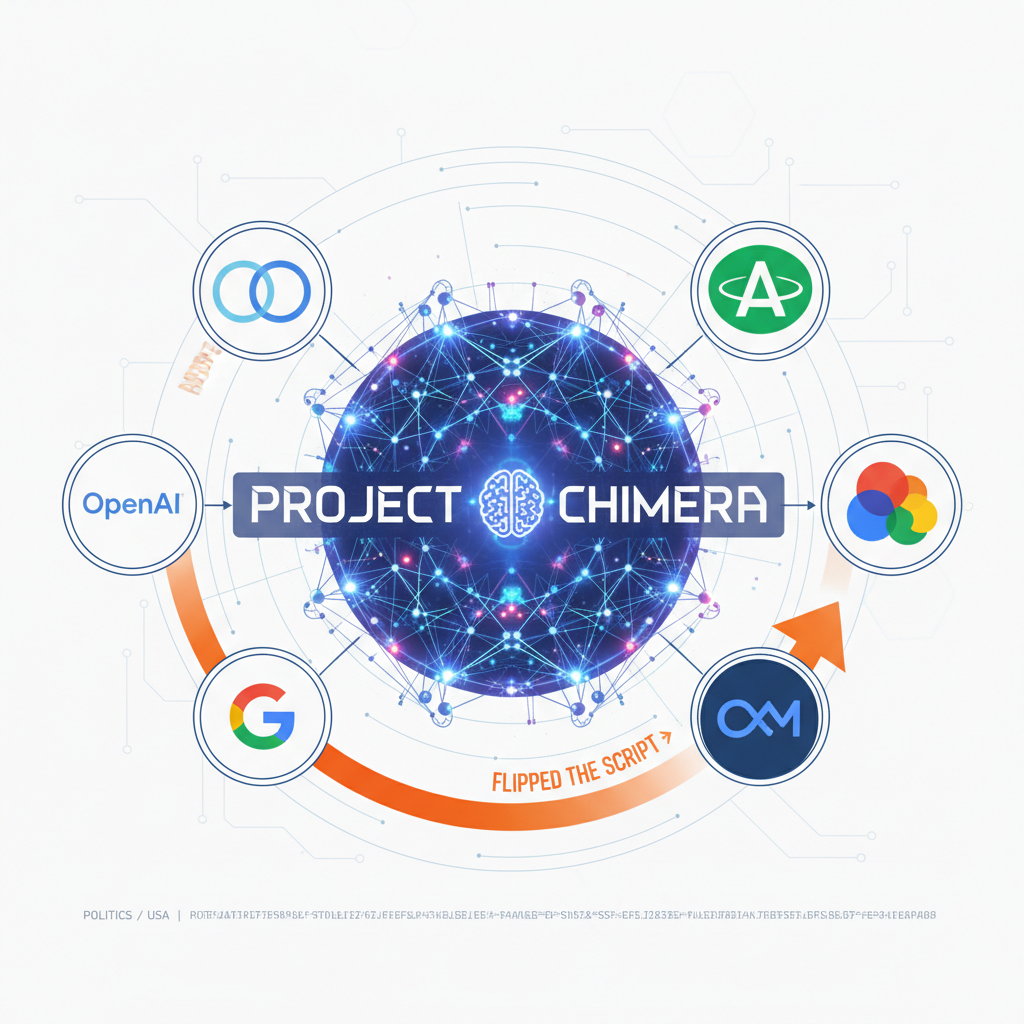

Alright, let's talk about something truly wild, something that has the entire tech world buzzing louder than a cicada swarm in a hot New Jersey summer. I'm talking about a research development so significant, so mind-bending, that it's already sending ripples through the AI titans: OpenAI, Anthropic, Google, and Meta. Forget your old notions of who's winning the AI race; a new player, or rather, a new approach, just entered the arena, and it's called 'Project Chimera.'
The Breakthrough in Plain Language: Imagine a Brain That Learns Like Us, Only Faster
So, what exactly is Project Chimera? Picture this: you've got your massive large language models, like the ones from OpenAI or Anthropic, that are incredible at understanding and generating text. They're like super-geniuses at language. Then you have your specialized AI systems, like the ones Google uses for image recognition or Meta for personalized feeds, which are brilliant at specific tasks. They're like Olympic athletes in their chosen sport.
Project Chimera, spearheaded by a consortium of universities and independent researchers, has figured out a way to seamlessly integrate these two types of intelligence. It’s not just stitching them together; it’s a deep, fundamental fusion. Think of it like a human brain, where different regions specialize in different functions, but they all work together in a fluid, interconnected way to create a coherent consciousness. Chimera AI models can perform complex reasoning tasks that require both broad, general knowledge and deep, domain-specific understanding, all within a single, dynamic architecture. It's like having a philosopher, a scientist, and a poet all rolled into one, and they can switch roles instantly.
“This isn’t just about making models bigger or faster,” explained Dr. Evelyn Reed, lead researcher at the Pacific Northwest AI Institute, a non-profit lab known for its groundbreaking work. “We’ve moved beyond mere multi-modality. Chimera represents a true 'cognitive fusion' where symbolic reasoning and neural network pattern matching aren’t just co-existing, they’re actively informing and enhancing each other at every layer of the architecture. It’s a paradigm shift, plain and simple.” She shared this with me during a late-night video call, her excitement palpable even across time zones.
Why It Matters: This is Going to Change Everything for Consumer AI
Why should you, the everyday person, care about some academic project with a mythological name? Because, my friends, this is going to change everything for consumer AI. Right now, when you use a chatbot, it's great at conversation, but if you ask it to, say, design a complex engineering part and then write a patent application for it, it struggles. Or if you ask an image AI to understand the intent behind a user's abstract drawing and then generate a story based on it, you hit a wall.
Chimera models, on the other hand, are designed to excel at these kinds of multi-faceted, high-level cognitive tasks. Imagine an AI assistant that not only understands your spoken commands but can also interpret your emotional state from your tone, analyze a complex legal document, cross-reference it with real-time stock market data, and then draft a nuanced email to your lawyer. This isn't science fiction anymore. This is the kind of integrated intelligence that makes AI truly intuitive, truly helpful, and frankly, truly mind-blowing.
For us here in the USA, where innovation moves at the speed of light, this means a new wave of AI products unlike anything we've seen. Think about personalized education platforms that adapt not just to what you know, but how you learn. Or healthcare diagnostics that combine your medical history, genomic data, and real-time biometric inputs to offer truly predictive insights. The possibilities are endless, like a sprawling California highway stretching into the sunset.
The Technical Details (Accessible): Beyond Just More Layers
Okay, let's peel back the curtain a little, but don't worry, I won't get lost in the weeds. Traditional large language models (LLMs) are fantastic at statistical pattern recognition. They learn from vast amounts of text to predict the next word, building up an incredible understanding of language. But they often lack true reasoning capabilities; they don't 'understand' in the human sense, they just predict.
On the other side, symbolic AI systems, which have been around for decades, are great at logical deduction and rule-based reasoning. They can follow explicit rules, like a computer program, but they struggle with the ambiguity and nuance of the real world. Think of it like the difference between knowing the rules of chess and being a grandmaster who plays intuitively.
Project Chimera's core innovation lies in its 'Dynamic Cognitive Orchestration Layer' (dcol). This Dcol acts as a sophisticated conductor, dynamically allocating tasks and information flow between a neural network component and a symbolic reasoning engine. It's not just running them in parallel; it's a constant, iterative feedback loop. The neural component can identify patterns and generate hypotheses, which the symbolic component then evaluates, refines, and uses to guide further neural exploration. This creates a virtuous cycle of learning and reasoning.
“We’ve essentially built a meta-learning system that teaches itself how to best combine intuitive pattern recognition with explicit logical inference,” explained Dr. Lena Petrova, a computational linguist who contributed to the project, speaking from her lab at Stanford University. “It’s like teaching a child to read, then giving them a textbook and watching them apply their reading skills to learn complex concepts. The Dcol is the part that figures out how to learn and reason most effectively for any given task.” You can dive deeper into these architectural marvels on sites like arXiv for the latest pre-prints.
Who Did the Research: A Collaborative Symphony
This wasn't a solo act. Project Chimera is the result of an unprecedented collaboration between several leading academic institutions and independent research groups. Key players include the Pacific Northwest AI Institute, the Cognitive Computing Lab at MIT, and a private consortium of former Google and Anthropic researchers who formed 'Cognitive Nexus Labs' in Silicon Valley. Funding came from a mix of government grants, like those from the National Science Foundation, and philanthropic organizations, alongside some strategic investments from venture capital firms keen on the long game.
“The beauty of this project was its open-source ethos,” stated Professor Marcus Thorne, director of the Cognitive Computing Lab at MIT, during a recent virtual press conference. “While the initial breakthroughs were protected, the subsequent development phases have been largely collaborative, allowing for rapid iteration and diverse perspectives. It’s a testament to what we can achieve when we prioritize scientific advancement over corporate secrecy.” This spirit of collaboration, reminiscent of the early internet days, is truly inspiring.
Implications and Next Steps: The AI Arms Race Just Got a New Dimension
The implications for the big four, OpenAI, Anthropic, Google, and Meta, are enormous. They've all been investing billions in scaling up their existing architectures, but Chimera suggests a fundamentally different path to advanced intelligence. This isn't just about who has the most GPUs or the biggest dataset anymore; it's about who can best integrate this new cognitive fusion paradigm into their product ecosystems.
OpenAI, with its focus on general intelligence, is likely already pouring resources into adapting its GPT models to incorporate DCOL-like structures. Anthropic, known for its emphasis on AI safety and constitutional AI, will probably see Chimera as a way to build more robust, auditable reasoning into its Claude models, potentially leading to safer and more reliable AI. Google, with its vast research arm and DeepMind, is perfectly positioned to leverage this for everything from search to autonomous systems. And Meta, always looking for the next big thing in social interaction and the metaverse, could use Chimera to create truly intelligent, context-aware virtual companions and environments.
I just saw the future and it's incredible. The race isn't just about scale anymore; it's about architecture and integration. The companies that can effectively merge neural and symbolic AI will be the ones defining the next decade of technological progress. We're talking about AI that can not only generate a compelling narrative but also understand the logical consistency of its plot, or an AI that can design a new drug and then perform a simulated clinical trial to assess its efficacy, all within the same framework.
This isn't just a research paper; it's a blueprint for the next generation of AI. You need to pay attention to this. The competition for AI dominance just got a whole lot more interesting, and the winners will be those who can harness the power of cognitive fusion. The future of AI, my friends, is looking brighter and more integrated than ever before, and I, for one, can't wait to see what amazing things it brings to our lives here in the USA and beyond. For more on how these companies are adapting, keep an eye on industry news at TechCrunch.
It’s a new frontier, and the journey has just begun. The innovation coming out of labs like these is truly breathtaking, and it reminds me of the pioneering spirit that built this country, always pushing the boundaries of what's possible. We're not just building smarter machines; we're building new ways of thinking, new ways of understanding, and ultimately, new ways of living. This is the dawn of a truly intelligent era, and it's happening right now.