
The olive groves shimmer under the April sun, a timeless scene that has played out for millennia. Yet, beneath this ancient tranquility, a very modern storm is brewing: the insatiable, almost mythological, appetite of artificial intelligence for compute infrastructure. Everywhere I look, from the bustling port of Piraeus to the quiet academic halls of Athens, people are talking about AI, but few are truly grasping the sheer, monumental scale of what it demands.
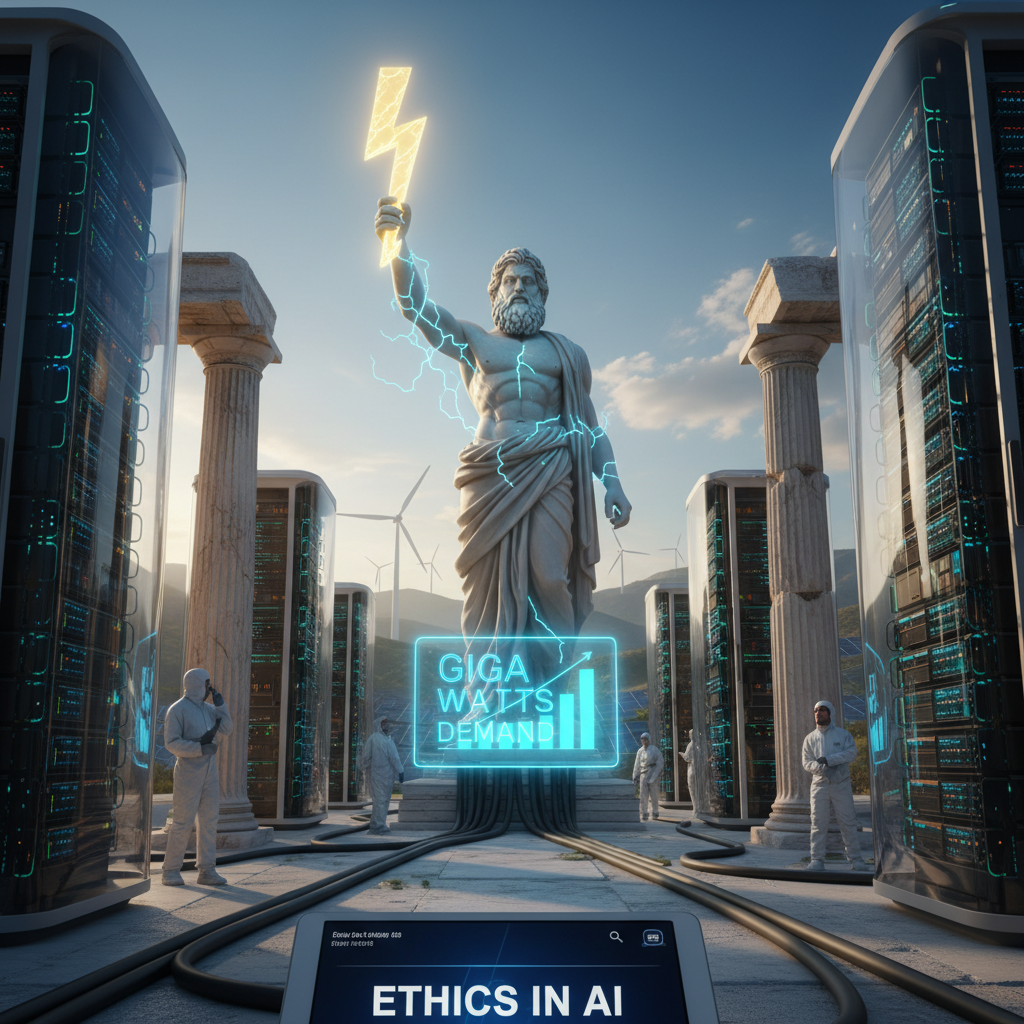
We are not just talking about a few servers humming in a dusty corner anymore. We are talking about data centers the size of small cities, gorging on electricity like Zeus on ambrosia, and spitting out heat that could warm the Aegean Sea. And here in Greece, a country that gave the world logic and philosophy, we are watching this global compute race with a mixture of fascination and a growing sense of unease. The gods of Olympus would have loved this AI drama, I think, especially the part where humanity scrambles to feed a digital beast it barely understands.
Silicon Valley, in its usual fashion, has gone full throttle. Companies like OpenAI and Anthropic are not just building models; they are building empires of silicon and energy. NVIDIA, the undisputed king of AI chips, recently announced another quarter of stratospheric growth, driven almost entirely by the demand for their H100 and upcoming B200 GPUs. According to Bloomberg Technology, the global market for AI data center infrastructure is projected to hit nearly 200 billion euros by 2030. That is a lot of drachmas, even if we do not use them anymore.
But where does Europe, and specifically Greece, fit into this colossal equation? Our continent, for all its technological prowess, has been a bit slow off the mark in building out the kind of hyperscale compute infrastructure that the US and parts of Asia now boast. We have excellent researchers, brilliant minds, and a rich history of innovation, but when it comes to the raw, brute force of AI compute, we are often playing catch-up. This is not just about having fast internet, my friends; it is about having the literal power to run the future.
"The energy demands are staggering, truly unprecedented," explains Dr. Eleni Stavropoulou, a leading energy policy analyst at the Hellenic Foundation for European and Foreign Policy (eliamep). "A single large AI data center can consume as much electricity as a medium-sized city. For Greece, with its existing grid challenges and ambitious renewable energy targets, integrating these massive loads requires careful planning and significant investment, not just in generation, but in transmission and storage too." She is not wrong. We are still figuring out how to get all that lovely solar power from the islands to the mainland reliably, and now we need to power AI brains too.
Consider the recent reports from the International Energy Agency, predicting that data centers globally could consume over 1,000 terawatt-hours by 2026, a figure comparable to the entire electricity consumption of Japan. This is not a distant future; this is next year. And while Greece is making strides in renewable energy, with solar and wind projects expanding rapidly, the sheer scale of AI's hunger could easily outstrip our current capacity and planning. We are building windmills, but AI needs a hurricane.
This compute deficit is not just an infrastructure problem; it is an economic and strategic one. If European startups cannot access affordable, powerful compute locally, they are forced to rely on American cloud providers, shipping their data and their innovation across the Atlantic. This creates a dependency that is not just inconvenient but potentially stifling for our own AI ecosystem. We risk becoming mere consumers of AI, rather than creators of it.
"We are seeing a brain drain, not just of human talent, but of digital processing power," states Ioannis Kouris, CEO of a promising Athens-based AI logistics startup. "To train a state-of-the-art large language model, you need thousands of NVIDIA GPUs running for weeks or months. The cost and availability of that kind of infrastructure in Europe, compared to the US, is a significant barrier. We often have to lease compute from overseas, which adds latency, cost, and raises data sovereignty concerns." Pass the ouzo, this tech news requires it, because it is enough to make a Greek philosopher weep.
There are efforts, of course. The European Union has launched initiatives like the EuroHPC Joint Undertaking, aiming to build a world-class supercomputing infrastructure across member states. Greece is participating, with plans for high-performance computing centers, but these are often focused on scientific research rather than the commercial, hyperscale AI training that companies like Google or Meta are doing. The scale is simply different.
Moreover, the environmental impact cannot be ignored. The water required to cool these massive data centers is another growing concern, especially in a Mediterranean climate prone to droughts. While companies claim to be using renewable energy, the sheer volume of energy and water consumption still leaves a significant footprint. It is a modern paradox: we want intelligent machines, but at what cost to our planet?
So, what is the solution for Greece and for Europe? It is not simple, of course. We need a multi-pronged approach. First, massive investment in renewable energy infrastructure and smart grids capable of handling these fluctuating, enormous loads. Second, a concerted effort to build competitive, hyperscale data centers within Europe, perhaps through public-private partnerships, to retain our data and our innovation. Third, a focus on energy efficiency in AI itself, pushing for more optimized algorithms and hardware that can do more with less.
Perhaps there is a lesson here from our own history. Ancient Greece, despite its philosophical heights, understood the practicalities of engineering and infrastructure. The aqueducts, the temples, the navigation systems, they were all built with foresight and a deep understanding of resource management. We need that same foresight now. We cannot simply wish for AI; we must build the foundations for it, responsibly and sustainably.
Otherwise, we risk being left behind, admiring the digital wonders from afar, while the real power and innovation reside elsewhere. Greece to Silicon Valley: we invented logic, remember? Now let us apply some of it to this compute conundrum before it consumes us all. The future of AI in Europe depends not just on brilliant algorithms, but on the very mundane, yet utterly critical, availability of power and infrastructure. It is time to electrify our ambitions, literally. For more on the broader implications of AI's energy demands, you can check out articles on MIT Technology Review.
This is not a problem that can be solved by a single startup or a single nation. It requires a continental strategy, a unified vision, and a willingness to invest in the fundamental physical infrastructure that underpins the digital age. Without it, our European AI dreams, however brilliant, might just remain in the realm of philosophy, unable to materialize in the real world. For a deeper dive into how AI is reshaping minds and economies, you might find this article interesting: The Billion-Euro Echo: How AI's Gold Rush is Reshaping Italian Minds, One Dream at a Time [blocked].