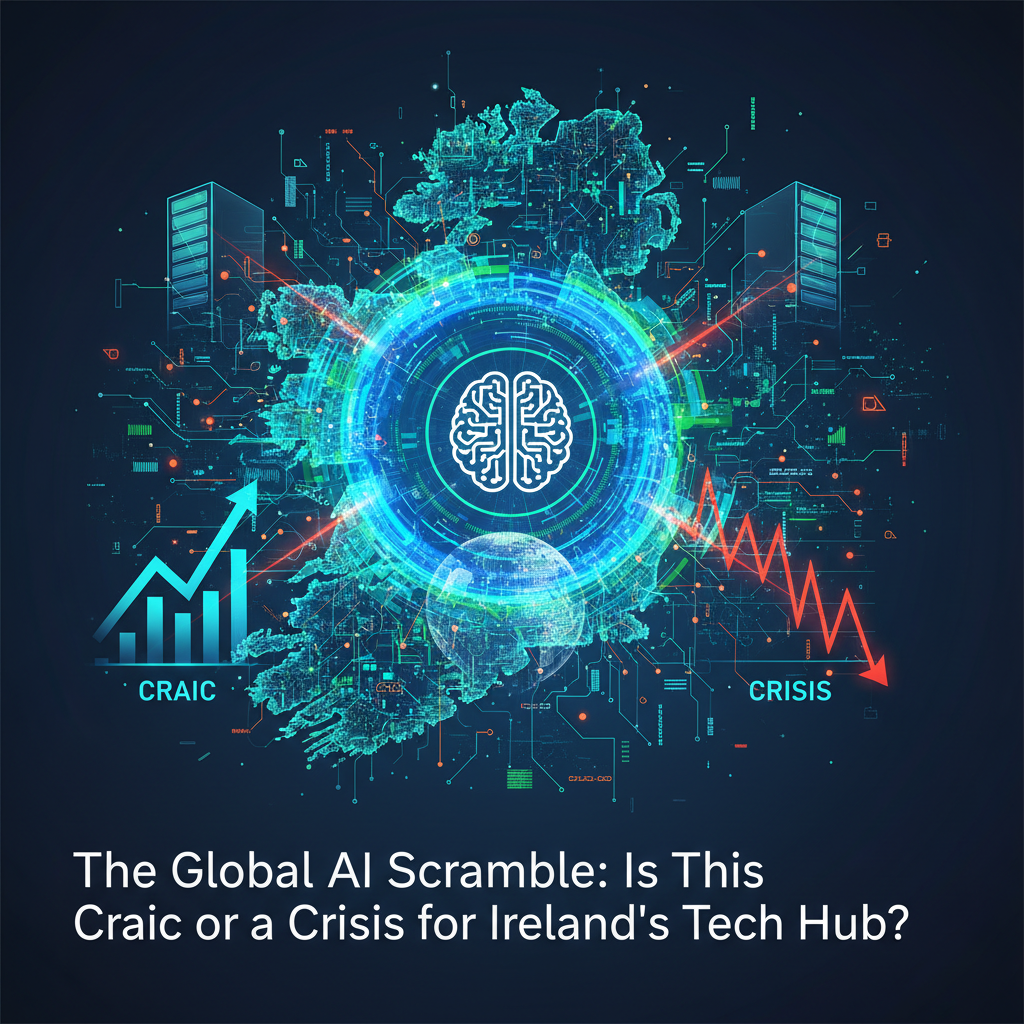

Is it just me, or does this whole 'AI arms race' business sound suspiciously like the tech world’s latest excuse for a good old-fashioned panic? Every other week, we hear about the US and China squaring off, the EU trying to catch up, and various emerging nations attempting to carve out their own slice of the digital pie. It’s a global scramble, alright, but whether it’s a sustainable sprint or just a grand, expensive folly remains to be seen. From where I’m sitting in Dublin, it looks a bit like everyone’s lost their hurley and is just flailing about.
Let's be clear, the idea of nations competing for technological dominance is hardly new. We’ve seen it with space races, nuclear arms, and even the early days of the internet. Remember the Cold War, when the US and the Soviet Union were locked in a perpetual state of one-upmanship? This AI kerfuffle has a similar scent, only instead of ICBMs, we’re talking about large language models and sophisticated algorithms. The stakes, however, feel just as high, perhaps even higher, given AI’s pervasive potential to reshape everything from healthcare to warfare.
Historically, Ireland has always been a bit of a quiet achiever, a strategic outpost for global tech giants looking for a friendly, English-speaking gateway into Europe. Dublin's Silicon Docks have a story to tell, one of attracting the likes of Google, Meta, and Microsoft with attractive corporate tax rates and a skilled workforce. We became the European headquarters for many of these behemoths, a lovely little arrangement that suited everyone just fine. But this new AI arms race, it’s different. It’s not just about setting up shop; it’s about control, intellectual property, and raw computing power, things that smaller nations might struggle to compete with on their own.
Today, the landscape is a dizzying array of national strategies and colossal investments. The United States, with its vibrant venture capital scene and tech titans like OpenAI, Google DeepMind, and Anthropic, continues to lead in foundational model development. We’re talking billions poured into research and development, often with direct or indirect government backing. China, not one to be left behind, has its own national AI strategy, aiming to be the world leader by 2030, with companies like Baidu and Alibaba pushing the envelope. Their focus is often on integrating AI into surveillance, urban management, and industrial automation, areas where they’ve already made significant inroads.
Then there’s the European Union, a bloc that often feels like it’s trying to herd cats while simultaneously drafting a 500-page regulatory document. The EU’s approach, while commendable in its focus on ethical AI and data privacy, sometimes feels a step behind the rapid innovation cycles of its American and Chinese counterparts. The AI Act, while a landmark piece of legislation, has been criticized by some for potentially stifling innovation with its stringent requirements. As Dr. Maeve O’Connell, a Senior Policy Analyst at the European Digital Rights Initiative, put it to me last week, “The EU is trying to build a cathedral of AI ethics while everyone else is building rocket ships. Both are important, but the pace is wildly different.”
And what about the rest of the world? Emerging nations are certainly not sitting idly by. India, for instance, is leveraging its massive talent pool in software development to foster its own AI ecosystem, focusing on applications relevant to its unique societal challenges. Countries in the Middle East, flush with capital, are investing heavily in AI infrastructure and talent acquisition. It’s a global game, and everyone wants a seat at the table.
So, is this an actual arms race, or just a lot of bluster? “It’s absolutely an arms race, but not in the traditional sense of military hardware,” says Professor Liam Gallagher, Head of Computer Science at University College Cork. “It’s an arms race for talent, for data, for compute, and for the foundational models that will underpin the next century of technological advancement. The nation that controls these will wield immense economic and geopolitical power.” He points to the staggering investments by NVIDIA in new GPU technologies, essential for training these massive models, as a key indicator of the intensity of this competition. You can read more about the broader tech landscape on Reuters Technology.
However, not everyone agrees with the 'arms race' framing. Fiona Kelly, CEO of a Dublin-based AI ethics startup, believes it’s a dangerous metaphor. “Calling it an arms race implies a zero-sum game, a winner-takes-all scenario that ignores the collaborative and open-source nature of much AI development,” she argued during a recent tech conference in Galway. “It also risks pushing us towards less ethical, more secretive development practices, all in the name of national security or economic advantage. We should be fostering global cooperation, not competition.” Her point is valid. While the big players are certainly battling it out, there's also a thriving open-source community, exemplified by projects like Hugging Face, that is democratizing access to AI tools and models.
From an Irish perspective, this global scramble presents both opportunities and challenges. On one hand, our established position as a European tech hub means we’re already home to many of the companies at the forefront of this race. This brings investment, jobs, and a chance to influence policy. Only in Ireland would you find this unique blend of global tech powerhouses and a fiercely independent regulatory spirit. We’re not just a passive recipient; we’re an active participant, albeit a small one. Our universities, like Trinity College Dublin and University College Dublin, are producing world-class AI researchers, and the craic is mighty in Irish AI startups, many of whom are finding niche markets and innovative solutions.
On the other hand, the sheer scale of investment and talent required to compete directly with the US or China is simply beyond us. We can’t build our own OpenAI or Baidu from scratch, nor can we match their compute power. Our strength lies in specialization, in fostering ethical AI development, in regulatory leadership, and in providing a stable, skilled environment for global companies. We need to be smart, not just loud.
My verdict? The AI arms race is definitely the new normal, not a passing fad. The geopolitical implications are too significant, and the economic potential too vast, for any nation to opt out. However, the nature of this 'race' is still being defined. Will it be a cutthroat competition leading to fragmentation and distrust, or can we find a way to foster responsible innovation through international collaboration? The EU’s AI Act, despite its critics, is an attempt to steer the ship towards the latter, emphasizing human-centric and trustworthy AI. You can delve into more detailed analysis of these trends on MIT Technology Review.
For Ireland, the path forward is clear: continue to be a beacon for responsible AI, leverage our strong regulatory environment, and foster our incredible talent. We may not be building the biggest rockets, but we can certainly help design the flight path for a safer, more ethical journey into the AI future. The world needs more than just raw power; it needs wisdom, and perhaps a bit of that famous Irish common sense. And maybe, just maybe, a good cup of tea to calm everyone down.